
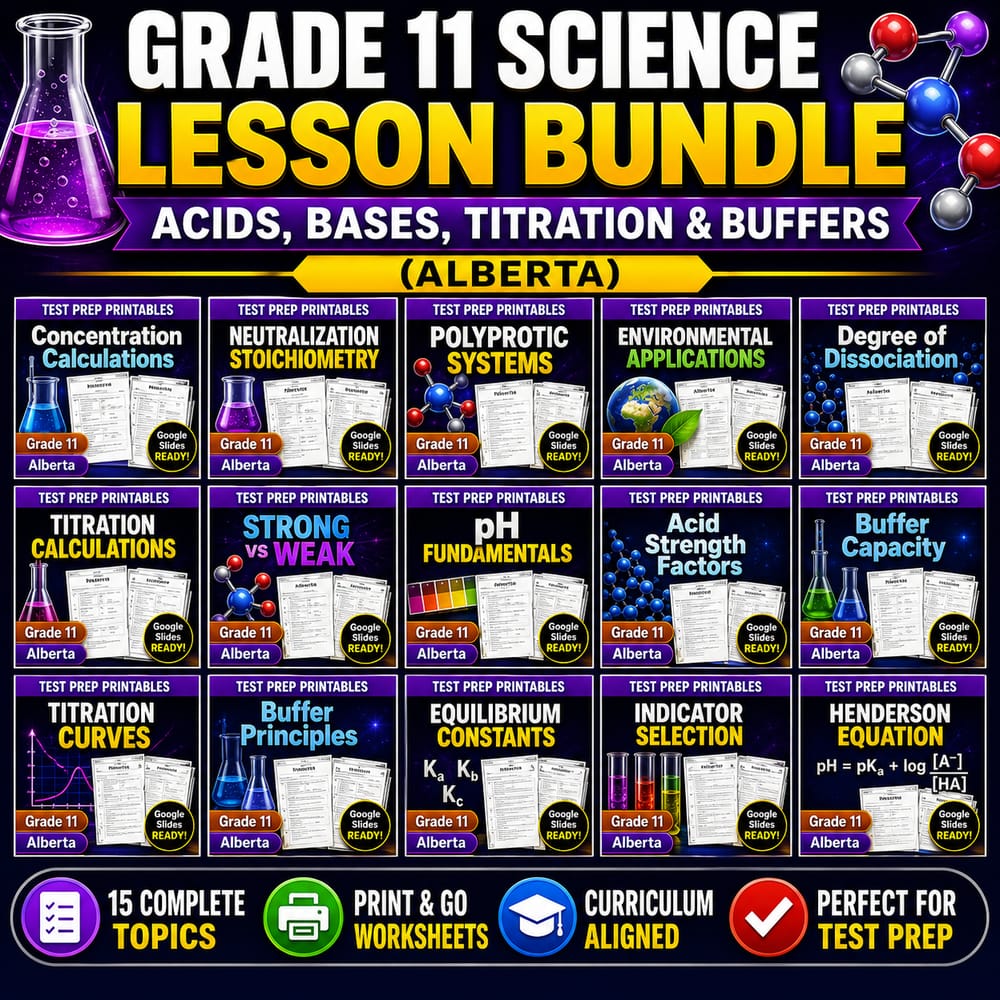


Grade 11 Science Lesson Bundle | Acids, Bases, Titration & Buffers (Alberta)
$60.00$75.00Save $15.00
Prism Point Learning
·2 followers·13 sales
SubjectScienceGradeGrade 11
What’s included
15 worksheets · Save $15.00 (20%) · prices shown inside the bundle
 Concentration Calculations Worksheet | Grade 11 Science Practice
- Determine hydrogen ion concentration from pH and hydroxide ion concentration from pOH using logarithmic relationships
- Use Kw to interrelate [H+], [OH-], and pH/pOH in water samples
- Apply correct significant figures, units, and conversions when reporting aqueous concentration results
$4.00$5.00 Neutralization Stoichiometry Worksheet | Grade 11 Science Practice
- Explain how neutralization produces salt and water and relate this to molar stoichiometry.
- Use balanced chemical equations to calculate moles and solve titration/equivalence problems.
- Identify the limiting reagent and determine how it affects the amount of product formed.
$4.00$5.00 Polyprotic Systems Worksheet | Grade 11 Science Practice
- Explain how polyprotic acids dissociate in steps and how each dissociation constant affects pH.
- Interpret titration curves by identifying equivalence points and buffer regions for systems like carbonate and phosphate.
- Calculate cumulative acidity and use stepwise dissociation information to predict pH trends across concentration ranges.
$4.00$5.00 Environmental Applications Worksheet | Grade 11 Science Practice
- Analyze how acid–base reactions and buffering influence environmental pH in Alberta contexts.
- Use stoichiometry and titration ideas to estimate neutralization requirements for contaminated water.
- Explain how dissociation and equilibrium affect remediation decisions and compliance targets.
$4.00$5.00 Degree Dissociation Worksheet | Grade 11 Science Practice
- Explain what degree of dissociation (α) means for weak acids and weak bases in solution.
- Predict how initial concentration and equilibrium effects change percent dissociation.
- Describe how the common-ion effect influences ionization of dissociated species.
$4.00$5.00 Titration Calculations Worksheet | Grade 11 Science Practice
- Use stoichiometry with balanced dissociation/neutralization relationships to calculate unknown titrant or analyte concentrations.
- Compute equivalence volume and relate it to reaction mole ratios for strong acid–base and weak acid–base titrations.
- Interpret titration data, including endpoint and pH considerations, to explain how weak systems affect calculations.
$4.00$5.00 Strong Versus Weak Worksheet | Grade 11 Science Activities
- Distinguish strong acids/bases from weak acids/bases based on how completely they ionize in water
- Relate the strength of an acid or base to the concentration of free H+ or OH− ions in solution
- Use equilibrium ideas to explain why weak species only partially dissociate
$4.00$5.00 pH Fundamentals Worksheet | Grade 11 Science Activities
- Explain what pH means and how it relates to hydrogen ion concentration and acidity/basicity.
- Use the pH–pOH relationship (at 25°C, pH + pOH = 14) to solve or check chemistry problems.
- Connect pH to real-world effects such as mineral solubility, chemical speciation, and aquatic organism suitability.
$4.00$5.00 Acid Strength Factors Worksheet | Grade 11 Science Practice
- Explain how molecular structure factors influence acid strength in water.
- Use trends such as bond polarity, electronegativity, atom size, resonance stabilization, and oxidation state to predict acidity.
- Relate electron-withdrawing groups in oxyacids and halogen-substituted acids to acidity trends.
$4.00$5.00 Buffer Capacity Worksheet | Grade 11 Science Activities
- Explain what buffer capacity means and how it relates to pH change after adding acid or base
- Identify factors that increase or decrease buffer capacity using buffer concentration and component ratio
- Use carbonate and organic system examples to reason about environmental buffering in real settings
$4.00$5.00
Reviews & Feedback
Loading reviews...
Questions & Answers
Loading questions…
About this bundle
Related categories
Frequently asked questions
Who is Grade 11 Science Lesson Bundle | Acids, Bases, Titration & Buffers (Alberta) designed for?
Grade 11 Science Lesson Bundle | Acids, Bases, Titration & Buffers (Alberta) is designed for Grade 11 students and Science learners and can be used in classrooms, homeschool, or independent practice.
How do I download Grade 11 Science Lesson Bundle | Acids, Bases, Titration & Buffers (Alberta)?
Add it to your cart and complete checkout. After payment, you can download immediately from your account, and you'll also receive a download link by email.
Similar Products

Grade 11 Acid-Base & Titration Science Daily Reading Lesson Bundle | Alberta
$48.00$60.00

Grade 11 Acid-Base Chemistry Lesson Bundle: Alberta Science
$36.00$45.00

Acids, Bases and pH Lesson Bundle – Grade 11 Science Alberta
$60.00$75.00

Grade 11 Science Lesson Bundle on Acids, Bases, and Titration | Alberta Framework
$36.00$45.00

Grade 11 Chemistry Titration & Stoichiometry Lesson Bundle Alberta
$48.00$60.00