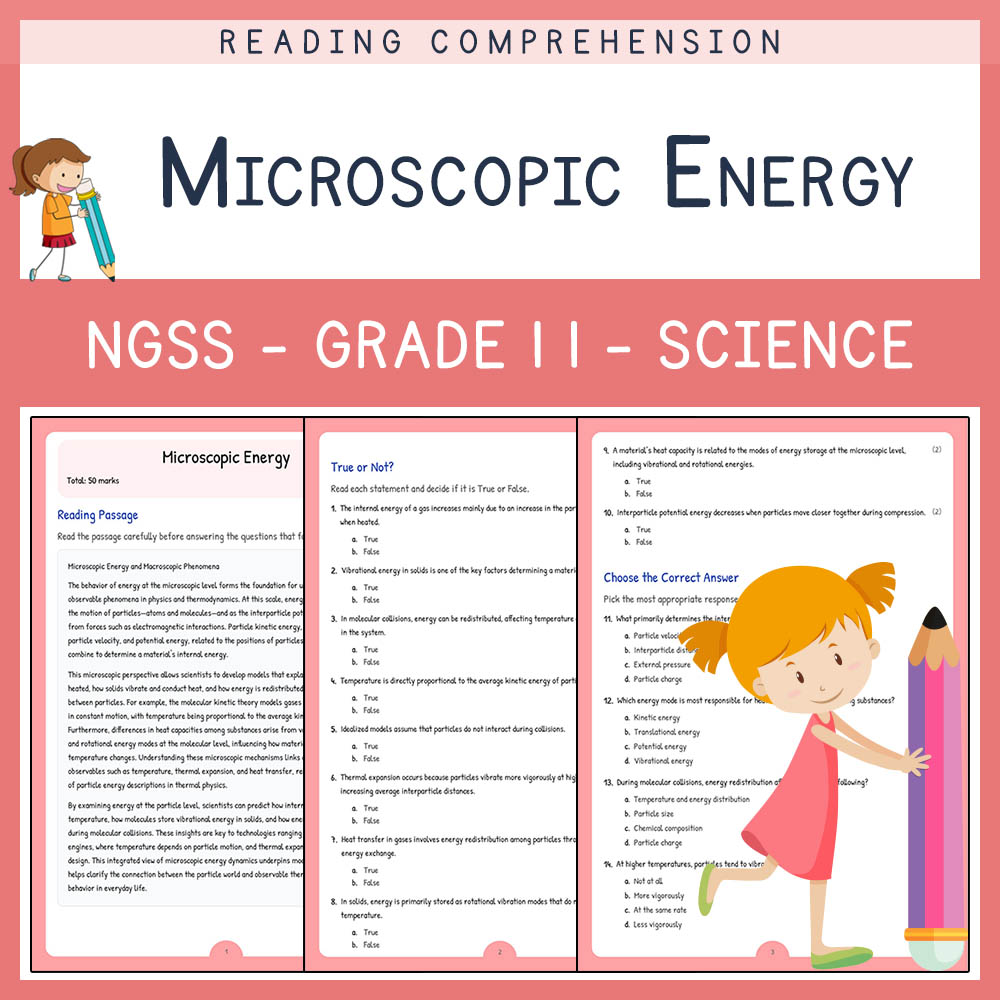
Are your Grade 11 students exploring the fascinating world of microscopic energy? This comprehensive worksheet is designed to deepen their understanding of how energy behaves at the particle level, an essential concept aligned with the Next Generation Science Standards (NGSS). By integrating reading passages, true/false, multiple choice, fill-in-the-blank, and short response questions, this resource provides a well-rounded approach to teaching microscopic energy concepts. Crafted specifically for high school science educators, this worksheet will help students connect microscopic particle behavior with observable thermal properties, fostering the critical thinking skills necessary for mastering physics and chemistry fundamentals.
What's Included
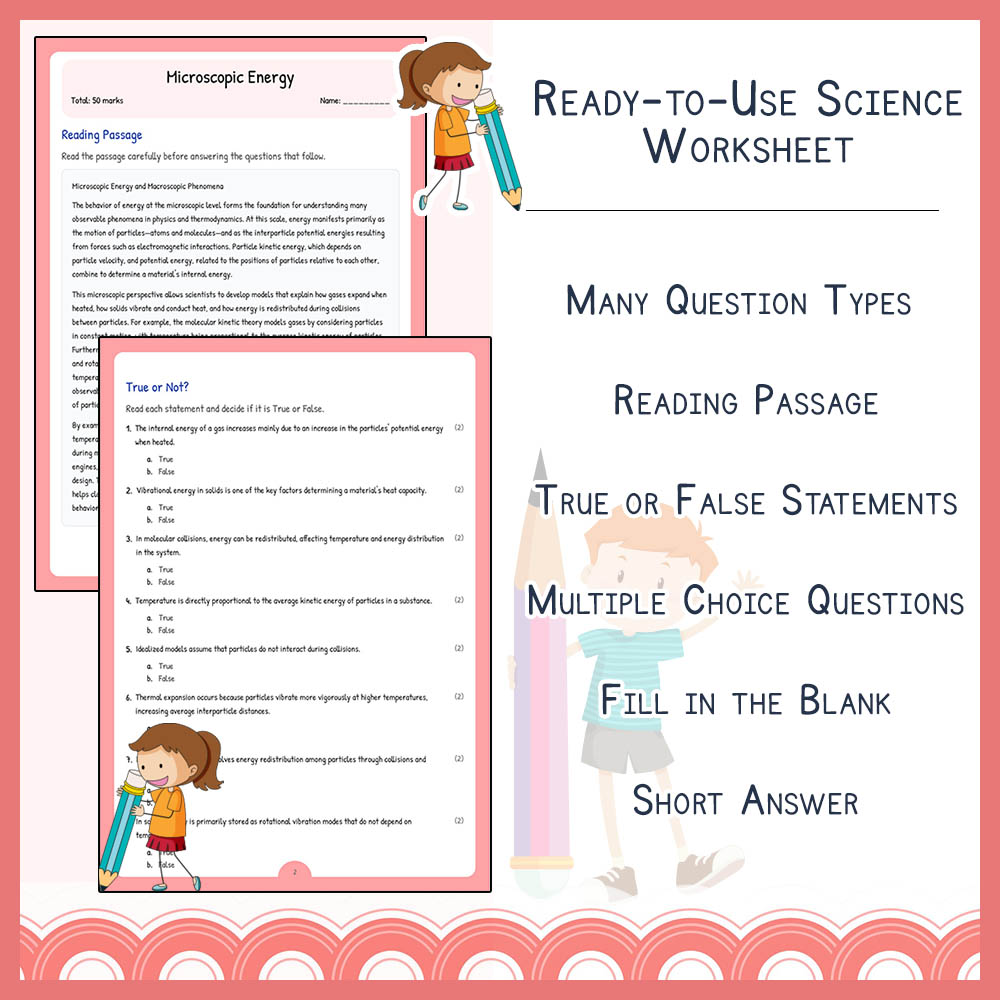
✅ Reading passage explaining the behavior of energy at the microscopic level and its significance in understanding observable phenomena
✅ 10 true or false questions to assess conceptual understanding of energy modes and their effects
✅ 5 multiple choice questions focused on key factors influencing internal energy and heat capacity
✅ 5 fill-in-the-blank questions designed to reinforce terminology and core concepts
✅ 5 short answer questions encouraging students to explain microscopic energy mechanisms and their macro-scale implications
✅ PDF worksheet formatted for easy printing and student distribution
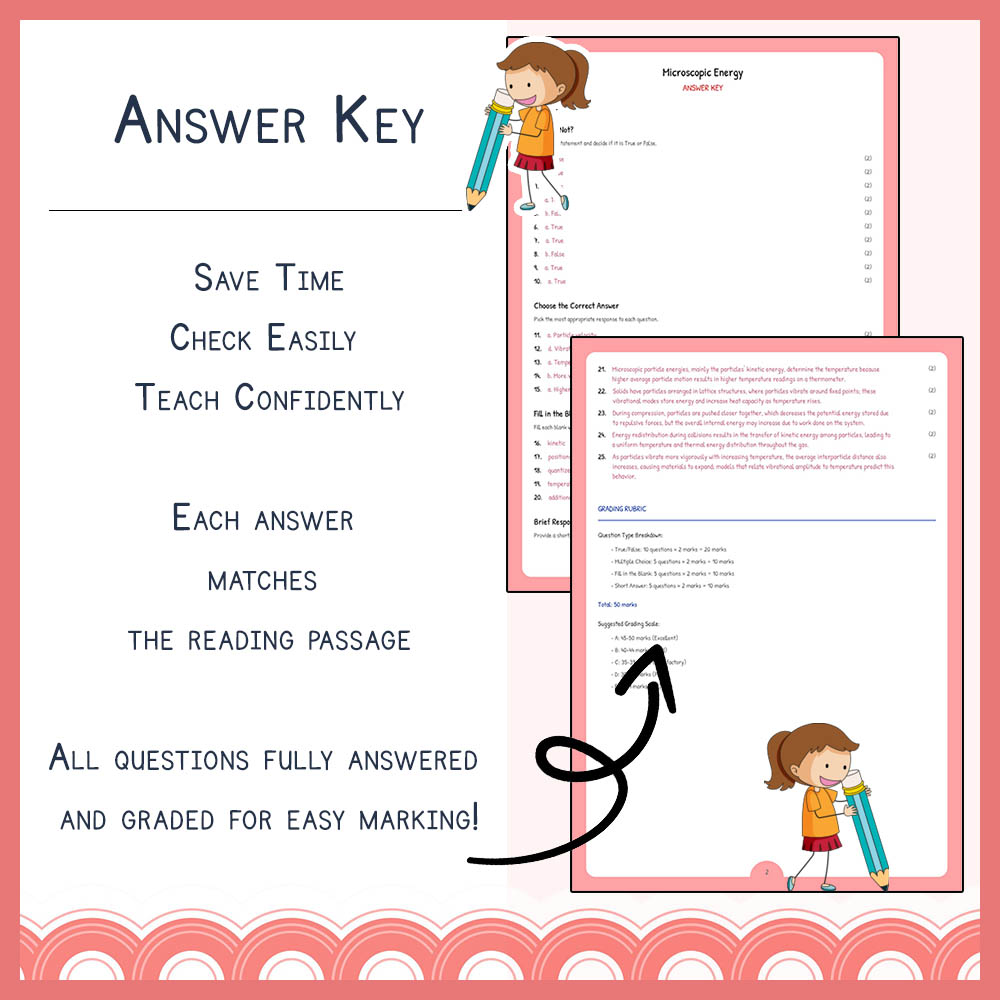
✅ PDF answer key with detailed rubrics for accurate assessment and feedback
Key Concepts Covered
➡️ Microscopic energy behavior – Exploration of how energy manifests at the particle level and its relation to thermal properties
➡️ Internal energy of gases – Understanding how particle motion contributes to overall energy in a system
➡️ Vibrational energy in solids – Examining the role of atomic vibrations in heat capacity and thermal behavior
➡️ Potential and kinetic energy interactions – Differentiating between energy types at microscopic scales and their effects
➡️ Temperature and particle energy correlation – Linking microscopic particle speeds to observable temperature measurements
Question Types / Formats
1. Reading passage comprehension to build foundational knowledge
2. True or false questions to assess conceptual understanding
3. Multiple choice questions testing critical thinking about energy determinants
4. Fill-in-the-blank items to reinforce key terminology
5. Short response questions encouraging detailed explanations and connections between microscopic and macro observations
Teacher Benefits
✅ Facilitates comprehensive assessment of students' grasp of microscopic energy concepts in line with NGSS standards
✅ Enhances student engagement through varied question formats and applied thinking exercises
✅ Provides a printable PDF worksheet and detailed answer key with rubric for efficient grading
✅ Supports effective lesson planning with ready-to-use, standards-aligned content
✅ Encourages deeper understanding of physical science fundamentals essential for high school curricula
Student Benefits
✅ Strengthens understanding of how microscopic particle energies influence observable thermal properties
✅ Develops critical thinking skills through diverse question types and real-world applications
✅ Reinforces key scientific vocabulary and concepts through targeted practice
✅ Improves ability to explain complex phenomena in clear, scientific language
✅ Prepares students for more advanced physics and chemistry topics with conceptual clarity
Perfect For
➡️ Classroom instruction and science lessons focused on thermodynamics and particle behavior
✅ Homework and independent practice to reinforce micro- and macro-level energy concepts
➡️ Science review sessions that solidify understanding of NGSS standards
✅ Lab report preparations where microscopic energy understanding is crucial
➡️ Science assessments designed to evaluate comprehension of thermal energy principles
✅ Substitutive activities for occasional or remote learning scenarios
Ready to enhance your Science teaching? Download this dynamic worksheet today and inspire your students to explore the microscopic world of energy! 🚀