
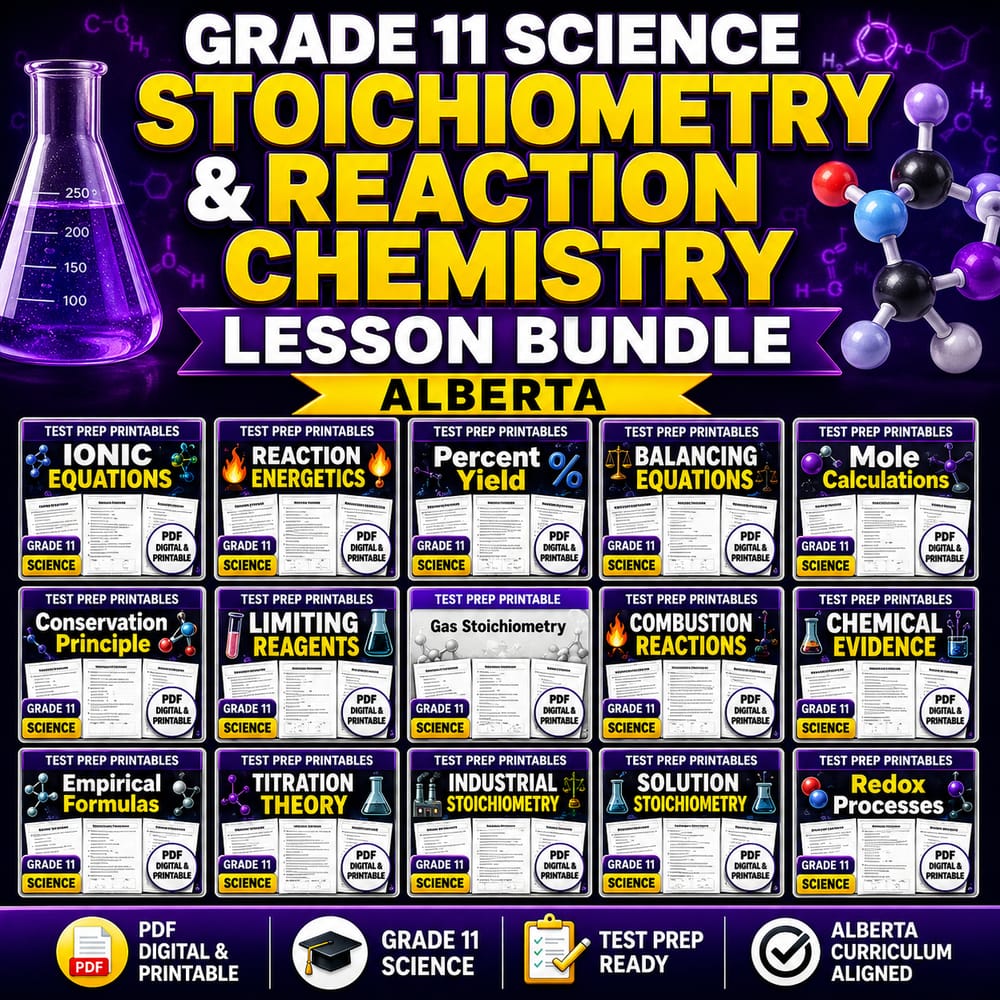


Grade 11 Science Stoichiometry & Reaction Chemistry Lesson Bundle | Alberta
$60.00$75.00Save $15.00
Prism Point Learning
·2 followers·13 sales
SubjectScienceGradeGrade 11
What’s included
15 worksheets · Save $15.00 (20%) · prices shown inside the bundle
 Ionic Equations Worksheet | Grade 11 Science Activities
- Explain the difference between molecular, complete ionic, and net ionic equations.
- Identify spectator ions and write simplified net ionic equations for reactions in aqueous solution.
- Apply solubility rules and charge balance to determine which ions appear in ionic equations.
$4.00$5.00 Reaction Energetics Worksheet | Grade 11 Science Activities
- Calculate reaction enthalpy using standard enthalpies of formation and balanced stoichiometric coefficients
- Interpret whether a reaction is exothermic or endothermic from the sign of ΔH and energy diagrams
- Explain how scaling reactant amounts affects total heat change using molar relationships
$4.00$5.00 Percent Yield Worksheet | Grade 11 Science Practice
- Calculate theoretical yield from a balanced chemical equation and identify the limiting reagent.
- Compute percent yield using actual yield and theoretical yield values.
- Explain common reasons actual yield is lower than theoretical yield and interpret yield as a quality metric.
$4.00$5.00 Balancing Equations Worksheet | Grade 11 Science Activities
- Explain how the conservation of atoms guides the process of balancing chemical equations
- Identify how stoichiometric coefficients act as numerical ratios in balanced equations
- Classify common reaction types (synthesis, decomposition, single- and double-displacement, combustion) using balanced examples
$4.00$5.00 Mole Calculations Worksheet | Grade 11 Science Activities
- Use Avogadro’s number and molar mass to convert between moles and particles for a substance.
- Convert between grams and moles using molar mass and apply consistent units.
- Relate gas volume at standard conditions to moles using the molar gas volume.
$4.00$5.00 Conservation Principle Worksheet | Grade 11 Science Assessment
- Explain the conservation principle in chemical reactions using mass and atom conservation concepts.
- Connect balanced chemical equations to stoichiometry and quantitative predictions in real contexts.
- Use mass-balance ideas to interpret measurements from laboratory or industrial (e.g., Alberta) processes.
$4.00$5.00 Limiting Reagents Worksheet | Grade 11 Science Practice
- Explain how to identify the limiting reactant using mole ratios from a balanced chemical equation
- Determine the theoretical yield and interpret it in terms of maximum possible product formation
- Connect limiting and excess reagents to industrial optimization and waste minimization
$4.00$5.00 Gas Stoichiometry Worksheet | Grade 11 Science Practice
- Apply the ideal gas law and gas stoichiometry to relate gas volume, pressure, temperature, and moles
- Convert between standard and nonstandard conditions using Gay-Lussac/combined gas-law reasoning
- Use balanced chemical equations to determine moles and gas volumes of reactants and products
$4.00$5.00 Combustion Reactions Worksheet | Grade 11 Science Activities
- Explain complete and incomplete combustion and relate them to oxygen availability and fuel type.
- Calculate oxygen demand conceptually and describe how stoichiometry affects CO2 and CO formation.
- Identify common combustion pollutants, including nitrogen oxides, and describe how conditions influence emissions.
$4.00$5.00 Chemical Evidence Worksheet | Grade 11 Science Activities
- Identify measurable indicators of a chemical reaction (e.g., gas, precipitate, color/temperature change) and explain what each indicator means.
- Connect macroscopic observations to microscopic particle changes and the conservation of mass.
- Use chemical evidence to predict whether a reaction occurred and to support safe, evidence-based conclusions in real contexts.
$4.00$5.00
Reviews & Feedback
Loading reviews...
Questions & Answers
Loading questions…
About this bundle
Related categories
Frequently asked questions
Who is Grade 11 Science Stoichiometry & Reaction Chemistry Lesson Bundle | Alberta designed for?
Grade 11 Science Stoichiometry & Reaction Chemistry Lesson Bundle | Alberta is designed for Grade 11 students and Science learners and can be used in classrooms, homeschool, or independent practice.
How do I download Grade 11 Science Stoichiometry & Reaction Chemistry Lesson Bundle | Alberta?
Add it to your cart and complete checkout. After payment, you can download immediately from your account, and you'll also receive a download link by email.
Similar Products

Grade 11 Chemistry Titration & Stoichiometry Lesson Bundle Alberta
$48.00$60.00

Grade 9 Chemistry Lesson Bundle | NGSS: Stoichiometry, Reactions & Bonding
$22.40$28.00

Chemical Reactions and Stoichiometry Lesson Bundle | Grade 11 Science Alberta
$60.00$75.00

Stoichiometry & Chemical Reactions Lesson Bundle — Grade 11 Science Alberta
$36.00$45.00

Grade 11 Science Chemical Reactions and Stoichiometry Lesson Bundle | Alberta
$36.00$45.00