Are your Grade 11 students exploring the fundamental concepts of molecular shapes and electron pair interactions?
Enhance your science instruction with this comprehensive worksheet focused on VSEPR theory, designed specifically for Alberta standards. This resource helps students build a strong understanding of molecular geometry, bond angles, and electron repulsion principles—crucial skills for mastering chemistry at the Grade 11 level.
What's Included
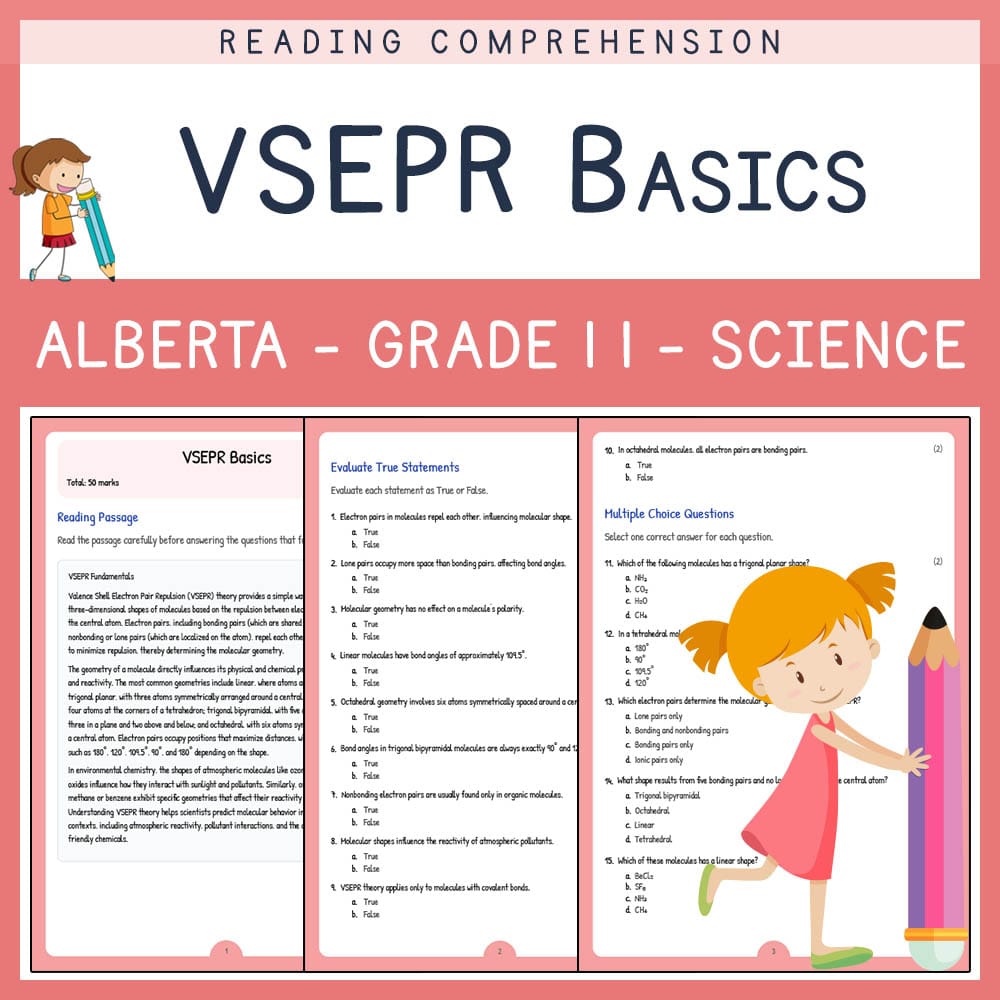
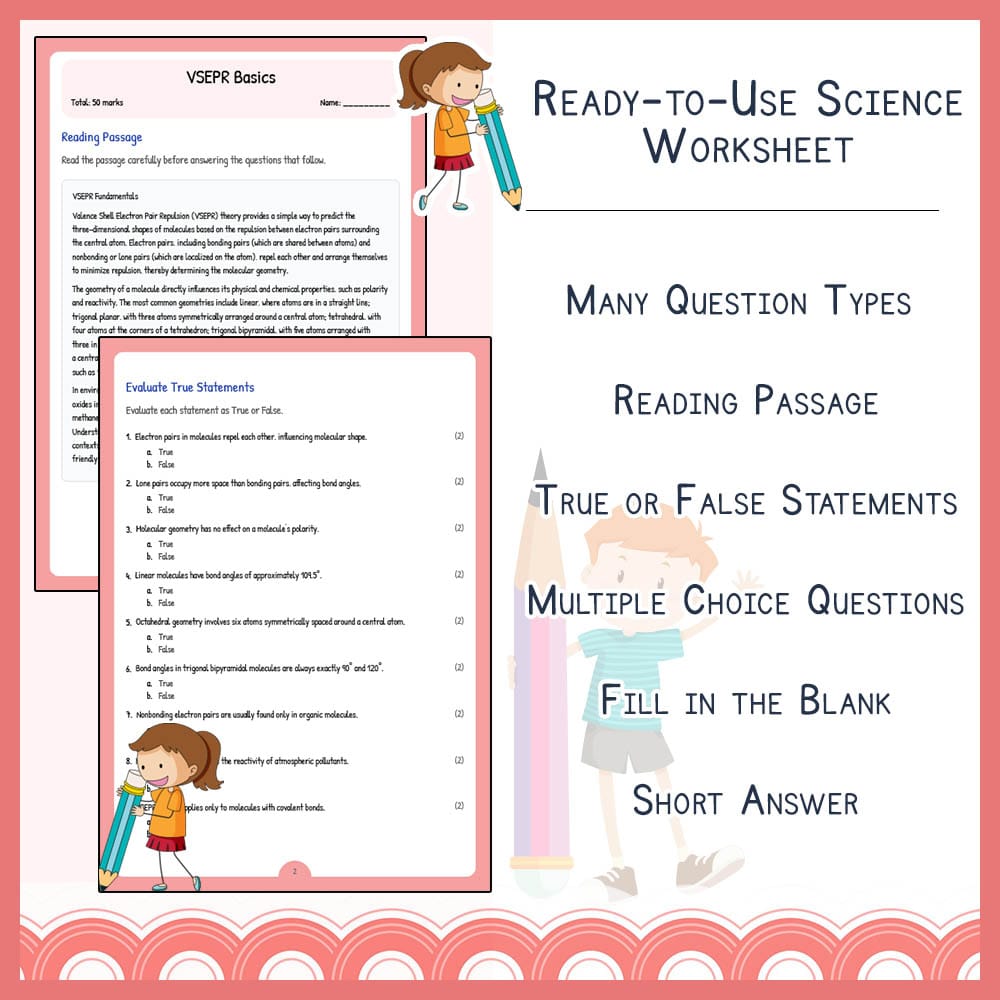
✅ Reading passage explaining Valence Shell Electron Pair Repulsion (VSEPR) theory, including its significance in predicting molecular geometry.
✅ 1 passage-based question to assess comprehension of VSEPR principles.
✅ Evaluate true/false questions (10 total) to reinforce key concepts about electron pairs, lone pairs, and their effects on molecular shape.
✅ Multiple choice questions (5 total) focusing on identifying molecular geometries and bond angles.
✅ Complete the sentences (5 questions) to test understanding of vocabulary and concepts like electron pairs and bond angles.
✅ Short answer questions (5 total) encouraging detailed explanations of how lone pairs influence molecular shape and polarity.
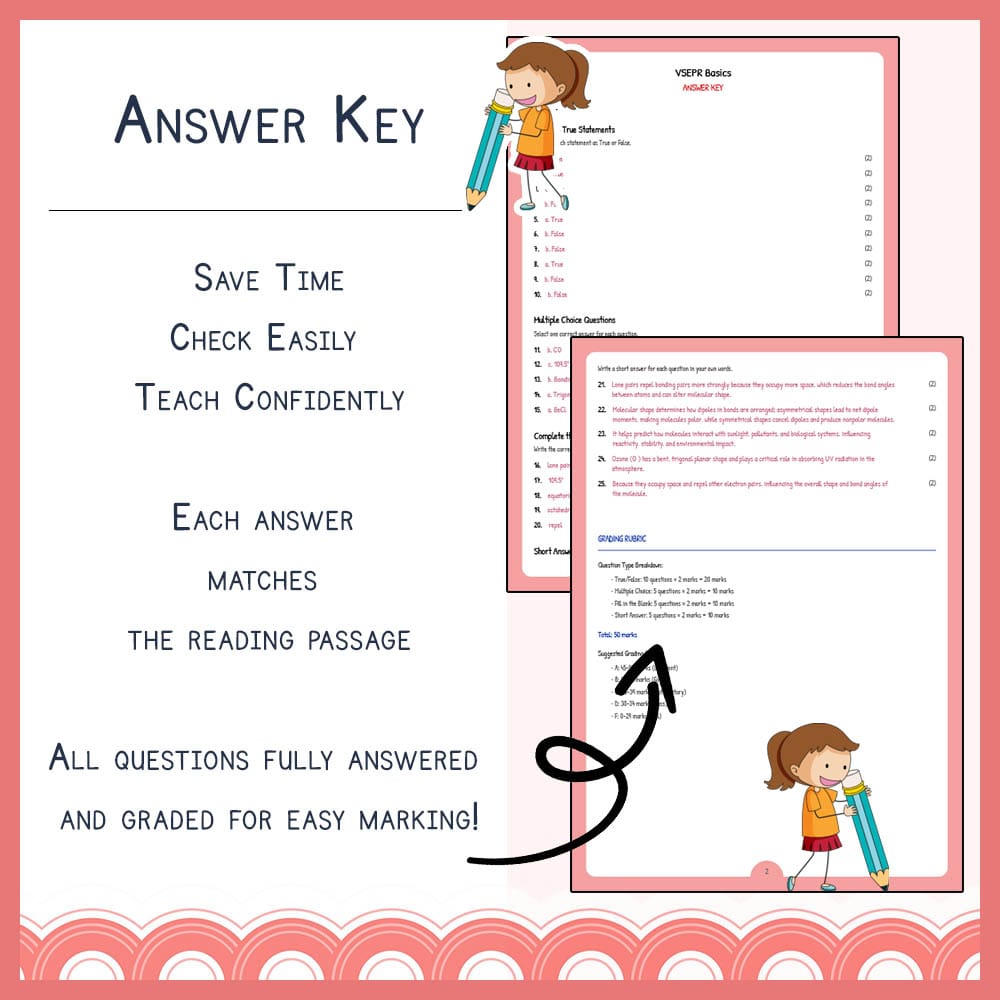
✅ PDF worksheet and PDF answer key with rubric for easy printing and grading.
Key Concepts Covered
➡️ VSEPR theory – A model describing how electron pairs around a central atom determine molecular shape.
➡️ Lone pairs vs. bonding pairs – Understanding how non-bonding electron pairs influence bond angles and molecular geometry.
➡️ Molecular shapes – Identifying trigonal planar, tetrahedral, and other geometries based on electron pair arrangements.
➡️ Bond angles – Recognizing the approximate angles characteristic of different molecular geometries.
➡️ Polarity – Explaining how shape impacts molecule polarity and physical properties.
Question Types / Formats
1. Reading passage with comprehension question
2. True/false evaluation statements
3. Multiple choice questions assessing recognition and application
4. Fill-in-the-blank sentences to test vocabulary and concept understanding
5. Short answer prompts encouraging explanation and reasoning
Teacher Benefits
✅ Provides a ready-to-use, comprehensive assessment aligned with Alberta science standards
✅ Facilitates diverse question formats to evaluate different levels of understanding
✅ Printable PDF worksheets and answer keys streamline lesson planning and grading
✅ Supports formative assessment to identify student needs and misconceptions
✅ Encourages active engagement with molecular geometry topics
Student Benefits
✅ Reinforces understanding of VSEPR theory and molecular shapes
✅ Develops critical thinking through application questions
✅ Strengthens vocabulary related to chemical bonding and molecular geometry
✅ Builds confidence in explaining complex concepts
✅ Prepares students for lab activities and higher-level chemistry coursework
Perfect For
➡️ Classroom instruction and practice exercises
✅ Homework assignments to reinforce lesson content
➡️ Review sessions before assessments
✅ Substituting as in-class activities or quick formative assessments
➡️ Use in science clubs or tutoring to target key learning goals
✅ Supplementary resource for science teachers seeking reliable, standards-aligned content
Ready to enhance your Science teaching? Download this dynamic worksheet today and inspire your students to mastery of molecular geometry! 🚀