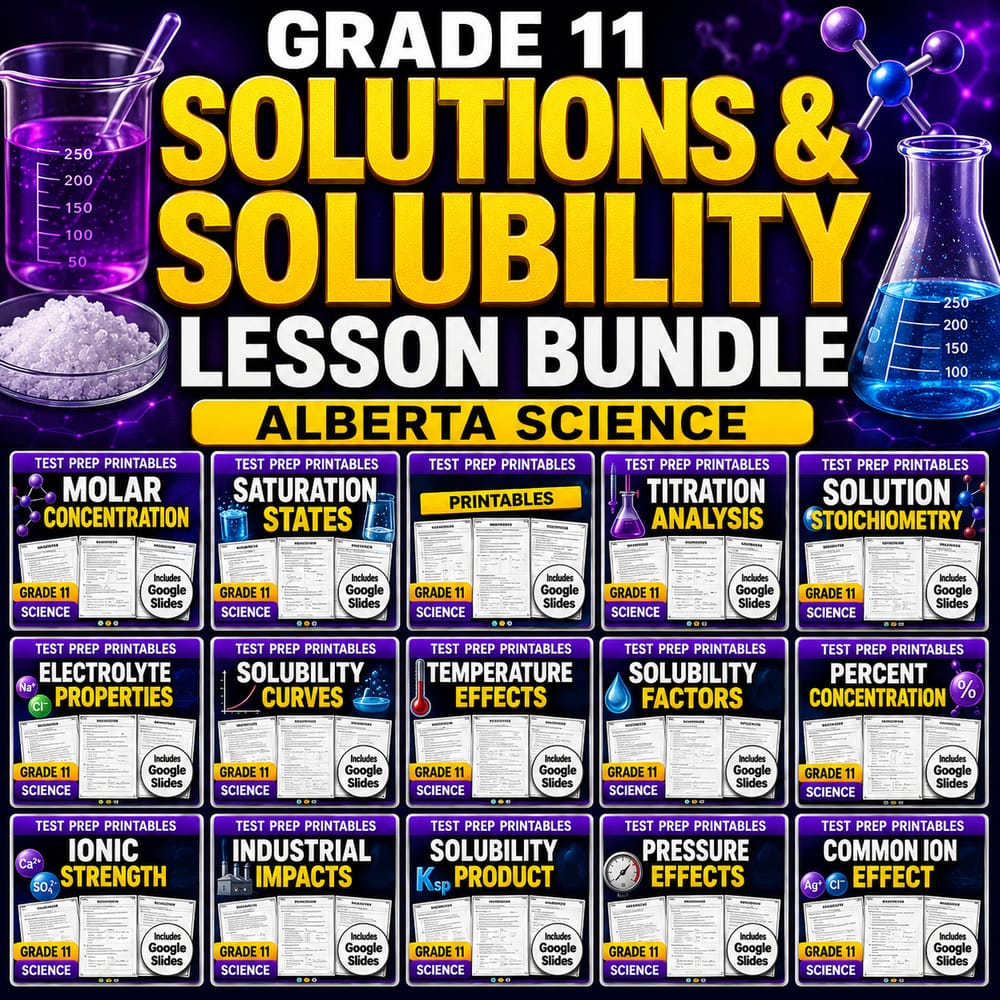
Grade 11 Solutions & Solubility Lesson Bundle | Alberta Science — bundle cover
Grade 11 Solutions & Solubility Lesson Bundle | Alberta Science — included worksheet 1
Grade 11 Solutions & Solubility Lesson Bundle | Alberta Science — included worksheet 2
Grade 11 Solutions & Solubility Lesson Bundle | Alberta Science — included worksheet 3
Grade 11 Solutions & Solubility Lesson Bundle | Alberta Science — included worksheet 4
Grade 11 Solutions & Solubility Lesson Bundle | Alberta Science — included worksheet 5
Grade 11 Solutions & Solubility Lesson Bundle | Alberta Science — included worksheet 6
Grade 11 Solutions & Solubility Lesson Bundle | Alberta Science — included worksheet 7
Grade 11 Solutions & Solubility Lesson Bundle | Alberta Science — included worksheet 8
Grade 11 Solutions & Solubility Lesson Bundle | Alberta Science — included worksheet 9
Grade 11 Solutions & Solubility Lesson Bundle | Alberta Science — included worksheet 10
Grade 11 Solutions & Solubility Lesson Bundle | Alberta Science — included worksheet 11
Grade 11 Solutions & Solubility Lesson Bundle | Alberta Science — included worksheet 12
Grade 11 Solutions & Solubility Lesson Bundle | Alberta Science — included worksheet 13
Grade 11 Solutions & Solubility Lesson Bundle | Alberta Science — included worksheet 14
Grade 11 Solutions & Solubility Lesson Bundle | Alberta Science — included worksheet 15
Grade 11 Science worksheet — Grade 11 Solutions & Solubility Lesson Bundle | Alberta Science

Description

Overview


Solutions & Solubility in Grade 11 Science focuses on solubility and titration analysis aligned to the Alberta framework, with 15 targeted worksheets to strengthen core chemistry problem-solving.

This Lesson Bundle supports students as they connect concentration, saturation behavior, and reaction stoichiometry to predictable outcomes. Learners practice interpreting data (including solubility curves), evaluating conditions that change solubility (temperature, pressure, and ionic strength), and using titration relationships to solve quantitative chemistry tasks. With consistent worksheet structures, students build confidence with calculations and explanation based on chemical principles rather than memorization.

Worksheet count: 15.

What's Included


  • ✅ Solubility Factors Worksheet | Grade 11 Science Practice – Students identify and explain the factors that influence solubility in practical contexts.
  • ✅ Titration Analysis Worksheet | Grade 11 Science Activities – Students analyze titration results and connect them to reaction stoichiometry.
  • ✅ Temperature Effects Worksheet | Grade 11 Science Activities – Students investigate how temperature changes solubility and interpret the results.
  • ✅ Solution Stoichiometry Worksheet | Grade 11 Science Practice – Students apply stoichiometric reasoning to solution-based reaction quantities.
  • ✅ Solution Basics Worksheet | Grade 11 Science Activities – Students review core solution concepts and translate them into calculation steps.
  • ✅ Solubility Product Ksp Worksheet | Grade 11 Science Activities – Students use Ksp to evaluate equilibrium and predict whether a precipitate forms.
  • ✅ Solubility Curves Worksheet | Grade 11 Science Activities – Students read solubility curves to determine solubility at different temperatures.
  • ✅ Saturation States Worksheet Grade 11 Science | Practice – Students determine saturation status and justify predictions using concentration relationships.
  • ✅ Pressure Effects Worksheet | Grade 11 Science Activities – Students analyze how pressure affects solubility for gases in solution.
  • ✅ Percent Concentrations Worksheet | Grade 11 Science Activities – Students calculate percent concentration and convert between representations.
  • ✅ Molar Concentration Worksheet | Grade 11 Science Activities – Students calculate molarity and use it to support further chemistry computations.
  • ✅ Ionic Strength Worksheet | Grade 11 Science Practice – Students connect ionic strength to solution behavior using evidence-based calculations.
  • ✅ Industrial Impacts Worksheet | Grade 11 Science Activities – Students connect solution chemistry to real-world environmental and industrial decision-making.
  • ✅ Electrolyte Properties Worksheet | Grade 11 Science Activities – Students relate electrolyte behavior to ions, conductivity, and solution properties.
  • ✅ Common Ion Effect Worksheet | Grade 11 Science Activities – Students use the common ion effect to predict changes in solubility.

Skills & Standards


Aligned to the Alberta science framework, this unit bundle emphasizes inquiry through modeling, quantitative reasoning, and evidence-based explanation. Students build disciplinary understanding by using particle and equilibrium ideas to justify outcomes such as precipitation formation (via Ksp), saturation state changes, and solubility shifts caused by competing ions and solution conditions.

Across worksheets, learners practice calculating and interpreting key relationships: concentration measures (percent and molarity), titration stoichiometry, temperature and pressure trends, and solution behavior described by ionic strength and electrolyte properties. Students also develop the habit of using data to support claims—for example, reading solubility curves to justify solubility at a given temperature, or applying solubility and titration analysis to determine the amounts involved in solution reactions.

Perfect For


  • Teachers seeking structured instruction
  • Sub plans
  • Homework or review
  • Intervention or centers
  • Assessment preparation

How to Use


Plan this single unit for typical 1–3 weeks. A common pacing is to start with solution foundations and concentration (Solution Basics, Percent Concentrations, Molar Concentration), then move into solubility modeling (Solubility Factors, Solubility Curves, Saturation States, Ksp, Common Ion Effect), and finish with applications and synthesis (Titration Analysis, Solution Stoichiometry, Ionic Strength, Electrolyte Properties, Industrial Impacts).

Use a quick warm-up each day to rehearse the day’s calculation skill (for example, converting concentration units or setting up Ksp expressions). During guided practice, have students annotate how each step connects to the underlying chemistry model (precipitation vs. no precipitation, saturated vs. unsaturated). Close with exit tickets that ask for one prediction plus one explanation—for example, using a solubility curve or analyzing titration results—then use an end-of-unit review worksheet set to check for common misconceptions across all topic areas.

Closing


These worksheets help students connect solubility behavior to measurable quantities and reasoning, so they can solve chemistry problems with clarity and confidence.

Grade 11 Solutions & Solubility Lesson Bundle | Alberta Science

$56.00$70.00Save $14.00
Prism Point Learning
·2 followers·13 sales
SubjectScienceGradeGrade 11

What’s included

15 worksheets · Save $14.00 (20%) · prices shown inside the bundle

  1. Molar Concentration Worksheet | Grade 11 Science Activities
    Molar Concentration Worksheet | Grade 11 Science Activities

    Grade 11 · Science · 30 Pages

    • Define molar concentration (molarity) and interpret what a given value of M means about a solution.
    • Convert between moles and mass using molar mass while keeping units consistent.
    • Use dilution relationships (C1V1 = C2V2) to determine an unknown concentration.
    $4.00$5.00
  2. Saturation States Worksheet Grade 11 Science | Practice
    Saturation States Worksheet Grade 11 Science | Practice

    Grade 11 · Science · 32 Pages

    • Differentiate unsaturated, saturated, and supersaturated solutions using solubility and equilibrium ideas
    • Explain how temperature and concentration changes affect whether crystals precipitate or dissolve
    • Describe nucleation triggers and give real-world examples of mineral scale and seasonal crystallization
    $4.00$5.00
  3. Solution Basics Worksheet | Grade 11 Science Activities
    Solution Basics Worksheet | Grade 11 Science Activities

    Grade 11 · Science · 31 Pages

    • Define solute, solvent, and solution using homogeneous-mixture language.
    • Explain how microscopic interactions drive dissolution and affect solution properties.
    • Use and interpret common concentration units and identify types of solutions.
    $4.00$5.00
  4. Titration Analysis Worksheet | Grade 11 Science Activities
    Titration Analysis Worksheet | Grade 11 Science Activities

    Grade 11 · Science · 32 Pages

    • Use titration data with molarity and reaction stoichiometry to calculate an unknown solution concentration
    • Interpret the equivalence point to connect measured volumes with chemical change
    • Apply algebraic relationships in titration calculations and evaluate reasonableness
    $4.00$5.00
  5. Solution Stoichiometry Worksheet | Grade 11 Science Practice
    Solution Stoichiometry Worksheet | Grade 11 Science Practice

    Grade 11 · Science · 32 Pages

    • Use molar concentration to convert between volume of solution and moles of dissolved reactants.
    • Apply mole-to-mole ratios from balanced equations to predict product amounts in aqueous reactions.
    • Identify the limiting reactant in solution-based problems using concentration and stoichiometry.
    $4.00$5.00
  6. Electrolyte Properties Worksheet | Grade 11 Science Activities
    Electrolyte Properties Worksheet | Grade 11 Science Activities

    Grade 11 · Science · 32 Pages

    • Differentiate strong and weak electrolytes based on how completely they produce ions in solution
    • Explain how ion concentration affects electrical conductivity of aqueous solutions
    • Describe, qualitatively, how dissolved solute particles change colligative properties such as freezing point
    $4.00$5.00
  7. Solubility Curves Worksheet | Grade 11 Science Activities
    Solubility Curves Worksheet | Grade 11 Science Activities

    Grade 11 · Science · 32 Pages

    • Read and interpret solubility curves to determine the state of a solution (unsaturated, saturated, or supersaturated).
    • Explain how temperature affects solute solubility for salts and how this shows up on graphs.
    • Connect trends on solubility curves to molecular interactions and to real-world Alberta contexts.
    $4.00$5.00
  8. Temperature Effects Worksheet | Grade 11 Science Activities
    Temperature Effects Worksheet | Grade 11 Science Activities

    Grade 11 · Science · 32 Pages

    • Explain how temperature changes kinetic energy and molecular motion
    • Predict how temperature affects solubility and reaction rates using qualitative thermodynamic ideas
    • Compare trends for solid solubility versus gas solubility with clear particle-level reasoning
    $4.00$5.00
  9. Solubility Factors Worksheet | Grade 11 Science Practice
    Solubility Factors Worksheet | Grade 11 Science Practice

    Grade 11 · Science · 31 Pages

    • Explain how intermolecular forces and solute/solvent polarity affect solubility
    • Predict how temperature and pressure can change solubility, especially for solids versus gases
    • Describe how saturation limits form in natural water systems using real-world examples
    Free
  10. Percent Concentrations Worksheet | Grade 11 Science Activities
    Percent Concentrations Worksheet | Grade 11 Science Activities

    Grade 11 · Science · 32 Pages

    • Explain the meaning of mass percent, volume percent, and parts per million (ppm) in solution chemistry
    • Convert and compare concentration units using consistent reference amounts (mass vs. volume)
    • Interpret how concentration values relate to real-world samples such as road salt brines and trace metals
    $4.00$5.00

Reviews & Feedback

Loading reviews...

Questions & Answers

Loading questions…

About this bundle

Related categories

Frequently asked questions

Who is Grade 11 Solutions & Solubility Lesson Bundle | Alberta Science designed for?
Grade 11 Solutions & Solubility Lesson Bundle | Alberta Science is designed for Grade 11 students and Science learners and can be used in classrooms, homeschool, or independent practice.
How do I download Grade 11 Solutions & Solubility Lesson Bundle | Alberta Science?
Add it to your cart and complete checkout. After payment, you can download immediately from your account, and you'll also receive a download link by email.