
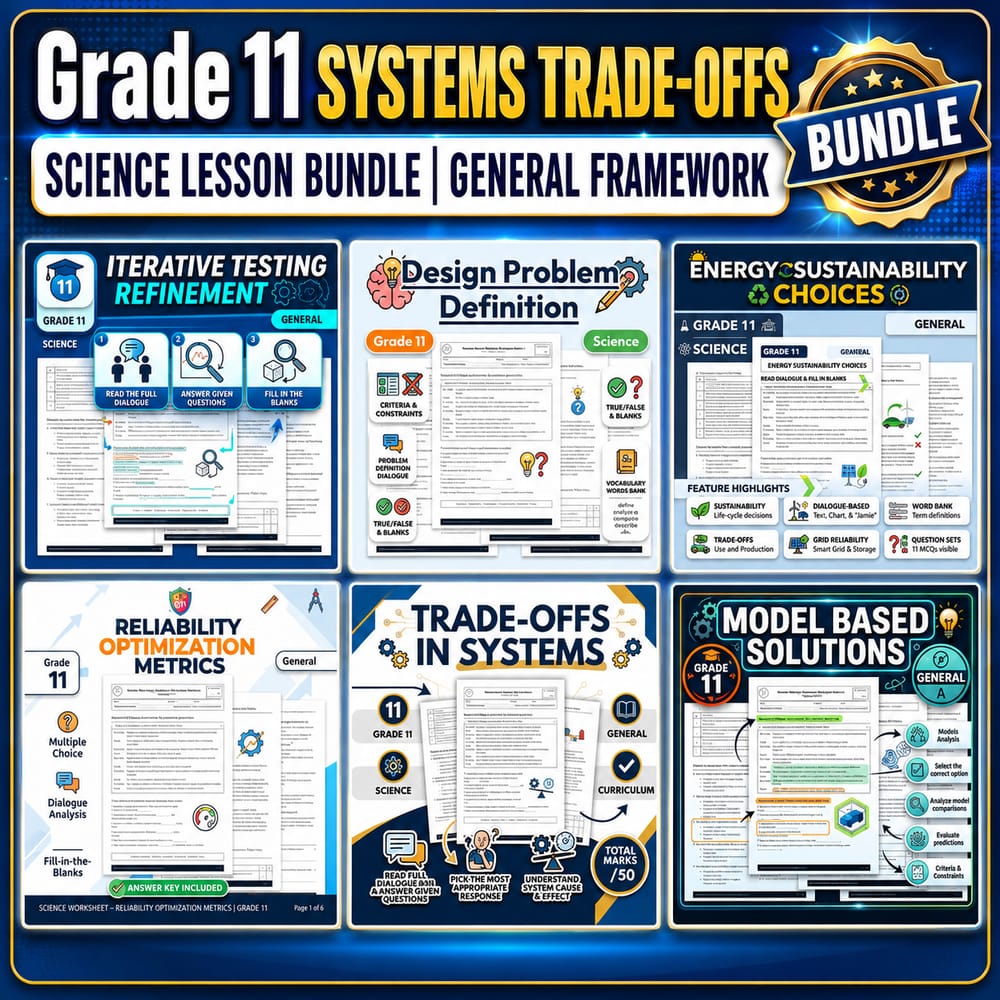
Grade 11 Systems Trade-offs Science lesson bundle | General framework
$24.00$30.00Save $6.00
J.S Sheets
New·3 followers·24 sales
SubjectScienceGradeGrade 11
What’s included
6 worksheets · Save $6.00 (20%) · prices shown inside the bundle
 Science Worksheet Iterative Testing Refinement Grade 11
- Explain how iterative testing uses results to refine a design toward specified performance criteria.
- Identify how analysis links observed outcomes to design causes (e.g., structural weaknesses, unexpected losses, control instability).
- Justify why refinement improves reliability and consistency, not only first-time success.
$4.00$5.00 Science Design Problem Definition Worksheet for Grade 11 | Standards-Aligned
- Identify the difference between design criteria and design constraints in a problem statement.
- Translate a general need into measurable performance criteria using quantitative targets.
- Recognize how constraints limit feasible design choices such as cost, space, materials, and safety.
$4.00$5.00 Energy Sustainability Choices Worksheet for Grade 11 Science
- Explain how energy-efficiency technologies affect system-level demand and grid operation.
- Evaluate trade-offs among cost, safety, efficiency, and environmental impacts in energy designs.
- Use reasoning about life-cycle and emissions outcomes to support sustainable technology choices.
$4.00$5.00 Science Worksheet Reliability Optimization Metrics | Grade 11 Assessment
- Explain how reliability-centered optimization uses metrics to set performance expectations under repeated operation and changing conditions
- Identify common reliability metrics such as stability under fluctuating demand, sustained efficiency over time, and acceptable failure rates
- Describe how models, simulations, and test data are used together to validate reliability targets and refine designs
$4.00$5.00 Science Grade 11 Trade-offs In Systems Worksheet | Standards-Aligned Practice
- Explain how a systems view connects engineering decisions to multiple outcomes, including cost, safety, efficiency, and environmental impact.
- Identify trade-offs and constraints when comparing design options for a real-world system.
- Evaluate statements and justify conclusions using evidence from system-level cause-and-effect relationships.
$4.00$5.00 Science Models Comparing Solution Approaches Worksheet | Grade 11 Science
- Explain how models represent relationships among variables to estimate outcomes before building or testing.
- Compare multiple model-based solution approaches using calculations and predicted performance.
- Identify assumptions and possible failure modes revealed by model comparisons.
$4.00$5.00
Reviews & Feedback
Loading reviews...
Questions & Answers
Loading questions…
About this bundle
Related categories
Frequently asked questions
Who is Grade 11 Systems Trade-offs Science lesson bundle | General framework designed for?
Grade 11 Systems Trade-offs Science lesson bundle | General framework is designed for Grade 11 students and Science learners and can be used in classrooms, homeschool, or independent practice.
How do I download Grade 11 Systems Trade-offs Science lesson bundle | General framework?
Add it to your cart and complete checkout. After payment, you can download immediately from your account, and you'll also receive a download link by email.
Similar Products

Grade 11 Science Assessment Lesson Bundle: Systems Trade-offs - General
$24.00$30.00

Grade 11 System Design & Trade-offs Science Lesson Bundle | General
$19.20$24.00

Grade 10 NGSS Science: Models, Systems, and Trade-Off Design Lesson Bundle
$16.00$20.00

Grade 8 Science Watershed Systems Lesson Bundle | Ontario Framework
$60.00$75.00

Grade 5 Earth Systems Science Lesson Bundle Worksheets | General Framework
$25.60$32.00