
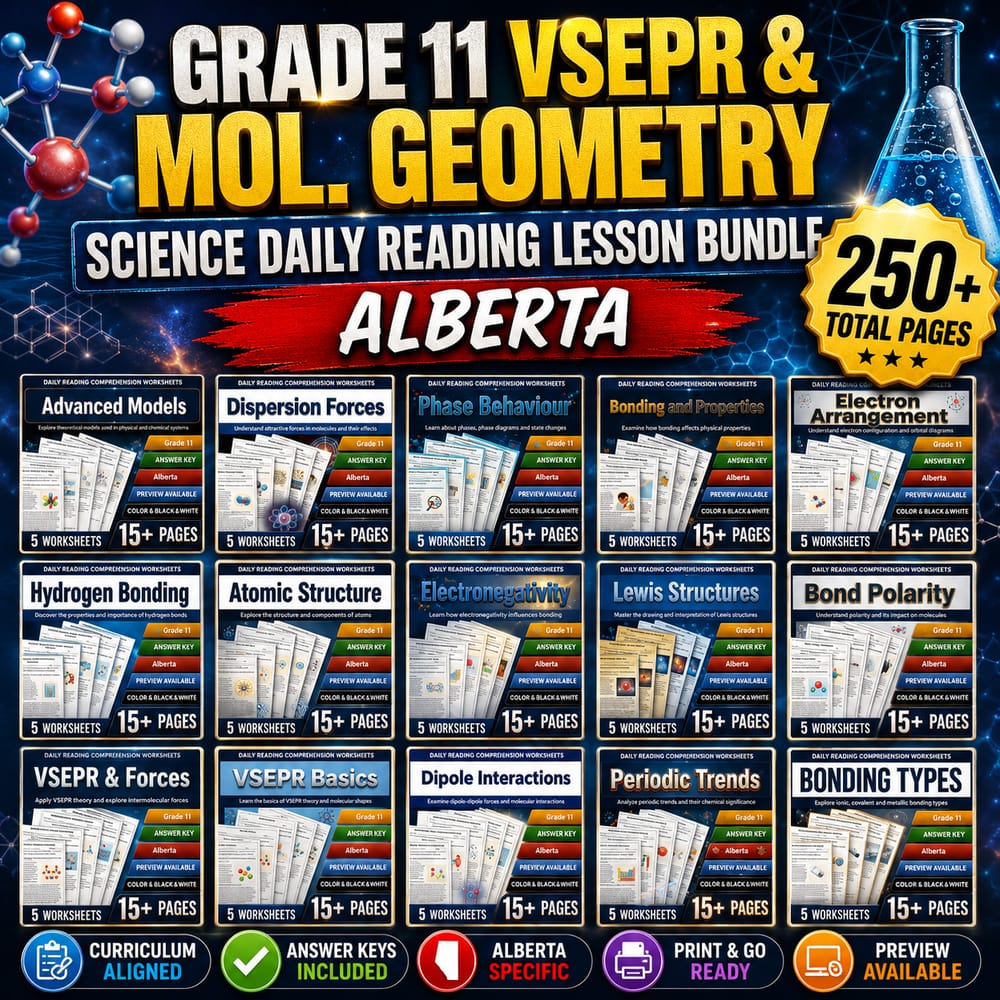


Grade 11 VSEPR & Mol. Geometry Science Daily Reading Lesson Bundle | Alberta
$48.00$60.00Save $12.00
Bright Mind Resources
New·1 followers·12 sales
SubjectScienceGradeGrade 11
What’s included
15 worksheets · Save $12.00 (20%) · prices shown inside the bundle
 Grade 11 Science – Molecular Orbital Theory & Band Theory | Reading Worksheet
- Understand the principles of molecular orbital formation and electron delocalization.
- Explain how orbital overlap influences bonding and material properties.
- Identify and analyze the electronic features of transition metal complexes and energy materials.
$3.20$4.00 Grade 11 Science – Understanding Dispersion Forces | Daily Reading Worksheet
- Understand key concepts related to Science
- Apply knowledge through practice questions
- Demonstrate comprehension of the material
$3.20$4.00 Grade 11 Science – Phase Behaviour & Intermolecular Forces | Reading Worksheet
- Understand the different types of intermolecular forces and how they affect phase changes.
- Describe the relationship between intermolecular forces, vapor pressure, and boiling points.
- Apply knowledge of phase diagrams to real-world environmental and industrial scenarios.
$3.20$4.00 Grade 11 Science – Bonding & Properties in Materials | Daily Reading Worksheet
- Understand the basic types of chemical bonds: ionic, covalent, and metallic.
- Learn how different bonds influence material properties such as hardness, conductivity, melting point, and solubility.
- Analyze examples of materials with different bonding types and their practical applications.
$3.20$4.00 Grade 11 Science – Electron Arrangement & Polarity | Daily Reading Worksheet
- Understand how valence electrons are arranged in molecules.
- Explain how electron distribution influences molecular polarity.
- Analyze examples of polar and nonpolar molecules based on electron arrangements.
$3.20$4.00 Grade 11 Science – Hydrogen Bonding & Water Properties | Daily Reading Worksheet
- Understand what hydrogen bonding is and how it occurs in water molecules
- Learn about the effects of hydrogen bonds on water's physical properties
- Explore the role of hydrogen bonding in protein structure and other biological molecules
$3.20$4.00 Grade 11 Science – Atomic Structure & Elements | Daily Reading Worksheet
- Identify protons, neutrons, and electrons in an atom
- Understand the basic structure of an atom and its parts
- Recognize the roles of electrons, shells, and valence electrons
$3.20$4.00 Grade 11 Science – Electronegativity & Chemical Behavior | Reading Worksheet
- Understand the concept of electronegativity and its importance in chemical bonding.
- Learn about the scale of electronegativity values across elements.
- Identify trends in electronegativity across periods and down groups.
$3.20$4.00 Grade 11 Science – Understanding Lewis Structures Daily Reading Worksheet
- Identify valence electrons in atoms of various elements.
- Draw basic Lewis structures for simple molecules.
- Understand the concept of bonding and lone pairs.
$3.20$4.00 Grade 11 Science – Bond Polarity & Molecules Daily Reading Worksheet
- Understand the concept of bond polarity and how it relates to partial charges.
- Identify polar and nonpolar bonds based on electronegativity differences.
- Explain how bond dipoles contribute to the overall polarity of molecules.
$3.20$4.00
Reviews & Feedback
Loading reviews...
Questions & Answers
Loading questions…
About this bundle
Related categories
Frequently asked questions
Who is Grade 11 VSEPR & Mol. Geometry Science Daily Reading Lesson Bundle | Alberta designed for?
Grade 11 VSEPR & Mol. Geometry Science Daily Reading Lesson Bundle | Alberta is designed for Grade 11 students and Science learners and can be used in classrooms, homeschool, or independent practice.
How do I download Grade 11 VSEPR & Mol. Geometry Science Daily Reading Lesson Bundle | Alberta?
Add it to your cart and complete checkout. After payment, you can download immediately from your account, and you'll also receive a download link by email.