
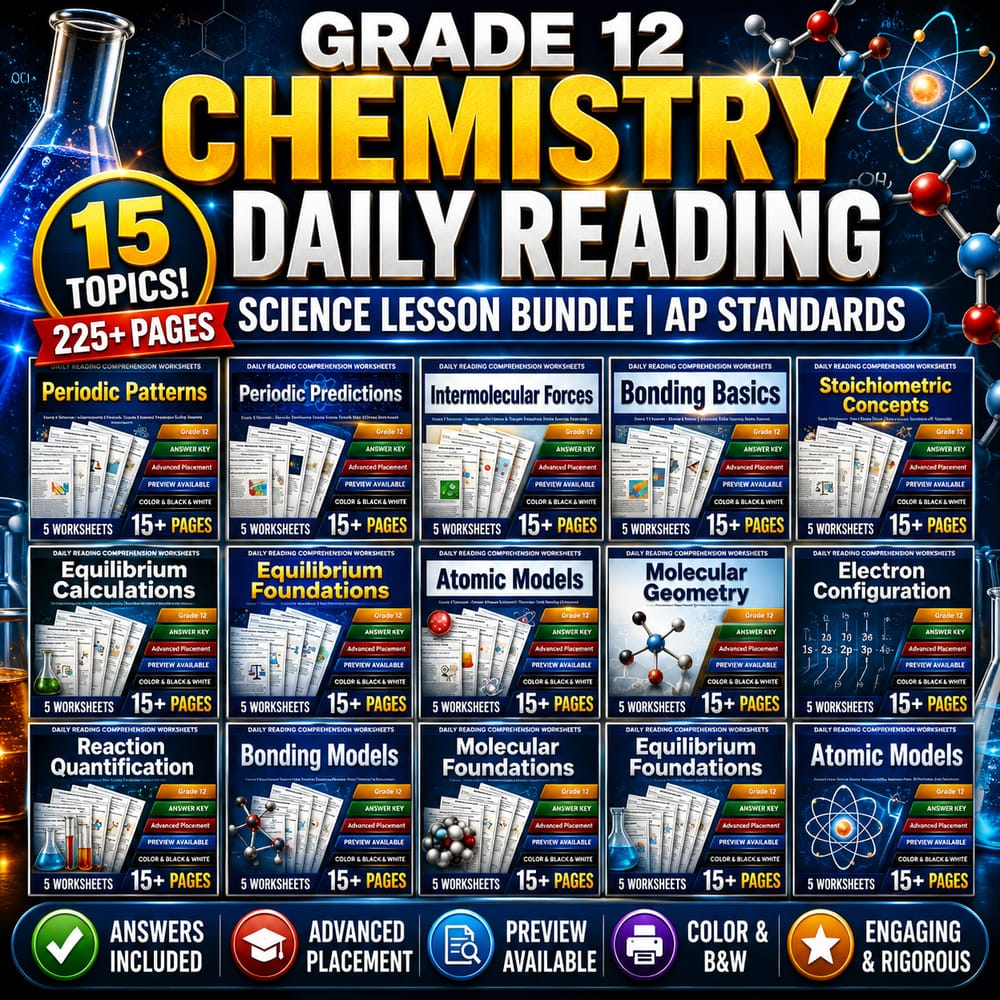


Grade 12 Chemistry Daily Reading Science Lesson Bundle | AP Standards
$38.40$48.00Save $9.60
Bright Mind Resources
New·1 followers·12 sales
SubjectScienceGradeGrade 12
What’s included
12 worksheets · Save $9.60 (20%) · prices shown inside the bundle
 Grade 12 Science – Periodic Trends & Atomic Properties | Daily Reading Worksheet
- Identify and describe key periodic properties such as atomic radius, ionization energy, electronegativity, and effective nuclear charge.
- Explain how electronic structure influences observable chemical behaviors across the periodic table.
- Interpret tabular and graphical data representing periodic trends.
$3.20$4.00 Grade 12 Science – Periodic Predictions Atomic Radius Trends Reading Worksheet
- Understand how atomic radius varies across periods and down groups in the periodic table.
- Analyze factors like nuclear charge and electron shielding influencing atomic size.
- Interpret graphical and tabular data related to periodic trends.
$3.20$4.00 Grade 12 Science – Intermolecular Forces & Physical Properties | Worksheet
- Understand the concept of intermolecular forces and their significance in chemistry.
- Identify the different types of intermolecular forces: dispersion, dipole–dipole, and hydrogen bonding.
- Relate the strength of intermolecular forces to physical properties such as boiling point, vapor pressure, viscosity, and solubility.
$3.20$4.00 Grade 12 Science – Bonding Basics & Structure | Daily Reading Worksheet
- Understand how charge transfer occurs in ionic bonds
- Identify features of lattice structures in metals and salts
- Describe the shared-electron model for covalent bonds
$3.20$4.00 Grade 12 Science – Mole & Molar Mass Daily Reading Worksheet | AP Standards
- Explain the concept of a mole in chemistry.
- Calculate molar mass of chemical compounds.
- Determine the number of particles in a sample using molar relationships.
$3.20$4.00 Grade 12 Science – Equilibrium Calculations & Concept Review | Reading Worksheet
- Understand the concept of chemical equilibrium as a balanced state in reactions.
- Learn to use ICE tables to calculate equilibrium concentrations.
- Explore the reaction quotient and how it predicts reaction direction.
$3.20$4.00 Grade 12 Science – Chemical Equilibrium & AP Standard | Daily Reading Worksheet
- Define chemical equilibrium as a dynamic balance between forward and reverse reactions.
- Explain the concept of the equilibrium constant and how it quantifies reaction position.
- Understand how changes in concentration and pressure affect the equilibrium state.
$3.20$4.00 Grade 12 Science – Atomic Models & Scientific Theories | Daily Reading Worksheet
- Describe the early development of atomic models and the evidence supporting them.
- Identify key features of Rutherford's nuclear model and Dalton's atomic theory.
- Explain how spectral lines and scattering experiments provide evidence for discrete energy levels and nuclear structure.
$3.20$4.00 Grade 12 Science – Molecular Geometry & Bond Angles | Daily Reading Worksheet
- Understand the principles of valence-shell electron-pair repulsion (VSEPR)
- Identify basic molecular geometries based on electron pairs
- Learn how hybridization influences molecular shape
$3.20$4.00 Grade 12 Science – Electron Configuration & Quantum Numbers | Reading Worksheet
- Understand the principles of electron configuration and orbital filling order.
- Identify the orbitals filled in different elements based on quantum numbers.
- Apply Hund’s rule and recognize exceptions in transition elements.
$3.20$4.00
Reviews & Feedback
Loading reviews...
Questions & Answers
Loading questions…
About this bundle
Related categories
Frequently asked questions
Who is Grade 12 Chemistry Daily Reading Science Lesson Bundle | AP Standards designed for?
Grade 12 Chemistry Daily Reading Science Lesson Bundle | AP Standards is designed for Grade 12 students and Science learners and can be used in classrooms, homeschool, or independent practice.
How do I download Grade 12 Chemistry Daily Reading Science Lesson Bundle | AP Standards?
Add it to your cart and complete checkout. After payment, you can download immediately from your account, and you'll also receive a download link by email.
Similar Products

Grade 10 Chemistry Science Lesson Bundle Daily Reading Worksheets | Alberta
$48.00$60.00

Grade 12 Chemistry Daily Reading Worksheets Lesson Bundle | Alberta Science
$48.00$60.00

Grade 11 Chemistry Concepts Science Daily Reading Worksheets Lesson Bundle | AP
$38.40$48.00

Grade 11 Chemistry Science Lesson Bundle Worksheets: Daily Reading | BC
$48.00$60.00

Grade 12 Chemistry Science Lesson Bundle | BC Daily Reading Worksheets
$48.00$60.00