
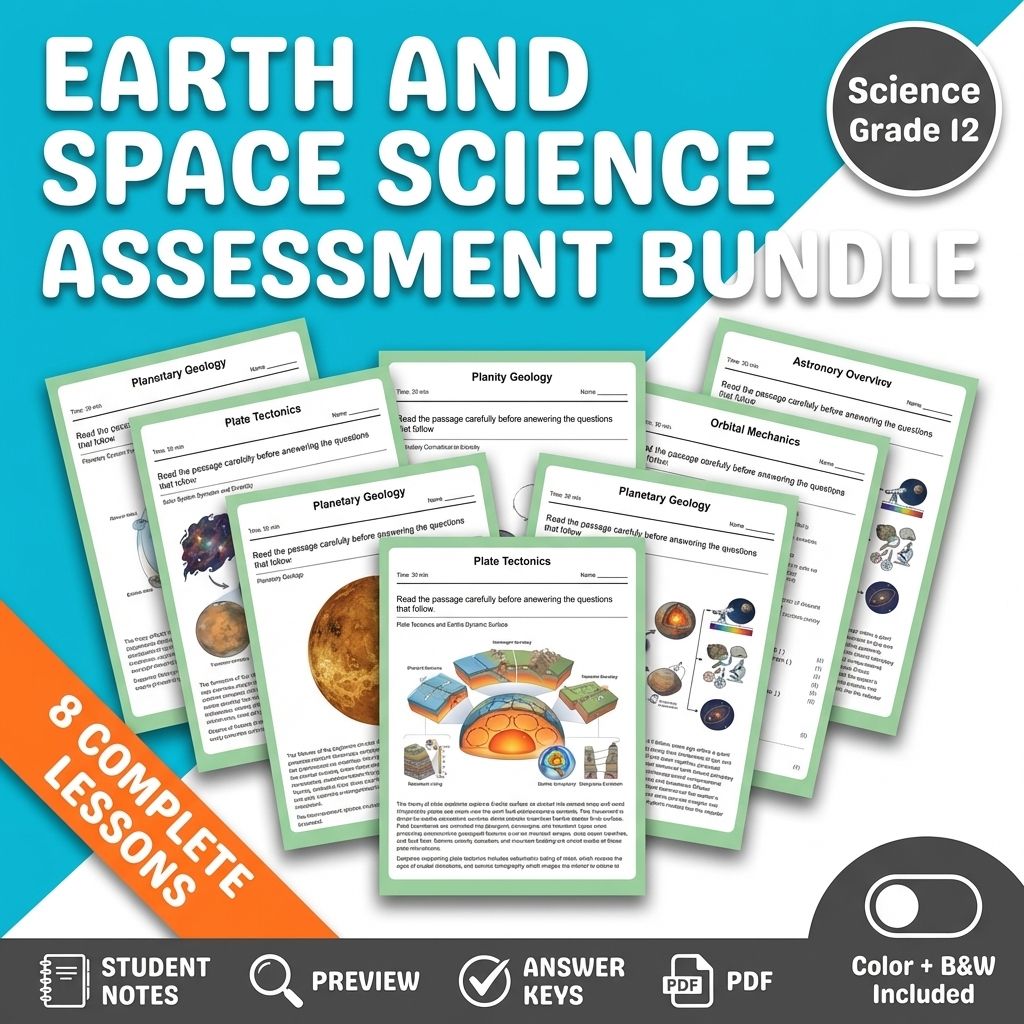
Grade 12 Earth & Space Science Lesson Bundle: TEKS Earth Systems Assessments
$32.00$40.00Save $8.00
Prism Point Learning
·2 followers·13 sales
SubjectScienceGradeGrade 12
What’s included
8 worksheets · Save $8.00 (20%) · prices shown inside the bundle
 Atmospheric Dynamics Assessment | TEKS Grade 12 Science Standards
- Explain the key forces and processes driving large-scale atmospheric circulation patterns.
- Identify and describe the roles of the Coriolis force, Hadley and Ferrel cells, and jet streams.
- Analyze how pressure systems, wind patterns, and frontal systems influence weather regimes.
$4.00$5.00 Astronomy Overview Assessment for Grade 12 Science | TEKS Standards
- Describe the formation processes and architecture of the Solar System within the context of planetary science.
- Explain the role of accretion, planetary differentiation, and protoplanetary disks in planetary formation.
- Analyze observational data from spectroscopy, orbital parameters, and sample analyses to understand planetary diversity.
$4.00$5.00 Planetary Geology Assessment for Grade 12 Science | TEKS Standards
- Compare surface features and processes of terrestrial and icy planetary bodies.
- Analyze the internal structures and geologic histories of planets beyond Earth.
- Evaluate the evidence from remote sensing, sample analysis, and in situ measurements.
$4.00$5.00 Ocean Circulation Assessment for Grade 12 Science | TEKS Standards
- Explain the mechanisms of thermohaline and wind-driven ocean circulation.
- Describe how surface gyres, upwelling, and the meridional overturning circulation influence climate and nutrient transport.
- Connect oceanic heat capacity and circulation patterns to regional climate modulation and episodic phenomena like El Niño.
$4.00$5.00 Orbital Mechanics Assessment | TEKS Standards Grade 12 Science
- Understand the principles of gravitational dynamics and Keplerian motion.
- Apply conservation laws to analyze orbital trajectories and resonances.
- Relate orbital parameters such as eccentricity, inclination, and semimajor axis to celestial phenomena.
$4.00$5.00 Climate Modeling Assessment for Grade 12 Science TEKS | Print-Ready
- Understand the conceptual and quantitative approaches used in climate modeling.
- Identify key components such as energy-balance models, radiative transfer, and ocean–atmosphere interactions.
- Evaluate methods for model validation using paleoclimate proxies and instrumental records.
$4.00$5.00 Plate Tectonics Assessment for Grade 12 Science TEKS Standards
- Explain the mechanisms driving plate movements such as mantle convection and isostasy.
- Identify different types of plate boundaries and their surface geological features.
- Describe the evidence used to reconstruct Earth's geologic history, including radiometric dating and seismic tomography.
$4.00$5.00 Earth Systems Assessment for Grade 12 Science TEKS Standards
- Understand the interactions between atmosphere, hydrosphere, lithosphere, and cryosphere in climate systems.
- Analyze energy transfer mechanisms and matter cycling within Earth systems.
- Evaluate the effects of radiative balance and albedo on climate variability.
$4.00$5.00
Reviews & Feedback
Loading reviews...
Questions & Answers
Loading questions…
About this bundle
Related categories
Frequently asked questions
Who is Grade 12 Earth & Space Science Lesson Bundle: TEKS Earth Systems Assessments designed for?
Grade 12 Earth & Space Science Lesson Bundle: TEKS Earth Systems Assessments is designed for Grade 12 students and Science learners and can be used in classrooms, homeschool, or independent practice.
How do I download Grade 12 Earth & Space Science Lesson Bundle: TEKS Earth Systems Assessments?
Add it to your cart and complete checkout. After payment, you can download immediately from your account, and you'll also receive a download link by email.
Similar Products

Grade 6 Earth and Space Science Lesson Bundle | TEKS Assessment Worksheets
$32.00$40.00

Grade 11 Space & Earth Systems Science Daily Reading Lesson Bundle | General
$22.40$28.00

Grade 12 Science Lesson Bundle: Space, Earth Systems, and Climate (General)
$16.00$20.00

Grade 12 Science Earth & Space Systems Worksheets Bundle
$16.80$21.00

Grade 8 Weather and Earth-Space Science Assessment Lesson Bundle TEKS
$36.00$45.00