
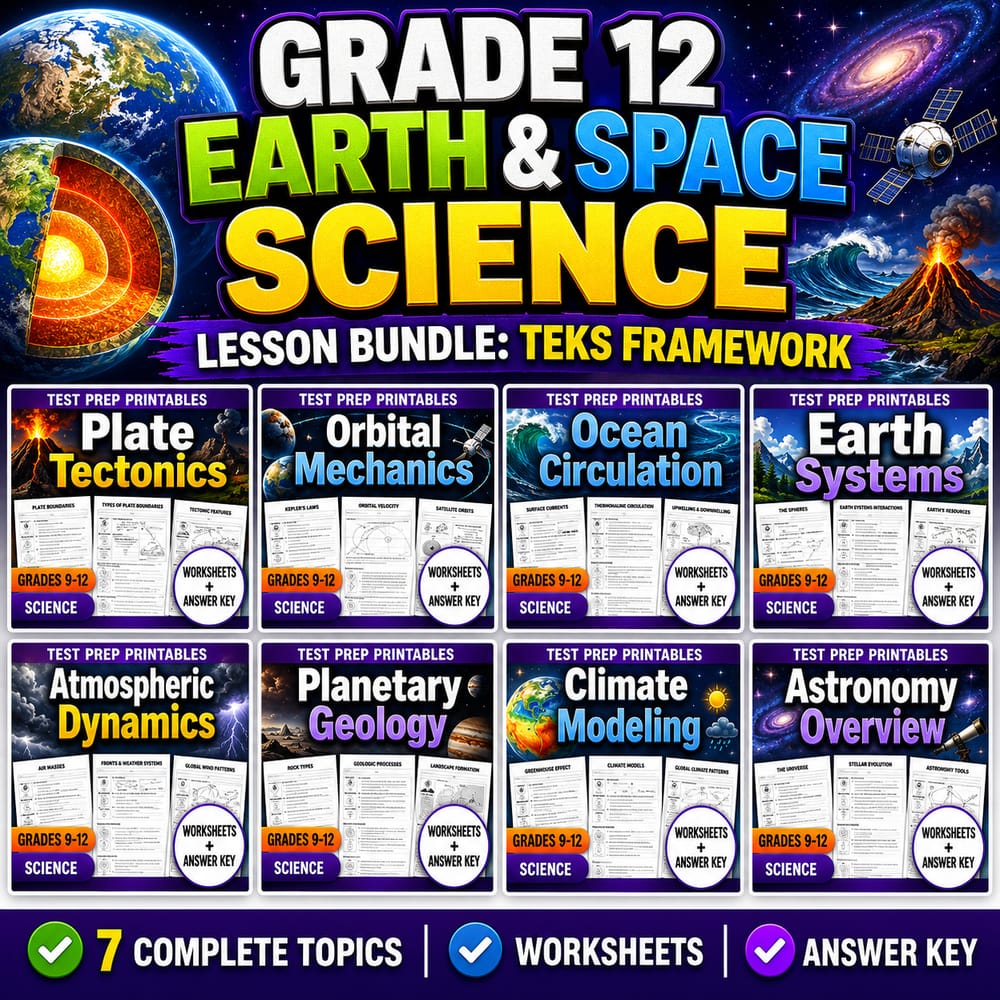
Grade 12 Earth & Space Science Lesson Bundle: TEKS Framework
$32.00$40.00Save $8.00
Prism Point Learning
·2 followers·13 sales
SubjectScienceGradeGrade 12
What’s included
8 worksheets · Save $8.00 (20%) · prices shown inside the bundle
 Plate Tectonics Worksheet | Grade 12 Science Activities
- Explain how lithospheric plate interactions at divergent, convergent, and transform boundaries produce earthquakes, volcanism, and major mountain building (orogeny).
- Connect evidence from radiometric dating, stratigraphic correlation, and seismic tomography to reconstruct geologic history and rates of crustal change.
- Describe how mantle convection and isostasy influence plate motion and surface geology.
$4.00$5.00 Orbital Mechanics Worksheet | Grade 12 Science Practice TEKS
- Explain how gravity produces Keplerian orbits and how orbital parameters (semimajor axis, eccentricity, inclination) shape motion
- Use conservation of energy and angular momentum to interpret escape velocity and changes in orbital energy
- Describe how perturbations, tides, and resonances alter orbital trajectories and long-term evolution
$4.00$5.00 Ocean Circulation Worksheet | Grade 12 Science Activities
- Explain how thermohaline circulation and wind-driven circulation move heat and nutrients in the ocean.
- Describe how salinity, density stratification, and mixing processes influence biogeochemical cycling and carbon sequestration.
- Connect ocean circulation and tracer observations to regional climate modulation and episodic events such as ENSO.
$4.00$5.00 Earth Systems Worksheet | Grade 12 Science Practice TEKS Standards
- Explain how energy transfer and matter cycling connect the atmosphere, hydrosphere, lithosphere, and cryosphere.
- Interpret radiative balance and albedo effects to predict how changes in Earth’s surface alter climate.
- Analyze hydrologic cycle processes and ocean–atmosphere coupling as mechanisms that drive climate variability and steady states.
$4.00$5.00 Atmospheric Dynamics Worksheet | Grade 12 Science Practice
- Explain how atmospheric composition, pressure gradients, and thermal structure drive large-scale circulation patterns.
- Use the Coriolis force and cell/jet/frontal concepts (Hadley and Ferrel cells, jet streams, fronts) to interpret weather regimes.
- Connect atmospheric stability, lapse rates, and radiative heating to short-term variability and longer-term climate patterns.
$4.00$5.00 Planetary Geology Worksheet | Grade 12 Science Practice
- Compare how impact processes and endogenic activity shape the surfaces of terrestrial planets and icy bodies.
- Explain how internal structure and thermal evolution are inferred from cratering, volcanic, tectonic, and erosion evidence.
- Interpret remote sensing and in situ observations as data used to reconstruct planetary geologic histories.
$4.00$5.00 Climate Modeling Worksheet | Grade 12 Science Practice with TEKS
- Explain how different climate models represent energy flow, radiation, convection, and circulation in planetary atmospheres.
- Interpret how parameterizations (e.g., radiative transfer, clouds, and ocean–atmosphere coupling) affect model outputs.
- Evaluate how model validation uses paleoclimate proxies, instrumental records, and sensitivity experiments to estimate uncertainty in projections.
$4.00$5.00 Astronomy Overview Worksheet | Grade 12 Science Practice
- Explain how protoplanetary disks and accretion contribute to Solar System formation.
- Describe how planetary differentiation and comparative planetology help interpret composition and atmospheres.
- Connect observational evidence (spectroscopy, orbital parameters, and samples) to solar nebula models and planetary diversity.
$4.00$5.00
Reviews & Feedback
Loading reviews...
Questions & Answers
Loading questions…
About this bundle
Related categories
Frequently asked questions
Who is Grade 12 Earth & Space Science Lesson Bundle: TEKS Framework designed for?
Grade 12 Earth & Space Science Lesson Bundle: TEKS Framework is designed for Grade 12 students and Science learners and can be used in classrooms, homeschool, or independent practice.
How do I download Grade 12 Earth & Space Science Lesson Bundle: TEKS Framework?
Add it to your cart and complete checkout. After payment, you can download immediately from your account, and you'll also receive a download link by email.
Similar Products

Grade 12 Science Lesson Bundle: Space, Earth Systems, and Climate (General)
$16.00$20.00

Grade 11 Space & Earth Systems Science Daily Reading Lesson Bundle | General
$22.40$28.00

Grade 7 Science Space, Gravity, and Earth History Lesson Bundle | NGSS
$16.00$20.00

Grade 7 Space, Gravity & Earth Processes Science Lesson Bundle (NGSS)
$12.80$16.00

Grade 8 Earth and Space Science Daily Reading Worksheets Bundle | TEKS
$36.00$45.00