
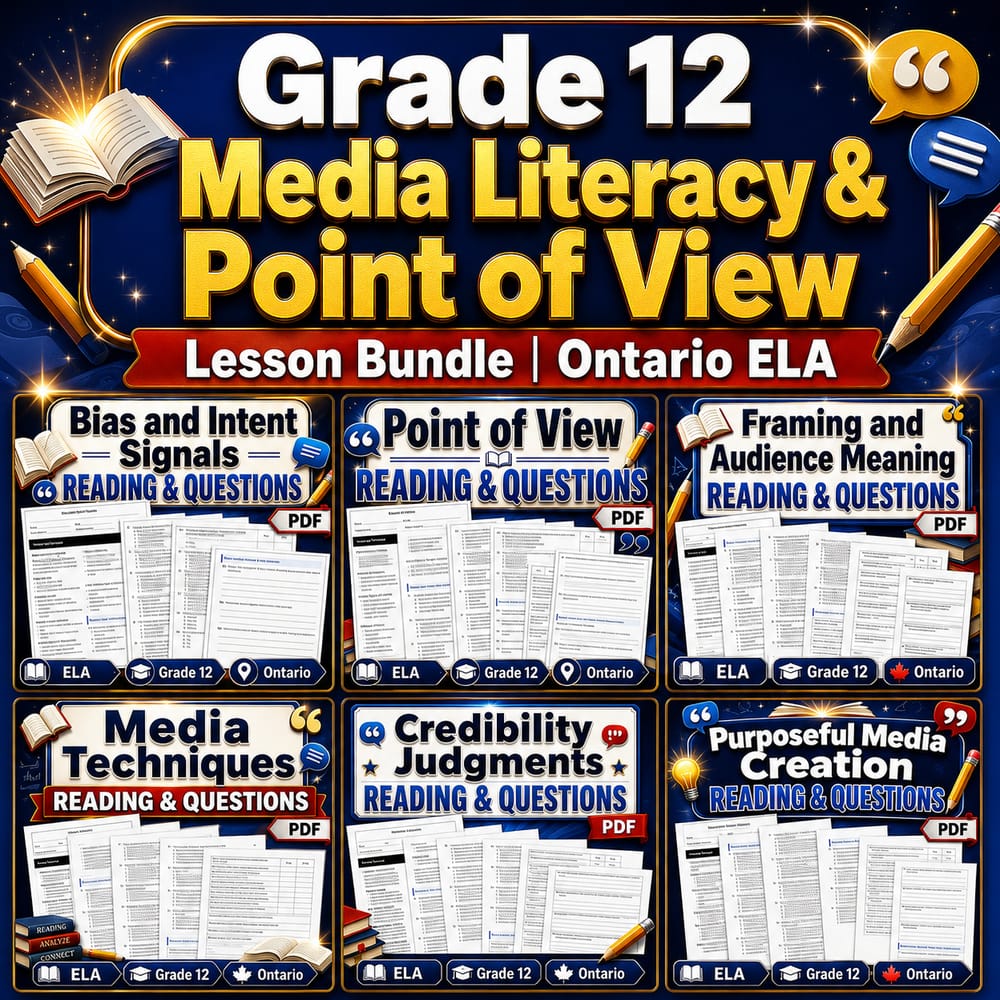
Grade 12 Media Literacy & Point of View Lesson Bundle | Ontario ELA
$19.20$24.00Save $4.80
Golden Apple Studio
New·2 followers·3 sales
SubjectELAGradeGrade 12Pages96 Pages
What’s included
6 worksheets · 96 pages · Save $4.80 (20%) · prices shown inside the bundle
 Bias and Intent Signals Worksheet Grade 12 ELA Ontario Answer Key
- Identify bias patterns in persuasive writing, including loaded language, selective imagery, missing counter-evidence, and inconsistent attribution.
- Evaluate how intent signals may persist across a message even when some facts are accurate.
- Use triangulation by comparing different types of evidence within the same text to determine whether it fairly represents competing perspectives.
$3.20$4.00 Grade 12 Point of View Worksheet | Ontario ELA Literary Analysis
- Analyze how narrative perspective affects what information readers and audiences treat as legitimate or credible.
- Evaluate how emphasis, framing, and omission influence conclusions drawn from media (stories, videos, posts, and news).
- Revise a claim by identifying whose voices are centered and whose experiences are excluded.
$3.20$4.00 Framing and Audience Meaning Worksheet Grade 12 ELA Ontario Media Literacy
- Analyze how framing choices in media influence audience interpretation, including implied certainty, stakes, and responsibility.
- Evaluate how headline wording, on-screen text, and visual composition work together to shape cause-and-effect meaning.
- Revise a brief news or documentary-style message to either strengthen or reduce implied conclusions while keeping underlying facts consistent.
$3.20$4.00 Media Techniques Worksheet Grade 12 ELA Ontario Media Literacy
- Identify observable media techniques (word choice, visuals, music, pacing, framing) and describe how they shape a message’s meaning.
- Analyze how repetition, emotional appeal, and selective presentation influence tone, urgency, and implied values.
- Use evidence from an advertisement or news clip to support claims about the creator’s intended interpretation.
$3.20$4.00 Grade 12 Credibility Judgments Worksheet | Ontario ELA Media Literacy
- Evaluate media claims by analyzing evidence quality, sourcing, and context.
- Compare how informational reporting and persuasive messaging use details to shape interpretation.
- Assess credibility by checking alignment across text, visuals, data, and omitted information.
$3.20$4.00 Purposeful Media Creation Worksheet Grade 12 ELA Ontario Answer Key
- Analyze how framing, tone, and sourcing choices shape an audience’s interpretation and perceived credibility.
- Identify common forms of bias (emphasis and omission) in short informational media.
- Design a brief caption or post that matches a clear purpose while using ethical sourcing.
$3.20$4.00
Reviews & Feedback
Loading reviews...
Questions & Answers
Loading questions…
About this bundle
Related categories
Frequently asked questions
Who is Grade 12 Media Literacy & Point of View Lesson Bundle | Ontario ELA designed for?
Grade 12 Media Literacy & Point of View Lesson Bundle | Ontario ELA is designed for Grade 12 students and ELA learners and can be used in classrooms, homeschool, or independent practice.
How do I download Grade 12 Media Literacy & Point of View Lesson Bundle | Ontario ELA?
Add it to your cart and complete checkout. After payment, you can download immediately from your account, and you'll also receive a download link by email.
Similar Products

Grade 12 ELA Media Literacy Worksheets | Ontario Media Literacy
$14.40$18.00

Grade 4 Media Literacy Lesson Bundle | Ontario ELA Worksheets
$12.00$15.00

Grade 12 Media & Point of View ELA Lesson Bundle - Common Core (CCSS)
$12.00$15.00

Grade 12 ELA Daily Reading & Literary Media Literacy Lesson Bundle | Ontario
$112.00$160.00

Grade 6 ELA Media Literacy Worksheets | Framing & Bias | Ontario
$12.00$15.00