
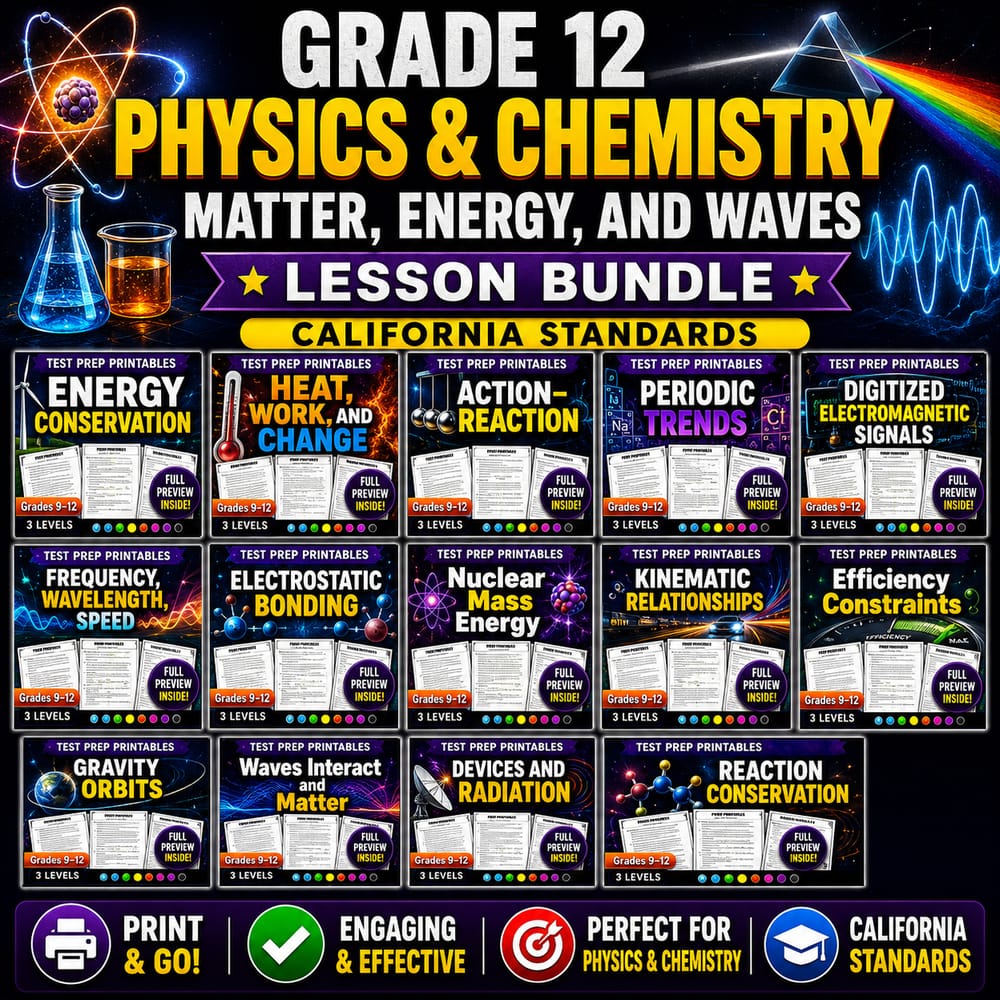


Grade 12 Physics & Chemistry Matter, Energy, and Waves Lesson Bundle | California Standards
$56.00$70.00Save $14.00
Prism Point Learning
·2 followers·14 sales
SubjectScienceGradeGrade 12
What’s included
14 worksheets · Save $14.00 (20%) · prices shown inside the bundle
 Energy Conservation Worksheet | Grade 12 Science Activity & Review
- Explain how total energy in a closed system stays conserved while energy changes forms.
- Differentiate heat transfer and work as two mechanisms for energy exchange.
- Use energy-before-and-after reasoning to predict temperature and motion changes in real interactions.
$4.00$5.00 Grade 12 Heat, Work, and Energy Change Worksheet | California Science
- Explain how heat and work transfer energy to a system and how each process affects internal energy
- Use thermodynamic ideas to predict changes in temperature, expansion, or phase state under different conditions
- Apply quantitative energy accounting concepts to reason about energy changes during heat/work interactions
$4.00$5.00 Action Reaction Worksheet | Newton’s Third Law Science Activity Grade 12
- Explain Newton’s third law by identifying force pairs that act on different objects.
- Use action–reaction force ideas to predict changes in momentum during collisions.
- Relate acceleration, force, and mass to compare how two interacting objects move differently.
$4.00$5.00 Grade 12 Chemistry Periodic Trends Worksheet | Atomic Properties
- Explain how electron structure (valence electrons, shielding, and energy levels) drives periodic trends across periods and down groups.
- Predict and justify changes in atomic radius, ionization energy, and electronegativity using periodic table patterns.
- Connect periodic trends to likely ionic charge formation for representative elements.
$4.00$5.00 Digitized Electromagnetic Signals Worksheet | Grade 12 Physics Activity
- Explain how digitization encodes information into electromagnetic signals using controlled signal variations
- Describe how electromagnetic waves carry energy through space while the data can be recovered from measurable signal properties
- Use evidence-based reasoning to connect frequency content and signal propagation to communication performance
$4.00$5.00 Frequency Wavelength Speed Worksheet | Grade 12 Wave Physics Activity
- Use the wave equation v = fλ to relate frequency, wavelength, and wave speed.
- Explain how changes in frequency affect wavelength when wave speed stays constant.
- Apply wave relationships to interpret electromagnetic spectrum examples.
$4.00$5.00 Electrostatic Bonding Worksheet | Chemical Bonding Science Activity
- Explain how Coulombic attraction and repulsion between charged particles lead to stable structures
- Describe how electron distribution affects bonding and material properties
- Connect electrostatic forces to conductivity, solubility, and melting behavior in different substances
$4.00$5.00 Nuclear Mass Energy Worksheet Grade 12 Physics | E=mc² Practice
- Explain how mass defect in nuclear reactions relates to energy released or absorbed.
- Use conservation of mass/energy and particle counts to describe nuclear decay and nuclear reactions.
- Interpret binding energy and radiation energy as evidence of changes in nuclear structure.
$4.00$5.00 Kinematic Relationships Worksheet Grade 12 Physics Motion Practice
- Use constant-acceleration kinematic equations to relate position, velocity, and time.
- Interpret changes in motion using velocity–time and position–time graphs.
- Connect initial conditions to how trajectories evolve in uniform acceleration.
$4.00$5.00 Efficiency and Constraints Worksheet | Grade 12 Science Activity
- Explain energy efficiency using the idea of useful output energy versus total input energy.
- Identify common energy losses and describe how they limit performance in real devices.
- Use energy-flow models to reason about why no process can convert all input energy into useful work.
$4.00$5.00
Reviews & Feedback
Loading reviews...
Questions & Answers
Loading questions…
About this bundle
Related categories
Frequently asked questions
Who is Grade 12 Physics & Chemistry Matter, Energy, and Waves Lesson Bundle | California Standards designed for?
Grade 12 Physics & Chemistry Matter, Energy, and Waves Lesson Bundle | California Standards is designed for Grade 12 students and Science learners and can be used in classrooms, homeschool, or independent practice.
How do I download Grade 12 Physics & Chemistry Matter, Energy, and Waves Lesson Bundle | California Standards?
Add it to your cart and complete checkout. After payment, you can download immediately from your account, and you'll also receive a download link by email.
Similar Products

Grade 12 Science Lesson Group | Physics, Energy, Waves & Electromagnetism
$36.00$45.00

Grade 7 Physical Science Worksheets Bundle | Energy, Waves & Motion
$24.00$30.00

Grade 5 Science Lesson Bundle | Energy, Matter, Motion, and Electricity
$24.00$30.00

Grade 11 Science Cross-Discipline Models of Energy, Matter & Force Lesson
$48.00$60.00

Grade 12 Physics Energy & Fields Science Lesson Bundle: Daily Reading | BC
$48.00$60.00