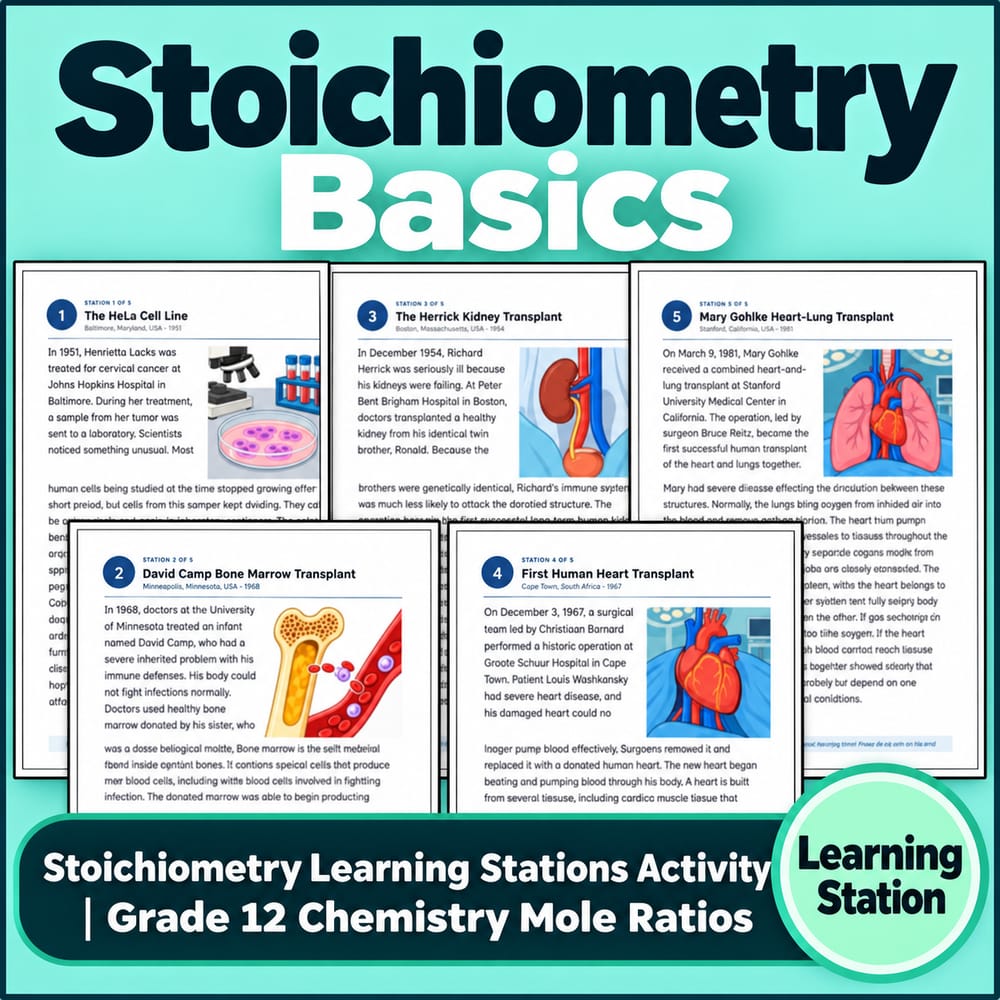
Grade 12 Science Chemistry 30 Learning Stations Bundle | 75 Stations — bundle cover
Grade 12 Science Chemistry 30 Learning Stations Bundle | 75 Stations — included worksheet 1
Grade 12 Science Chemistry 30 Learning Stations Bundle | 75 Stations — included worksheet 2
Grade 12 Science Chemistry 30 Learning Stations Bundle | 75 Stations — included worksheet 3
Grade 12 Science Chemistry 30 Learning Stations Bundle | 75 Stations — included worksheet 4
Grade 12 Science Chemistry 30 Learning Stations Bundle | 75 Stations — included worksheet 5
Grade 12 Science Chemistry 30 Learning Stations Bundle | 75 Stations — included worksheet 6
Grade 12 Science Chemistry 30 Learning Stations Bundle | 75 Stations — included worksheet 7
Grade 12 Science Chemistry 30 Learning Stations Bundle | 75 Stations — included worksheet 8
Grade 12 Science Chemistry 30 Learning Stations Bundle | 75 Stations — included worksheet 9
Grade 12 Science Chemistry 30 Learning Stations Bundle | 75 Stations — included worksheet 10
Grade 12 Science Chemistry 30 Learning Stations Bundle | 75 Stations — included worksheet 11
Grade 12 Science Chemistry 30 Learning Stations Bundle | 75 Stations — included worksheet 12
Grade 12 Science Chemistry 30 Learning Stations Bundle | 75 Stations — included worksheet 13
Grade 12 Science Chemistry 30 Learning Stations Bundle | 75 Stations — included worksheet 14
Grade 12 Science Chemistry 30 Learning Stations Bundle | 75 Stations — included worksheet 15
Grade 12 Science worksheet — Grade 12 Science Chemistry 30 Learning Stations Bundle | 75 Stations

Description

These Grade 12 Chemistry 30 learning stations bring together 15 chemistry activities with 75 stations in total, giving Alberta science teachers ready-to-use topics for small-group rotations and lesson review. Each activity contains five stations focused on a specific chemistry concept, so you can select the material your class needs without searching for separate resources.

🧪 What's Included

The 15 Grade 12 chemistry learning stations activities are organised around five connected areas of chemistry.

Atomic Structure and Periodic Properties
• Atomic models — examine how scientific explanations of atomic structure developed.
• Atomic spectra — explore the relationship between atomic structure and spectral evidence.
• Electron configuration — investigate electron arrangements in atoms.
• Periodic trends — compare patterns in elemental properties.

Chemical Bonding and Structure
• Chemical bond types — distinguish between different forms of chemical bonding.
• Bond polarity — investigate how electrons are shared in chemical bonds.
• Molecular geometry — examine molecular shapes and their relationship to bonding.
• Solids and crystal lattices — explore the arrangement of particles in solid structures.

Chemical Reactions and Calculations
• Stoichiometry — work with mole ratios and chemical quantities.
• Limiting reagents — determine which reactant restricts product formation.
• Reaction types — identify and compare different chemical reactions.

Reaction Behaviour and Energy
• Reaction rates — investigate factors affecting reaction speed.
• Enthalpy changes — examine energy changes during chemical reactions.
• Chemical equilibrium — explore reversible reactions and equilibrium conditions.

Oxidation and Reduction
• Redox reactions — examine oxidation, reduction and electron transfer.

📚 Topics Covered

• Atomic theory, atomic spectra and electron configurations
• Periodic trends and chemical properties
• Ionic and covalent bonding, bond polarity and molecular shapes
• Crystal lattices and solid structures
• Stoichiometric mole ratios and limiting reagent calculations
• Chemical reaction classification and redox processes
• Reaction rates, enthalpy changes and chemical equilibrium

👩‍🏫 How Teachers Can Use It

Set up five stations around the classroom and have small groups rotate through a selected chemistry topic. The format works well when students need to discuss ideas, compare approaches or revisit calculations before moving into another lesson.

You can also pull out an individual five-station activity for unit revision or use different topics at separate points in your Chemistry 30 teaching sequence. Keeping atomic structure, bonding, reactions and equilibrium resources together makes it easier to return to earlier concepts when needed.

💰 Bundle Savings

The complete set of 15 Grade 12 Chemistry 30 learning stations activities costs $48, compared with $60 when purchased separately. That's a $12 saving (20%) for all 75 stations.

With the related chemistry topics in one bundle, you can choose the five-station set that matches your next lesson or review session.

Grade 12 Science Chemistry 30 Learning Stations Bundle | 75 Stations

$48.00$60.00Save $12.00
MTS Academic Studio
New·0 followers·1 sales
SubjectScienceGradeGrade 12Pages189 PagesSubject areaChemistry, Physical ScienceStandardsAligned to Alberta curriculumAnswer keyIncluded
Learning Objectives
Compare atomic models, electron configurations and periodic trends.
Identify chemical bond types and explain molecular geometry.
Calculate mole ratios and determine limiting reagents in reactions.

What’s included

15 worksheets · 189 pages · Save $12.00 (20%) · prices shown inside the bundle

  1. Chemical Equilibrium Learning Stations Activity | Grade 12 Chemistry 30
    Chemical Equilibrium Learning Stations Activity | Grade 12 Chemistry 30

    Grade 12 · Science · 13 Pages

    • Analyze reversible reactions in documented industrial and environmental applications.
    • Apply equilibrium expressions to real-world chemical systems.
    • Predict equilibrium shifts using Le Chatelier's principle.
    $3.20$4.00
  2. Solids and Crystal Lattices Learning Stations Activity | Grade 12 Chemistry
    Solids and Crystal Lattices Learning Stations Activity | Grade 12 Chemistry

    Grade 12 · Science · 13 Pages

    • Identify ionic, metallic, covalent network, and semiconductor crystal structures.
    • Compare bonding arrangements in different types of crystalline solids.
    • Explain how atomic arrangement influences electrical conductivity.
    $3.20$4.00
  3. Molecular Geometry Learning Stations Activity | Grade 12 Chemistry
    Molecular Geometry Learning Stations Activity | Grade 12 Chemistry

    Grade 12 · Science · 13 Pages

    • Explain molecular shapes using VSEPR theory and electron-domain geometry.
    • Interpret bond angles from three-dimensional molecular arrangements.
    • Explain relationships between molecular geometry and polarity.
    $3.20$4.00
  4. Reaction Rates Learning Stations Activity | Grade 12 Chemistry 30
    Reaction Rates Learning Stations Activity | Grade 12 Chemistry 30

    Grade 12 · Science · 13 Pages

    • Explain temperature effects on reaction rates using collision theory.
    • Analyze how reactant concentration influences collision frequency.
    • Explain how surface area changes reaction speed.
    $3.20$4.00
  5. Chemical Reaction Types Learning Stations Activity | Grade 12 Chemistry
    Chemical Reaction Types Learning Stations Activity | Grade 12 Chemistry

    Grade 12 · Science · 12 Pages

    • Classify chemical reactions using reactants and products.
    • Interpret balanced equations to identify chemical reaction patterns.
    • Identify evidence that indicates a chemical change has occurred.
    $3.20$4.00
  6. Limiting Reagent Learning Stations Activity | Grade 12 Chemistry
    Limiting Reagent Learning Stations Activity | Grade 12 Chemistry

    Grade 12 · Science · 13 Pages

    • Identify limiting reactants using balanced equations and reactant quantities.
    • Determine excess reactants from stoichiometric relationships.
    • Explain how reactant ratios constrain theoretical product yield.
    $3.20$4.00
  7. Chemical Bond Types Learning Stations Activity | Grade 12 Chemistry
    Chemical Bond Types Learning Stations Activity | Grade 12 Chemistry

    Grade 12 · Science · 12 Pages

    • Identify ionic, covalent, and metallic bonding from electron behavior.
    • Explain how bonding structures influence melting points.
    • Compare electrical conductivity across different bonding types.
    $3.20$4.00
  8. Stoichiometry Learning Stations Activity | Grade 12 Chemistry Mole Ratios
    Stoichiometry Learning Stations Activity | Grade 12 Chemistry Mole Ratios

    Grade 12 · Science · 11 Pages

    • Interpret mole ratios from balanced chemical equations.
    • Calculate reactant and product quantities using stoichiometric relationships.
    • Convert between mass and moles using molar mass.
    $3.20$4.00
  9. Redox Reactions Learning Stations Activity | Grade 12 Chemistry 30
    Redox Reactions Learning Stations Activity | Grade 12 Chemistry 30

    Grade 12 · Science · 12 Pages

    • Identify oxidation and reduction through changes in oxidation states.
    • Analyze electron transfer in industrial and environmental redox processes.
    • Interpret oxidation and reduction half-reactions in chemical processes.
    $3.20$4.00
  10. Atomic Spectra Learning Stations Activity – Grade 12 Chemistry 30
    Atomic Spectra Learning Stations Activity – Grade 12 Chemistry 30

    Grade 12 · Science · 13 Pages

    • Explain how quantized electronic transitions produce characteristic spectral lines
    • Distinguish emission spectra from absorption spectra
    • Interpret relationships between photon energy and wavelength
    $3.20$4.00

Reviews & Feedback

Loading reviews...

Questions & Answers

Loading questions…

About this bundle

Related categories

Frequently asked questions

Who is Grade 12 Science Chemistry 30 Learning Stations Bundle | 75 Stations designed for?
Grade 12 Science Chemistry 30 Learning Stations Bundle | 75 Stations is designed for Grade 12 students and Science learners and can be used in classrooms, homeschool, or independent practice.
How do I download Grade 12 Science Chemistry 30 Learning Stations Bundle | 75 Stations?
Add it to your cart and complete checkout. After payment, you can download immediately from your account, and you'll also receive a download link by email.