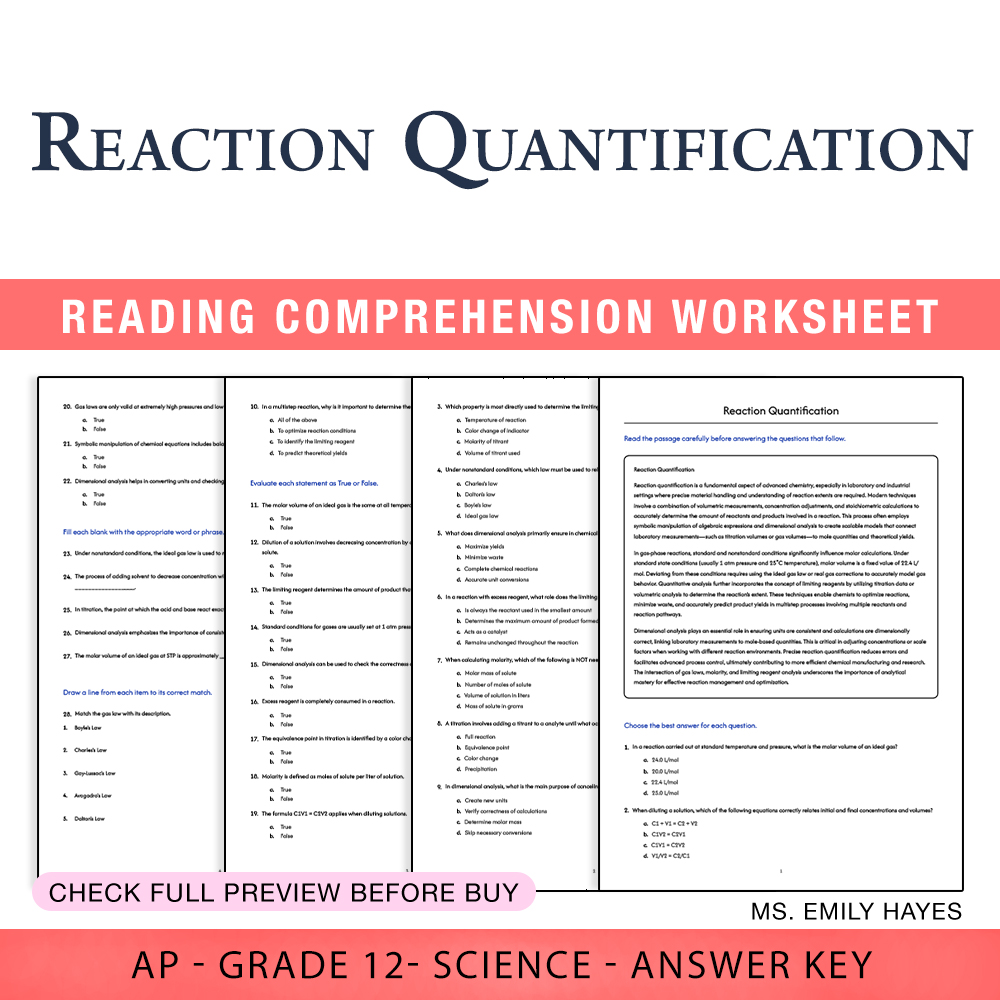
Are you seeking a comprehensive, print-ready resource to enhance your Grade 12 Science classroom and deepen students' understanding of complex reaction quantification concepts? This Reaction Quantification worksheet assessment addresses a common challenge teachers face—building student mastery in advanced chemistry concepts through engaging, practical assessments. Designed specifically for classroom use, this PDF worksheet and answer key with rubric provide an effective solution for evaluating student comprehension, fostering critical thinking, and encouraging mastery of essential skills aligned with the AP Science framework. Perfect for in-class practice, homework, or review sessions, this resource helps teachers save time while delivering a high-quality, standards-aligned assessment experience.
Why Teachers Love This ✅ Easy to implement with a print-ready, high-quality PDF format that requires no setup
✅ Designed specifically for Grade 12 AP science classrooms, focusing on reaction quantification — a key topic for success in advanced chemistry
✅ Covers multiple question formats, including reading passages, multiple choice, true/false, fill-in-the-blank, matching, and short answer to diversify assessment methods
✅ Clearly structured to assess both conceptual understanding and practical skills, ensuring students grasp vital lab and theoretical concepts
✅ Includes a detailed answer key with rubric for objective grading, saving teachers time and effort in assessment evaluation
✅ Aligns with curriculum frameworks, reinforcing essential standards and fostering long-term comprehension
Why Students Succeed With This ✅ Offers engaging, varied question formats that cater to different learning styles and reinforce key concepts
✅ Provides immediate opportunities for critical thinking and application of theoretical knowledge
✅ Uses real-world examples of reaction quantification and gas laws, increasing relevance and motivation
✅ Builds confidence through scaffolded questions that progressively increase in difficulty
✅ Prepares students for high-stakes exam questions with thoughtfully designed tasks and comprehensive assessments
✅ Encourages mastery of essential topics such as molar volume, solution dilution, gas laws, and limiting reagents, which are critical in AP chemistry and beyond
What You Get Complete, print-ready PDF worksheet and answer key with rubric including:
• A detailed reading passage explaining reaction quantification and laboratory applications
• Ten multiple-choice questions testing key concepts like molar volume and solution dilution
• Twelve true/false questions to assess foundational gas law principles
• Five fill-in-the-blank prompts related to gas laws and solution concentration
• A matching exercise pairing gas laws with their descriptions for active engagement
• Five short-answer questions that promote critical thinking, including dimensional analysis and limiting reagent explanations
• Two essay questions challenging students to analyze combined volumetric and symbolic methods and the integration of gas law adjustments in reaction analysis
Key Learning Objectives Students will master these core skills:
➡️ Understanding and applying reaction quantification methods
➡️ Calculating molar volumes of gases under standard and nonstandard conditions
➡️ Using the ideal gas law and related formulas to solve real-world problems
➡️ Analyzing solution dilutions and solution concentrations
➡️ Matching gas laws with their descriptions and understanding their applications in experiments
➡️ Applying dimensional analysis and limiting reagent calculations to predict reaction yields
Ideal Usage This worksheet assessment is perfect for classroom practice, homework assignments, and review sessions in advanced placement chemistry courses. It can be used as a comprehensive formative assessment or as a preparation tool for upcoming exams. Its print-ready PDF format makes it suitable for whole-class, small-group, or independent learning activities. Incorporate it into lesson plans focused on laboratory techniques, theoretical calculations, or conceptual understanding of chemical reactions and gas laws to reinforce student learning and success 🚀