
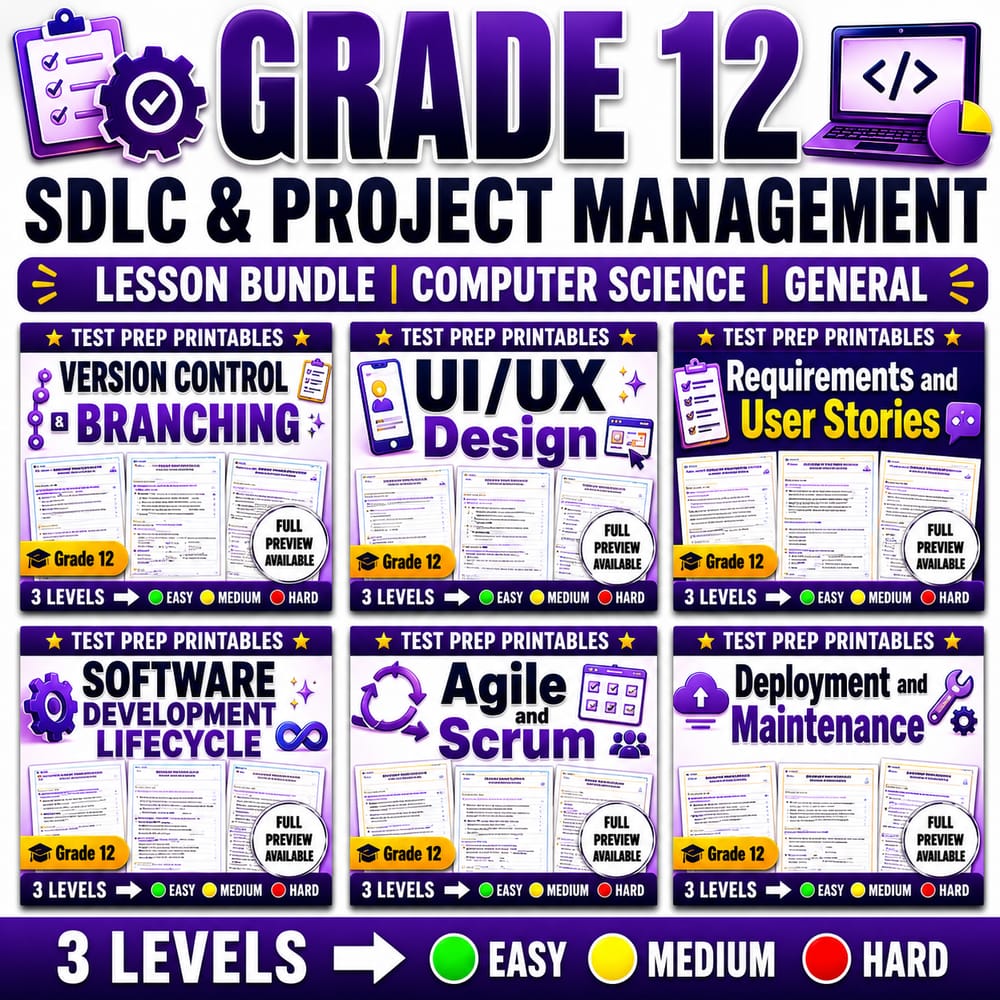
Grade 12 SDLC & Project Management Lesson Bundle | Computer Science General
$24.00$30.00Save $6.00
Prism Point Learning
·2 followers·13 sales
SubjectComputer ScienceGradeGrade 12Pages183 Pages
What’s included
6 worksheets · 183 pages · Save $6.00 (20%) · prices shown inside the bundle
 Version Control and Branching Worksheet Grade 12 Computer Science
- Explain how version control helps teams track changes and collaborate safely.
- Describe the roles of commits, branches, and merges in the development workflow.
- Evaluate scenarios to determine why version history matters and how overwriting is avoided.
$4.00$5.00 UI/UX Design Worksheet: Accessibility, Usability & User Experience
- Explain how UI elements (menus, buttons, forms, and displays) help users complete tasks efficiently.
- Evaluate an interface using usability principles such as clarity, accessibility, and feedback.
- Identify design choices that reduce errors, confusion, and cognitive load.
$4.00$5.00 Requirements and User Stories Worksheet | Grade 12 Computer Science
- Distinguish functional requirements from non-functional requirements
- Explain how user stories capture user needs and acceptance criteria
- Write clear user-centered scenarios to reduce ambiguity in development
$4.00$5.00 Software Development Lifecycle SDLC Checkpoint Worksheet Grade 12 CS
- Identify the correct order of stages in the Software Development Lifecycle (planning, designing, building, testing, deploying, maintaining).
- Explain how testing and maintenance reduce risks after a new release.
- Apply SDLC stage vocabulary to scenarios involving apps, websites, and games.
$4.00$5.00 Agile and Scrum Worksheet: Sprints, Iterations & Project Management
- Explain how agile development uses iterations to improve work quickly through feedback
- Describe how Scrum roles, sprints, and check-ins help teams adapt to changing requirements
- Compare agile planning with more traditional planning approaches when requirements evolve
$4.00$5.00 Software Deployment and Maintenance Worksheet Grade 12 Computer Science
- Explain the difference between deployment and testing in a software release process.
- Describe how monitoring and feedback support ongoing maintenance after deployment.
- Identify common maintenance activities such as bug fixes and feature improvements.
$4.00$5.00
Reviews & Feedback
Loading reviews...
Questions & Answers
Loading questions…
About this bundle
Related categories
Frequently asked questions
Who is Grade 12 SDLC & Project Management Lesson Bundle | Computer Science General designed for?
Grade 12 SDLC & Project Management Lesson Bundle | Computer Science General is designed for Grade 12 students and Computer Science learners and can be used in classrooms, homeschool, or independent practice.
How do I download Grade 12 SDLC & Project Management Lesson Bundle | Computer Science General?
Add it to your cart and complete checkout. After payment, you can download immediately from your account, and you'll also receive a download link by email.
