
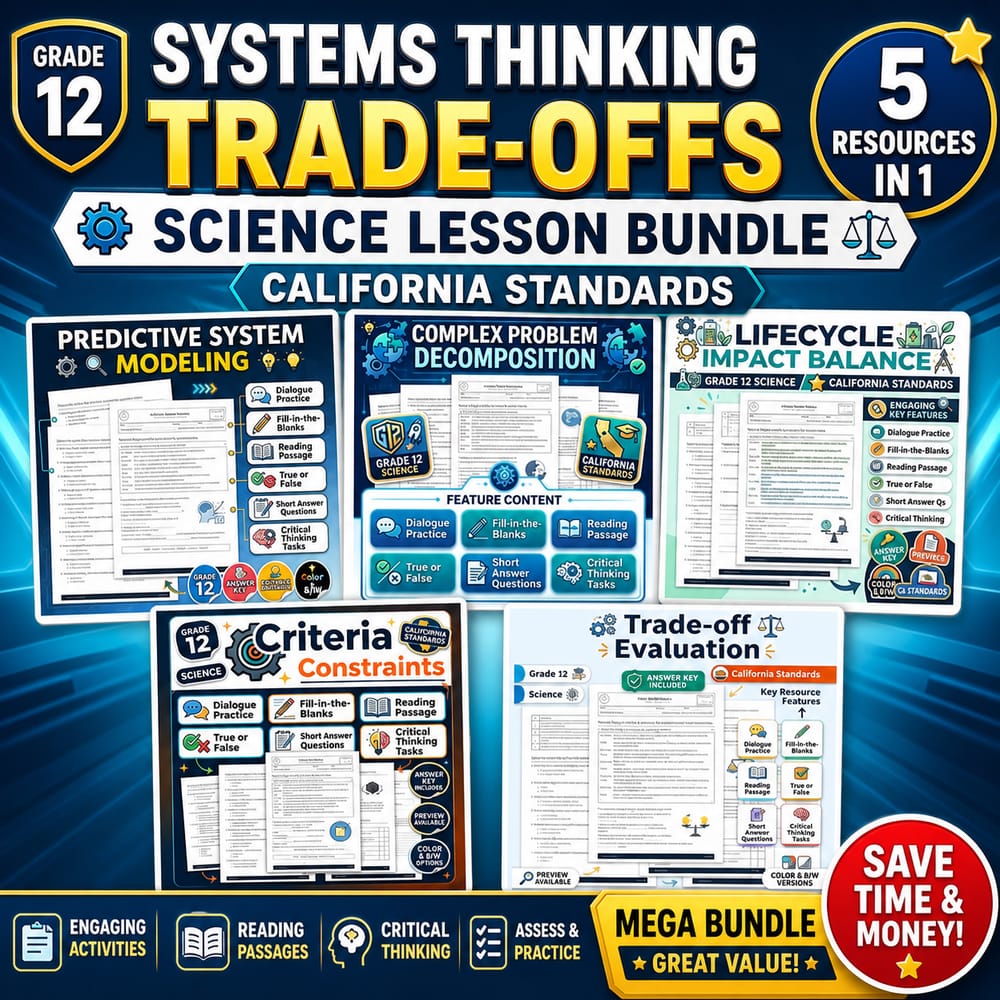
Grade 12 Systems Thinking Trade-Offs Science Lesson Bundle
$20.00$25.00Save $5.00
J.S Sheets
New·3 followers·24 sales
SubjectScienceGradeGrade 12
What’s included
5 worksheets · Save $5.00 (20%) · prices shown inside the bundle
 Predictive System Modeling Worksheet | California Standards Grade 12 Science
- Understand how mathematical and computational models are used to predict system behaviors.
- Identify key principles such as conservation laws, reaction kinetics, and energy transfer in system modeling.
- Analyze the importance of predictions for engineering design, safety, and feasibility assessments.
$4.00$5.00 Complex Problem Decomposition Worksheet | California Standards Grade 12 Science
- Understand how complex real-world problems are broken down into smaller design problems.
- Learn how relationships among subsystems are preserved during decomposition.
- Analyze the connection between top-level criteria and subsystem design choices.
$4.00$5.00 Lifecycle Impact Balance Worksheet | California Standards Grade 12 Science
- Understand how full life cycle evaluation influences technological decision-making in sustainability.
- Analyze scientific mechanisms such as battery chemistry, thermal limits, and recovery efficiency relevant to engineering choices.
- Compare electric vehicle battery management and recycling approaches considering resource extraction, emissions, efficiency, failure risks, and end-of-life recovery.
$4.00$5.00 Criteria Constraints Worksheet | Standards-Aligned Science Practice for Grade 12
- Understand how societal needs are translated into measurable criteria and constraints for engineering solutions.
- Identify key qualitative and quantitative criteria such as cost, safety, energy use, and environmental boundaries.
- Analyze examples of criteria application in real-world engineering challenges like water access during droughts.
$4.00$5.00 Trade-off Evaluation Worksheet | Science Standards Grade 12 Practice
- Understand how to evaluate competing design solutions using prioritized criteria.
- Analyze trade-offs among environmental, economic, and social impacts in system design.
- Apply evidence and data to support claims about performance and unintended consequences.
$4.00$5.00
Reviews & Feedback
Loading reviews...
Questions & Answers
Loading questions…
About this bundle
Related categories
Frequently asked questions
Who is Grade 12 Systems Thinking Trade-Offs Science Lesson Bundle designed for?
Grade 12 Systems Thinking Trade-Offs Science Lesson Bundle is designed for Grade 12 students and Science learners and can be used in classrooms, homeschool, or independent practice.
How do I download Grade 12 Systems Thinking Trade-Offs Science Lesson Bundle ?
Add it to your cart and complete checkout. After payment, you can download immediately from your account, and you'll also receive a download link by email.
Similar Products

Grade 11 System Design & Trade-offs Science Lesson Bundle | General
$19.20$24.00

Grade 11 Science Assessment Lesson Bundle: Systems Trade-offs - General
$24.00$30.00

Grade 10 NGSS Science: Models, Systems, and Trade-Off Design Lesson Bundle
$16.00$20.00

Grade 6 Prototype Design Science Lesson Bundle: General Systems Thinking
$22.40$28.00

Grade 10 Science Cells and Systems Lesson Bundle | Alberta Curriculum
$36.00$45.00