
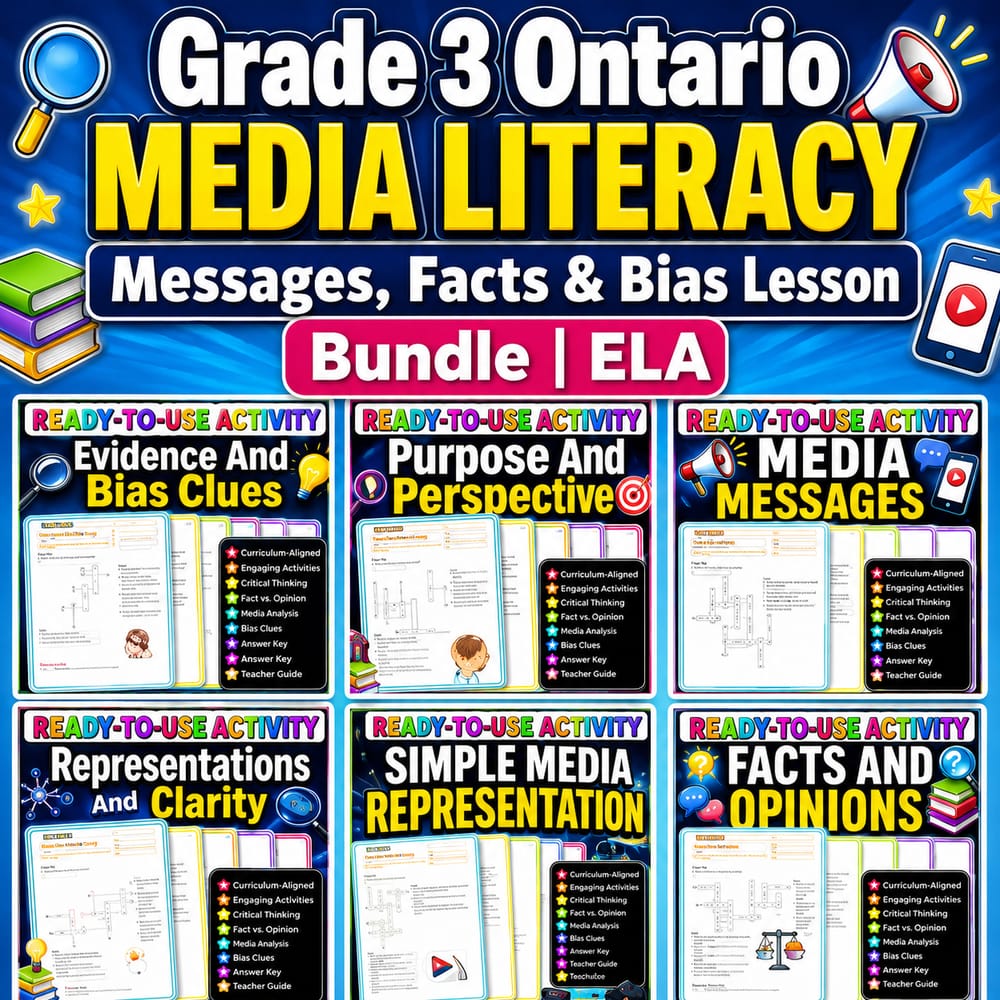
Grade 3 Ontario Media Literacy Messages, Facts & Bias Lesson Bundle | ELA
$12.00$15.00Save $3.00
Sunny Desk Resources
·2 followers·18 sales
SubjectELAGradeGrade 3
What’s included
6 worksheets · Save $3.00 (20%) · prices shown inside the bundle
 Grade 3 Ontario Evidence and Bias Clues Worksheet | ELA Critical Thinking
- Identify evidence and bias clues in short texts and captions.
- Explain how absolute words, loaded adjectives, and one-sided comparisons can signal bias or exaggeration.
- Distinguish between what is known (with reasons, numbers, sources) and how something is described.
$2.40$3.00 Grade 3 Ontario Purpose and Perspective Worksheet | ELA Media Literacy
- Identify how media messages can have a purpose and a perspective.
- Explain how emphasis, missing details, and tone can change meaning.
- Compare two messages about the same topic to determine how framing affects the central message.
$2.40$3.00 Grade 3 Ontario Media Messages Worksheet | ELA Media Literacy Activities
- Explain how media messages use word choice, images, layout, color, sound, and timing to communicate ideas or claims.
- Identify the audience and the central claim in simple media products like posters or toy ads.
- Use text evidence to describe how specific media choices guide attention toward important details.
$2.40$3.00 Grade 3 Ontario ELA Representations With Clarity Worksheet & Teacher Guide
- Explain how consistent point of view helps a poster or slide message make sense.
- Choose relevant images and write clear captions that reduce confusion.
- Distinguish factual claims from opinions by using accurate information and clear labels.
$2.40$3.00 Grade 3 Ontario ELA Simple Media Representation Worksheet with Answer Key
- Identify key features (drawing, photo, caption, and short sequence) that help communicate a clear message in media representation.
- Match a message to the intended topic and audience using plain language and supportive visuals.
- Explain how captions, images, and sequence help an audience understand information.
Free Grade 3 Ontario Facts and Opinions Worksheet | ELA Critical Thinking Skills
- Distinguish between facts and opinions in media and reading passages
- Identify key clue words that signal judgment or personal preference
- Sort statements as verifiable details (facts) or personal beliefs (opinions)
$2.40$3.00
Reviews & Feedback
Loading reviews...
Questions & Answers
Loading questions…
About this bundle
Related categories
Frequently asked questions
Who is Grade 3 Ontario Media Literacy Messages, Facts & Bias Lesson Bundle | ELA designed for?
Grade 3 Ontario Media Literacy Messages, Facts & Bias Lesson Bundle | ELA is designed for Grade 3 students and ELA learners and can be used in classrooms, homeschool, or independent practice.
How do I download Grade 3 Ontario Media Literacy Messages, Facts & Bias Lesson Bundle | ELA?
Add it to your cart and complete checkout. After payment, you can download immediately from your account, and you'll also receive a download link by email.
Similar Products

Grade 12 ELA Media Literacy Worksheets | Ontario Media Literacy
$14.40$18.00

Grade 6 ELA Media Literacy Worksheets | Framing & Bias | Ontario
$12.00$15.00

Grade 12 ELA Daily Reading & Literary Media Literacy Lesson Bundle | Ontario
$112.00$160.00

Grade 7 ELA Media Literacy Worksheets | Persuasive Techniques Ontario
$19.20$24.00

Grade 10 Media Literacy Worksheets Bundle | Ontario ELA Resources
$12.00$15.00