
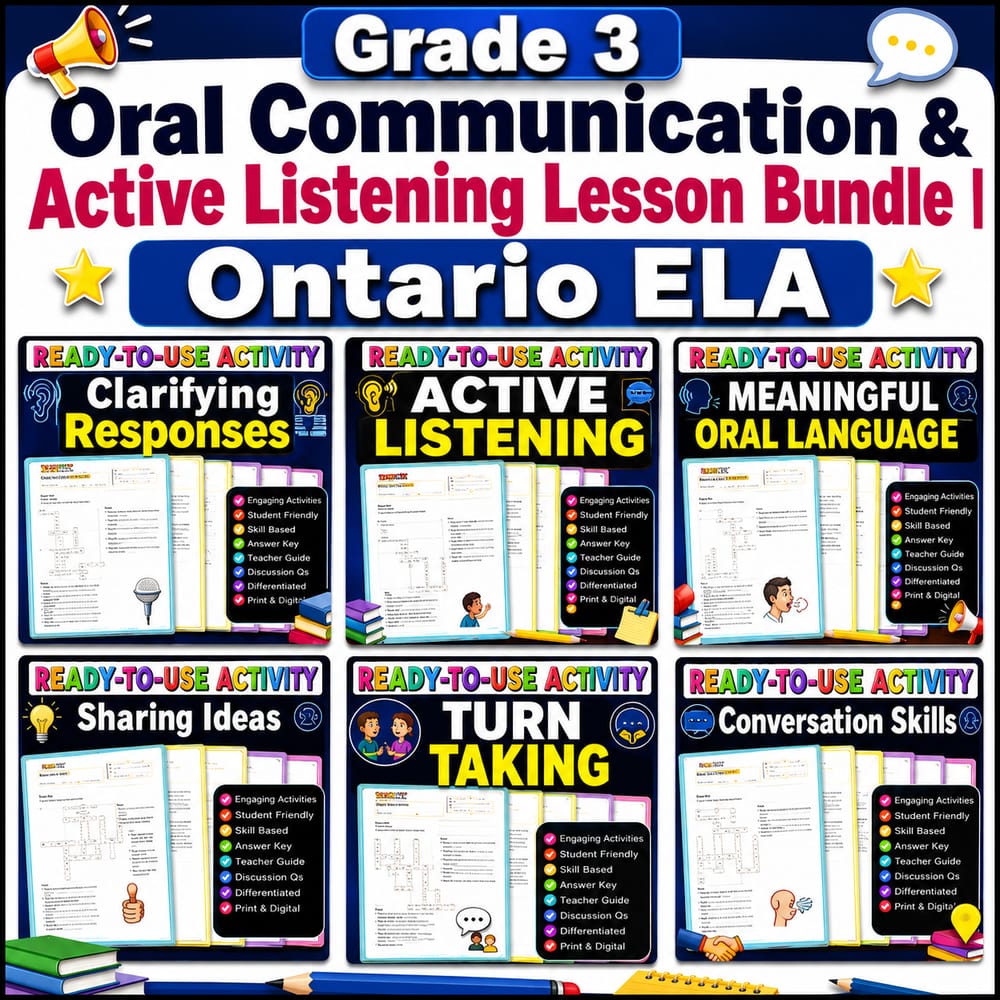
Grade 3 Oral Communication & Active Listening Lesson Bundle | Ontario ELA
$14.40$18.00Save $3.60
Sunny Desk Resources
·2 followers·18 sales
SubjectELAGradeGrade 3Pages66 Pages
What’s included
6 worksheets · 66 pages · Save $3.60 (20%) · prices shown inside the bundle
 Grade 3 ELA Clarifying Responses Worksheet Ontario Oral Skills
- Restate or rephrase key parts of a message when meaning is uncertain
- Ask targeted follow-up questions to get missing or clearer details
- Use brief confirmations to show understanding during discussions
$2.40$3.00 Grade 3 Active Listening ELA Worksheet Ontario Oral Communication
- Explain how listening helps meaning in conversations.
- Identify main ideas and important details when someone is speaking.
- Use active listening responses such as confirming understanding and asking for repetition.
$2.40$3.00 Grade 3 ELA Meaningful Oral Language Worksheet Ontario Skills
- Use precise vocabulary and sentence structure to clearly explain, retell, and describe events.
- Use tone and intonation to show emphasis and help listeners understand meaning.
- Add descriptive details that explain what happened and how it affects others.
$2.40$3.00 Sharing Ideas Grade 3 ELA Oral Communication Worksheet Ontario SEL
- Share ideas clearly by organizing a message with a beginning, middle, and end.
- Use logical order and relevant details when speaking to match a purpose.
- Identify key speaking behaviors such as staying on topic and using complete thoughts.
$2.40$3.00 Turn Taking Grade 3 ELA Social Skills Worksheet Ontario Communication
- Identify how good turn taking helps a conversation stay on topic during group discussion.
- Use listening cues and appropriate pauses to decide when it is your turn to speak.
- Respond respectfully by adding ideas that connect to the current speaker’s message.
$2.40$3.00 Grade 3 Conversation Skills ELA Worksheet Ontario Oral Communication
- Participate in discussions by making relevant comments that connect to the shared topic and to what others have said.
- Use conversation skills such as turn-taking, respectful language, and staying focused on the topic.
- Explain ideas clearly by giving examples and connecting new points to previous ideas.
$2.40$3.00
Reviews & Feedback
Loading reviews...
Questions & Answers
Loading questions…
About this bundle
Related categories
Frequently asked questions
Who is Grade 3 Oral Communication & Active Listening Lesson Bundle | Ontario ELA designed for?
Grade 3 Oral Communication & Active Listening Lesson Bundle | Ontario ELA is designed for Grade 3 students and ELA learners and can be used in classrooms, homeschool, or independent practice.
How do I download Grade 3 Oral Communication & Active Listening Lesson Bundle | Ontario ELA?
Add it to your cart and complete checkout. After payment, you can download immediately from your account, and you'll also receive a download link by email.
Similar Products

Grade 12 Oral Communication Bundle | Ontario Communication Lessons
$19.20$24.00

Grade 4 Ontario ELA Oral Communication & Listening Lesson Bundle
$14.40$18.00

Grade 11 English Oral Communication Ontario ELA Unit Bundle
$16.80$21.00

Grade 7 Oral Communication ELA Daily Reading Lesson Bundle | Ontario
$25.60$32.00

Oral Communication Skills Lesson Bundle | Grade 9 ELA | Ontario
$19.20$24.00