
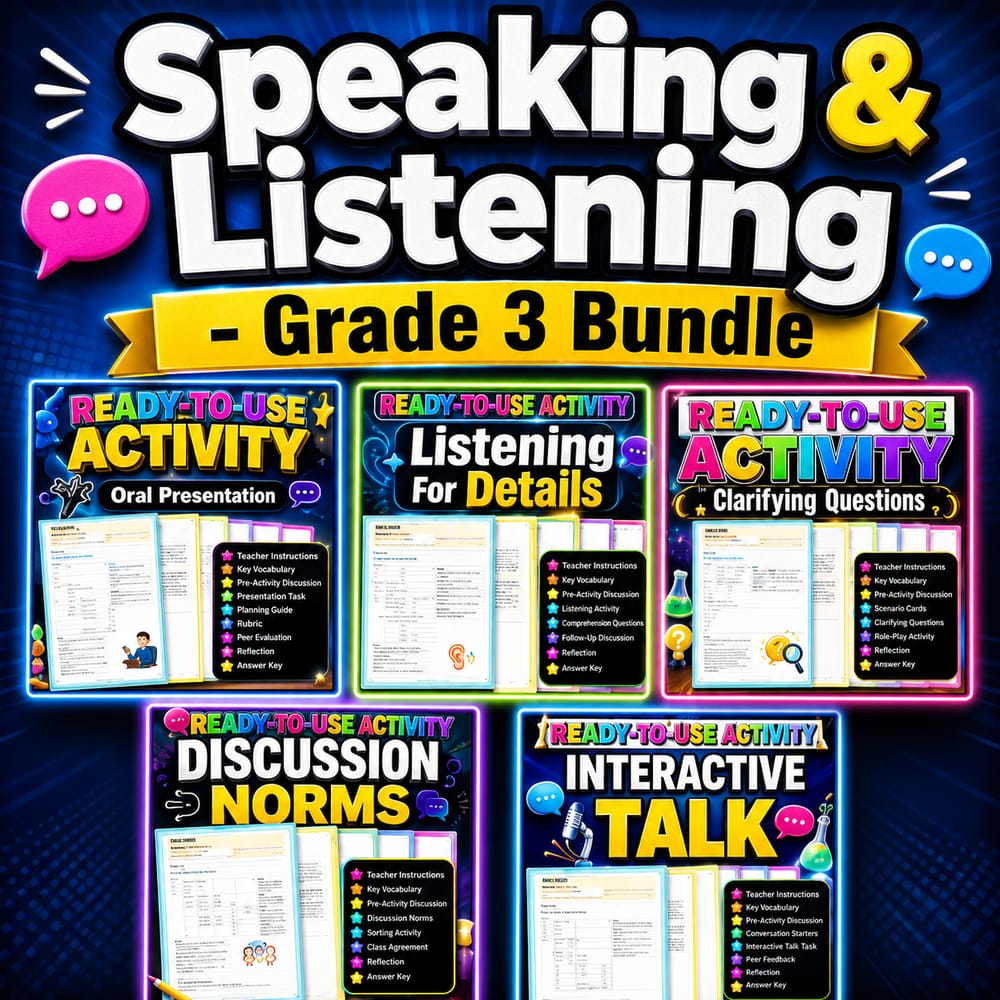
Grade 3 Speaking & Listening Lesson Bundle: ELA General ELA
$12.00$15.00Save $3.00
Sunny Desk Resources
·2 followers·18 sales
SubjectELAGradeGrade 3Pages55 Pages
What’s included
5 worksheets · 55 pages · Save $3.00 (20%) · prices shown inside the bundle
 Oral Presentation Worksheets Grade 3 Speaking Listening ELA Activities
- State a central idea and organize supporting details in a logical sequence.
- Use transitions to connect ideas from one part of an oral presentation to the next.
- Choose relevant facts or examples that match the main claim.
$2.40$3.00 Listening for Details Worksheets Grade 3 ELA Listening Skills Practice
- Identify key facts, reasons, and examples by listening for specific details during discussion.
- Use listening notes to support a claim and answer targeted questions accurately.
- Recognize when another speaker corrects or emphasizes information and record the exact detail.
$2.40$3.00 Clarifying Questions Worksheets Grade 3 Speaking Listening ELA Skills
- Ask clarifying questions that target missing or unclear information
- Use evidence from a text or conversation to answer questions clearly
- Use key question words (who, what, where, when, why, how) to guide follow-up questions
$2.40$3.00 Discussion Norms Posters Worksheets Grade 3 Speaking Listening Rules
- Identify and explain common discussion norms for sharing ideas respectfully
- Use discussion norms to build on others’ ideas during a classroom conversation
- Practice responding using respectful language and staying on the topic
$2.40$3.00 Interactive Talk Activities Grade 3 Speaking Listening ELA Discussion Skills
- Use discussion norms to take turns respectfully during interactive talk.
- Ask clarification questions that connect to specific parts of a presentation.
- Identify how a speaker keeps details consistent to stay on topic.
$2.40$3.00
Reviews & Feedback
Loading reviews...
Questions & Answers
Loading questions…
About this bundle
Related categories
Frequently asked questions
Who is Grade 3 Speaking & Listening Lesson Bundle: ELA General ELA designed for?
Grade 3 Speaking & Listening Lesson Bundle: ELA General ELA is designed for Grade 3 students and ELA learners and can be used in classrooms, homeschool, or independent practice.
How do I download Grade 3 Speaking & Listening Lesson Bundle: ELA General ELA?
Add it to your cart and complete checkout. After payment, you can download immediately from your account, and you'll also receive a download link by email.
Similar Products

Grade 9 Speaking and Listening Lesson Bundle | Alberta ELA
$19.20$24.00

Grade 12 ELA Speaking & Listening Lesson Bundle | TEKS Framework
$16.00$20.00

Grade 6 ELA Speaking & Listening Worksheets Alberta Bundle
$28.00$35.00

Grade 7 Speaking & Listening: Presenting, Claims & Collaboration Lesson Bundle | CCSS ELA
$9.60$12.00

Speaking Listening Grade 8 ELA Daily Reading Worksheets Lesson Bundle | Alberta
$19.20$24.00