
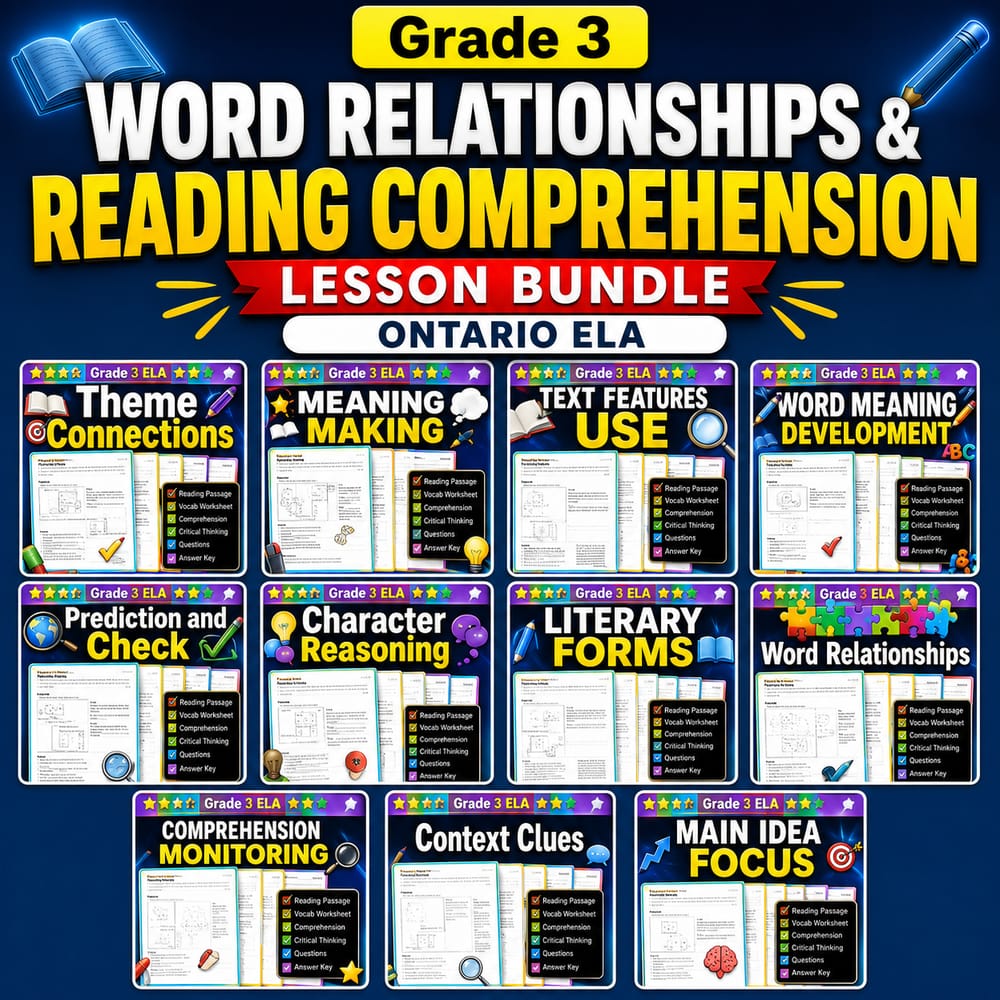

Grade 3 Word Relationships & Reading Comprehension Lesson Bundle | Ontario ELA
$26.40$33.00Save $6.60
Sunny Desk Resources
·2 followers·18 sales
SubjectELAGradeGrade 3Pages121 Pages
What’s included
11 worksheets · 121 pages · Save $6.60 (20%) · prices shown inside the bundle
 Grade 3 Theme Connections Worksheet Ontario ELA Reading Skills
- Identify a theme (a unifying message) in a story
- Explain how key details and events support a theme using evidence
- Make connections between theme and text features (title, repeated ideas, and key moments)
$2.40$3.00 Grade 3 Meaning Making Worksheet Ontario ELA Reading Comprehension
- Identify the central idea of a short text by using the main events and important details.
- Explain why a character’s actions matter and how events connect to each other.
- Give an opinion about what happened and support it with details from the text.
$2.40$3.00 Grade 3 Text Feature Use Worksheet Ontario ELA Reading Skills
- Identify common text features such as titles, headings, captions, bold print, diagrams, and labels in informational and literary texts.
- Use text features to locate and understand key ideas and specific details.
- Explain how the information in a text feature connects to nearby sentences.
$2.40$3.00 Grade 3 Word Meaning Development Ontario ELA Vocabulary Worksheets
- Use context clues and illustrations to infer the meaning of unfamiliar words.
- Explain how word choice (like adjectives and mood words) can change the tone of a text.
- Identify and reuse important vocabulary words from informational and narrative texts.
$2.40$3.00 Grade 3 Prediction and Check Worksheet Ontario ELA Reading Skills
- Use text clues (sequence words, dialogue, and details) to make predictions about what may happen next
- Check predictions by comparing them to new information in the text and revising when needed
- Explain how story events connect from beginning to end using evidence from the text
$2.40$3.00 Character Reasoning Grade 3 ELA Ontario Reading Comprehension Worksheet
- Make character inferences by linking what a character does and says to their feelings, motivations, and traits
- Explain how a character changes across key events using evidence from the text
- Use clear reasoning to support statements about a character’s traits
$2.40$3.00 Literary Forms Grade 3 ELA Ontario Reading Comprehension Worksheet
- Identify how literary form affects meaning in stories, poems, and plays
- Use narrative purpose and problem-solution structure to understand story events
- Explain how rhyme or repetition can create rhythm and emphasize ideas in poems
$2.40$3.00 Grade 3 Ontario Word Relationships Worksheet | ELA Vocabulary & Reading Skills
- Identify synonyms and antonyms and explain how word meanings connect in a sentence.
- Notice word families and related words that appear around the same topic.
- Compare two sentences with different adjectives to understand meaning more precisely.
$2.40$3.00 Comprehension Monitoring Grade 3 ELA Ontario Reading Strategy Worksheet
- I can notice when I do not understand what I read.
- I can check earlier sentences and use rereading to restore meaning.
- I can use text clues and pictures/captions to understand who or what pronouns refer to.
$2.40$3.00 Context Clues Grade 3 ELA Worksheet Ontario Reading Skills
- Identify how context clues help determine the meaning of an unfamiliar word
- Use examples, definitions, contrasts, and descriptions in sentences to infer word meanings
- Explain what clue words or phrases helped you figure out a meaning
$2.40$3.00
Reviews & Feedback
Loading reviews...
Questions & Answers
Loading questions…
About this bundle
Related categories
Frequently asked questions
Who is Grade 3 Word Relationships & Reading Comprehension Lesson Bundle | Ontario ELA designed for?
Grade 3 Word Relationships & Reading Comprehension Lesson Bundle | Ontario ELA is designed for Grade 3 students and ELA learners and can be used in classrooms, homeschool, or independent practice.
How do I download Grade 3 Word Relationships & Reading Comprehension Lesson Bundle | Ontario ELA?
Add it to your cart and complete checkout. After payment, you can download immediately from your account, and you'll also receive a download link by email.
