
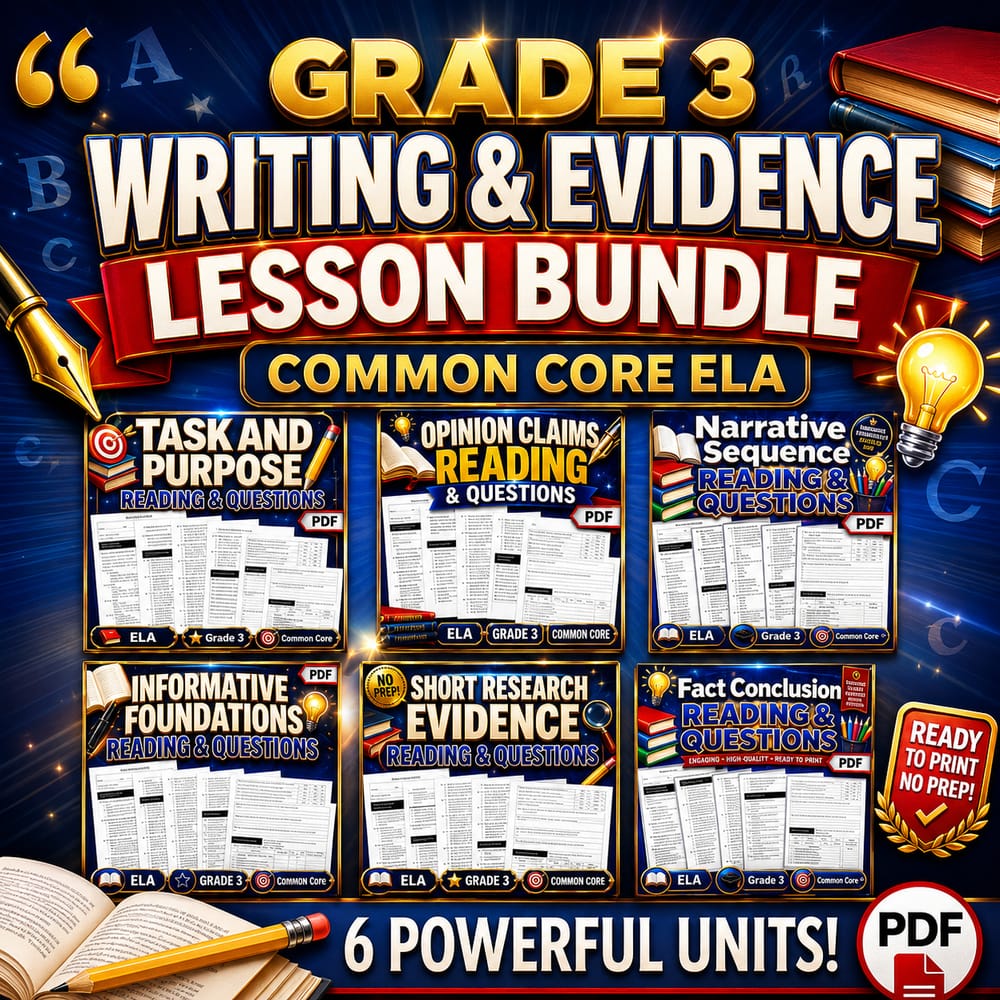
Grade 3 Writing & Evidence Lesson Bundle – Common Core ELA
$22.40$28.00Save $5.60
Golden Apple Studio
New·2 followers·3 sales
SubjectELAGradeGrade 3Pages104 Pages
What’s included
7 worksheets · 104 pages · Save $5.60 (20%) · prices shown inside the bundle
 Grade 3 ELA Worksheet | Task and Purpose CCSS (PDF)
- Identify the purpose of a text (to persuade, to inform, or to tell a story) and match it to what the writer includes.
- Explain how a writer’s task influences organization, details, and structure.
- Revise writing by adding genre-appropriate features for the intended audience and purpose.
$3.20$4.00 Grade 3 ELA Opinion Claims Worksheet | Common Core Practice (PDF)
- Identify an opinion claim in a piece of writing and explain what topic it is about.
- Choose reasons that connect to an opinion claim and add helpful explanation.
- Use opinion-writing structure by including a concluding statement that restates the main idea.
$3.20$4.00 Grade 3 ELA Narrative Sequence Worksheet – Common Core CCSS (PDF)
- Write a short narrative that follows events in clear order (beginning, middle, end).
- Use details from the setting and characters to keep the story coherent.
- Include dialogue that helps the reader understand thoughts, actions, or relationships.
$3.20$4.00 Grade 3 ELA Worksheet | Informative and Explanatory Writing (PDF) – CCSS
- Explain what informative and explanatory writing is and what it aims to do for the reader.
- Identify how informative writing organizes ideas using logical structure and key details.
- Use transition words and relationship phrases to show how facts connect.
$3.20$4.00 Grade 3 ELA Fact Conclusion Worksheet (PDF) - Common Core Standards
- Identify what makes an informative writing conclusion effective: summary, closure, and connection to the topic.
- Restate the main ideas using facts and definitions without adding unrelated new information.
- Use conclusion language that shows how the facts work together to explain the topic.
$3.20$4.00 Grade 3 ELA Short Research Evidence Worksheet – Common Core (PDF)
- Use a focused question to choose which facts from texts are relevant evidence
- Distinguish between summary evidence and direct quotations in short research writing
- Organize research information so readers can see how evidence supports the central idea
$3.20$4.00 Grade 3 ELA Worksheet | Plan Revise Edit with Common Core Standards (PDF)
- Identify how planning helps writers organize ideas with a clear beginning, middle, and end.
- Explain how revising strengthens writing by adding details and improving sequence.
- Use editing strategies to check spelling, punctuation, and word choice.
$3.20$4.00
Reviews & Feedback
Loading reviews...
Questions & Answers
Loading questions…
About this bundle
Related categories
Frequently asked questions
Who is Grade 3 Writing & Evidence Lesson Bundle – Common Core ELA designed for?
Grade 3 Writing & Evidence Lesson Bundle – Common Core ELA is designed for Grade 3 students and ELA learners and can be used in classrooms, homeschool, or independent practice.
How do I download Grade 3 Writing & Evidence Lesson Bundle – Common Core ELA?
Add it to your cart and complete checkout. After payment, you can download immediately from your account, and you'll also receive a download link by email.
Similar Products

Grade 7 Writing & Text Evidence ELA Lesson Bundle for Common Core (CCSS)
$24.00$30.00

Grade 6 Supporting Evidence ELA Lesson Bundle: Common Core CCSS Writing
$21.60$27.00

Grade 5 Writing Lesson Bundle for ELA | Common Core Writing Skills
$24.00$30.00

Informative Writing, Evidence & Revision Grade 8 ELA Lesson Bundle | Common Core
$25.60$32.00

Grade 12 Writing & Evidence ELA Lesson Bundle Daily Reading Worksheets | BC
$38.40$48.00