
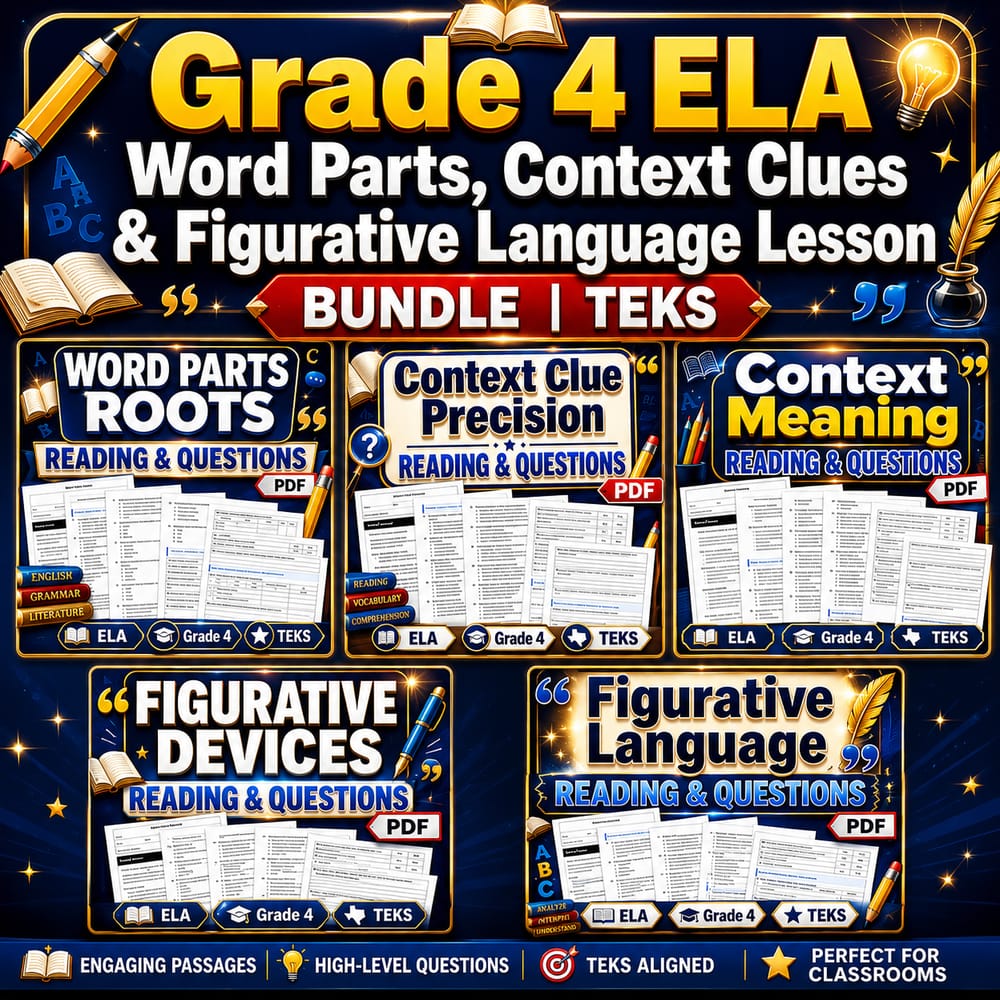
Grade 4 ELA Word Parts, Context Clues & Figurative Language Lesson Bundle | TEKS
$16.00$20.00Save $4.00
Golden Apple Studio
New·2 followers·3 sales
SubjectELAGradeGrade 4Pages75 Pages
What’s included
5 worksheets · 75 pages · Save $4.00 (20%) · prices shown inside the bundle
 Word Parts Roots Worksheet | Grade 4 ELA Vocabulary TEKS Activity
- Explain how root words provide the core meaning of a word.
- Use common prefixes and suffixes to infer meaning.
- Determine word meaning by connecting word parts to context in a sentence.
$3.20$4.00 Context Clue Precision Worksheet | Grade 4 ELA Vocabulary TEKS
- Use multiple contextual clues (synonyms, paraphrases, cause-and-effect, and descriptive details) to determine the meaning of an unfamiliar word.
- Explain how the most likely meaning of a word connects to the topic and the author’s purpose.
- Distinguish between different possible meanings of a word by using evidence from nearby sentences.
$3.20$4.00 Context Meaning ELA Worksheet Grade 4 TEKS Vocabulary Skills Practice
- Infer the meaning of an unfamiliar word or phrase using nearby sentences.
- Identify context clues such as embedded definitions, restatements, and contrasts.
- Choose the correct meaning when a word has multiple meanings by considering topic and tone.
$3.20$4.00 Figurative Devices ELA Worksheet Grade 4 TEKS Literary Elements
- Identify figurative devices such as idioms, similes, and metaphors in a text.
- Infer the meaning of figurative language by connecting it to the text’s imagery and mood.
- Explain how figurative wording helps readers understand theme and important ideas.
$3.20$4.00 Figurative Language Worksheet Grade 4 ELA TEKS Reading Skills
- Identify whether a figurative expression is a simile, metaphor, or personification.
- Infer the meaning of figurative language by using context clues from surrounding sentences.
- Explain how figurative language helps the reader understand a message or mood.
$3.20$4.00
Reviews & Feedback
Loading reviews...
Questions & Answers
Loading questions…
About this bundle
Related categories
Frequently asked questions
Who is Grade 4 ELA Word Parts, Context Clues & Figurative Language Lesson Bundle | TEKS designed for?
Grade 4 ELA Word Parts, Context Clues & Figurative Language Lesson Bundle | TEKS is designed for Grade 4 students and ELA learners and can be used in classrooms, homeschool, or independent practice.
How do I download Grade 4 ELA Word Parts, Context Clues & Figurative Language Lesson Bundle | TEKS?
Add it to your cart and complete checkout. After payment, you can download immediately from your account, and you'll also receive a download link by email.


