
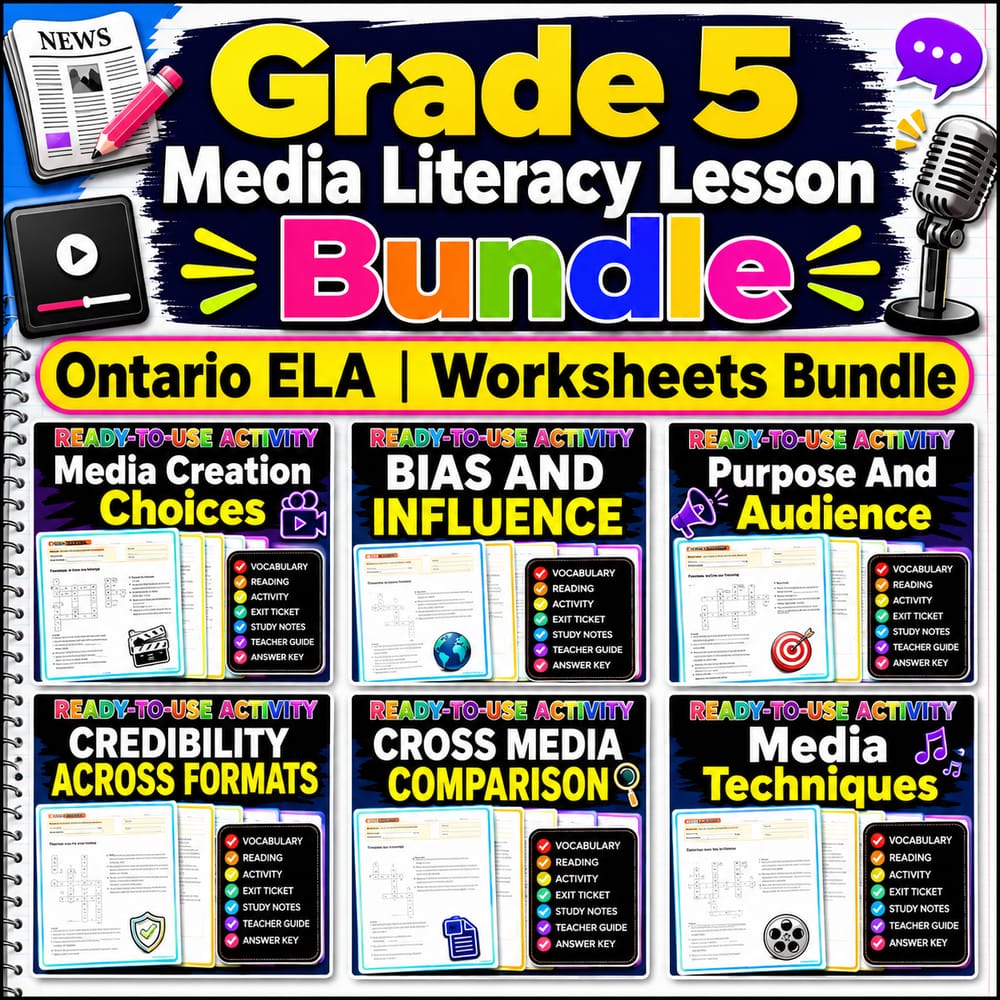
Grade 5 Media Literacy Lesson Bundle | Ontario ELA | Worksheets Bundle
$14.40$18.00Save $3.60
Sunny Desk Resources
·2 followers·18 sales
SubjectELAGradeGrade 5Pages66 Pages
What’s included
6 worksheets · 66 pages · Save $3.60 (20%) · prices shown inside the bundle
 Grade 5 Media Creation Choices Worksheet | Ontario ELA Media Literacy
- Explain how purpose affects what information is included and how it is organized in a media text
- Choose an appropriate format and tone for a specific audience and goal
- Use design features such as layout and emphasis to make a media message clear and coherent
$2.40$3.00 Grade 5 Bias and Influence Worksheet | Ontario ELA Media Literacy Activity
- Identify how perspective and technique (such as loaded language, selective facts, and framing) can influence a message
- Use evidence from a text to explain whether an account seems credible or misleading
- Recognize how generalizations and stereotypes can shape audience expectations
$2.40$3.00 Grade 5 Purpose and Audience Worksheet | Ontario ELA Media Literacy
- Identify the purpose of a media text (inform, persuade, entertain, or motivate action).
- Infer the intended audience by analyzing tone, vocabulary, design choices, and information emphasized.
- Explain how perspective affects what is included or left out and how claims are framed.
$2.40$3.00 Grade 5 Credibility Across Formats Worksheet | Ontario ELA Media Literacy
- Compare how the same event can be presented with different levels of credibility across media formats
- Identify evidence, sources, and framing choices that make claims more or less reliable
- Recognize how specific details and uncertainty are signaled in text and media messages
$2.40$3.00 Grade 5 Cross Media Comparison Worksheet | Ontario ELA Media Literacy
- Compare how different media formats present the same idea by focusing on emphasis, tone, and implied values.
- Identify similarities and differences in key points and supporting details across texts.
- Explain how wording and imagery can change a reader’s understanding and conclusions.
$2.40$3.00 Grade 5 Media Techniques Worksheet | Ontario ELA Media Literacy Activity
- Explain how visual and audio media techniques shape message and audience response
- Identify techniques such as framing, lighting, camera angles, music, pacing, and captions in a text or media example
- Connect a technique to its effect by using evidence from details
$2.40$3.00
Reviews & Feedback
Loading reviews...
Questions & Answers
Loading questions…
About this bundle
Related categories
Frequently asked questions
Who is Grade 5 Media Literacy Lesson Bundle | Ontario ELA | Worksheets Bundle designed for?
Grade 5 Media Literacy Lesson Bundle | Ontario ELA | Worksheets Bundle is designed for Grade 5 students and ELA learners and can be used in classrooms, homeschool, or independent practice.
How do I download Grade 5 Media Literacy Lesson Bundle | Ontario ELA | Worksheets Bundle?
Add it to your cart and complete checkout. After payment, you can download immediately from your account, and you'll also receive a download link by email.
Similar Products

Grade 12 ELA Media Literacy Worksheets | Ontario Media Literacy
$14.40$18.00

Grade 12 ELA Daily Reading & Literary Media Literacy Lesson Bundle | Ontario
$112.00$160.00

Grade 4 Media Literacy Lesson Bundle | Ontario ELA Worksheets
$12.00$15.00

Grade 6 ELA Media Literacy Worksheets | Framing & Bias | Ontario
$12.00$15.00

Grade 10 Media Literacy Worksheets Bundle | Ontario ELA Resources
$12.00$15.00