
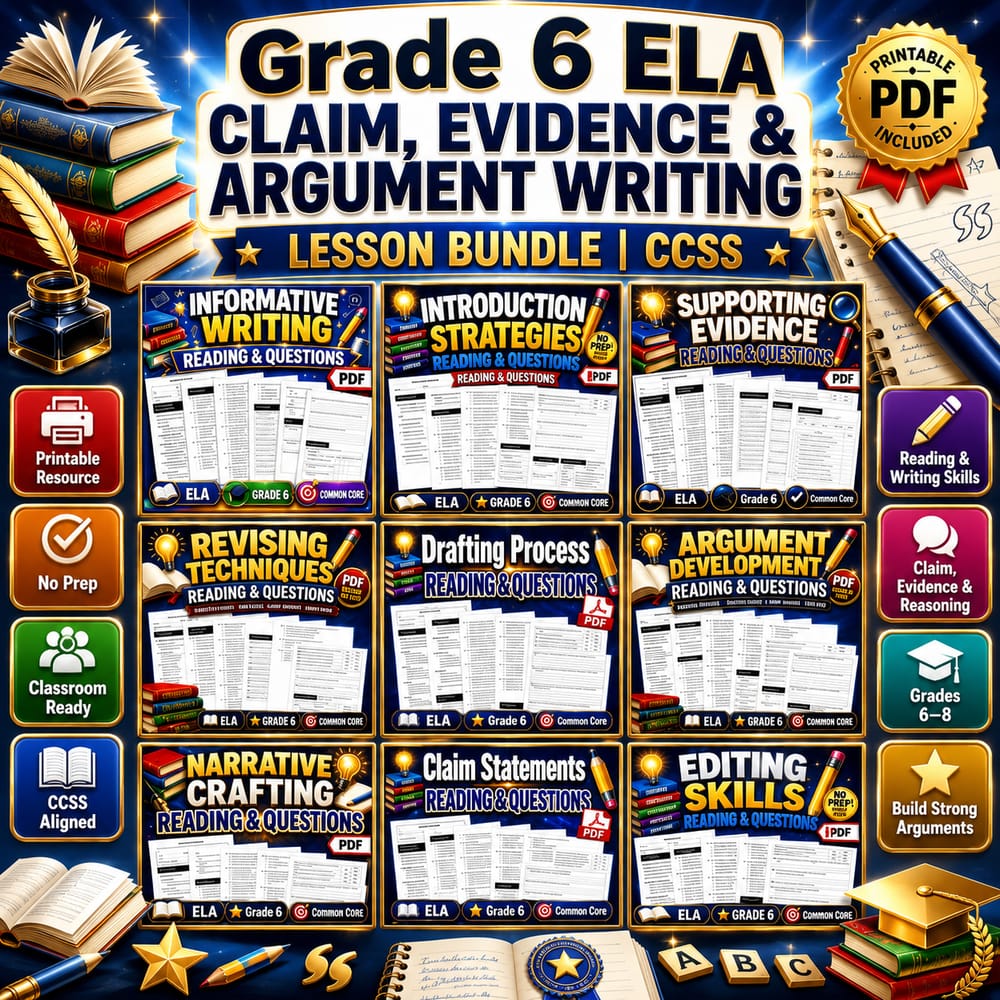
Grade 6 ELA Claim, Evidence & Argument Writing Lesson Bundle | CCSS
$28.80$36.00Save $7.20
Golden Apple Studio
New·2 followers·3 sales
SubjectELAGradeGrade 6Pages142 Pages
What’s included
9 worksheets · 142 pages · Save $7.20 (20%) · prices shown inside the bundle
 6th Grade ELA Worksheet | Informative Writing with Common Core Standards (PDF)
- Plan an informative paragraph using a clear main idea and logical order.
- Support claims with relevant facts, details, and evidence.
- Use headings and descriptions to help readers understand a process or concept.
$3.20$4.00 6th Grade ELA Introduction Strategies Worksheet (PDF) – Common Core Standards
- Use hooks, background information, and thesis statements to craft engaging introductions.
- Identify how an introduction sets purpose, context, and focus for persuasive, informative, and narrative writing.
- Revise an introduction to improve clarity and reader interest.
$3.20$4.00 6th Grade ELA Supporting Evidence Worksheet (CCSS) PDF
- Gather relevant evidence (facts, examples, and data) to support a claim in informational writing.
- Evaluate sources for credibility by checking author, purpose, evidence, and timeliness.
- Integrate evidence smoothly by using explanations that connect the evidence back to the claim.
$3.20$4.00 6th Grade ELA Revising Techniques Worksheet (CCSS) | Practice & Assessment
- Revise a draft to improve clarity by identifying unclear sentences and rewriting them for precise meaning.
- Improve coherence by checking how ideas connect and reorganizing paragraphs when needed.
- Strengthen arguments by ensuring evidence supports claims and by sharpening word choice and style.
$3.20$4.00 6th Grade ELA Worksheet – Drafting Process | Common Core (PDF)
- Explain the purpose of planning, outlining, drafting, and revising in the drafting process
- Use audience and purpose to make decisions about content, organization, and word choice
- Create and use a simple outline to draft coherent paragraphs with topic sentences and transitions
$3.20$4.00 6th Grade ELA Argument Development Worksheet (PDF) | CCSS Standards
- Write a clear claim for a persuasive argument supported by relevant evidence
- Use logical reasoning to explain how evidence supports a position
- Address counterarguments fairly and maintain focus on the main topic
$3.20$4.00 6th Grade ELA | Narrative Crafting Worksheets (PDF) – CCSS Aligned
- Identify the key elements of narrative writing: character, setting, plot, and point of view
- Use clear sequencing to connect events from beginning to end
- Apply vivid details and point of view to make a story engaging
$3.20$4.00 6th Grade ELA | Claim Statements Worksheet – Common Core (PDF)
- Identify the difference between a fact and an arguable claim in argumentative writing.
- Write a central claim that clearly states a position and can be supported with evidence and logical reasoning.
- Revise claim statements to improve clarity, specificity, and alignment with supporting evidence.
$3.20$4.00 Grade 6 ELA Editing Skills Worksheet (Worksheet + Answer Key) – Common Core
- Identify and correct common grammar, punctuation, and usage errors during the editing stage of writing.
- Revise sentence structure to improve clarity and meaning without changing the writer’s intent.
- Apply editing strategies that match the conventions of a chosen genre.
$3.20$4.00
Reviews & Feedback
Loading reviews...
Questions & Answers
Loading questions…
About this bundle
Related categories
Frequently asked questions
Who is Grade 6 ELA Claim, Evidence & Argument Writing Lesson Bundle | CCSS designed for?
Grade 6 ELA Claim, Evidence & Argument Writing Lesson Bundle | CCSS is designed for Grade 6 students and ELA learners and can be used in classrooms, homeschool, or independent practice.
How do I download Grade 6 ELA Claim, Evidence & Argument Writing Lesson Bundle | CCSS?
Add it to your cart and complete checkout. After payment, you can download immediately from your account, and you'll also receive a download link by email.
Similar Products

Grade 7 ELA Writing Routinely & Claims Lesson Bundle | CCSS
$32.00$40.00

Grade 12 Text Structure, Claims & Evidence Lesson Bundle | General ELA
$14.40$18.00

Grade 8 Claim & Evidence ELA Lesson Bundle: Common Core (CCSS)
$19.20$24.00

Grade 7 Speaking & Listening: Presenting, Claims & Collaboration Lesson Bundle | CCSS ELA
$9.60$12.00

Grade 7 ELA Lesson Bundle: Presenting Knowledge & Evaluating Claims | CCSS
$9.60$12.00