
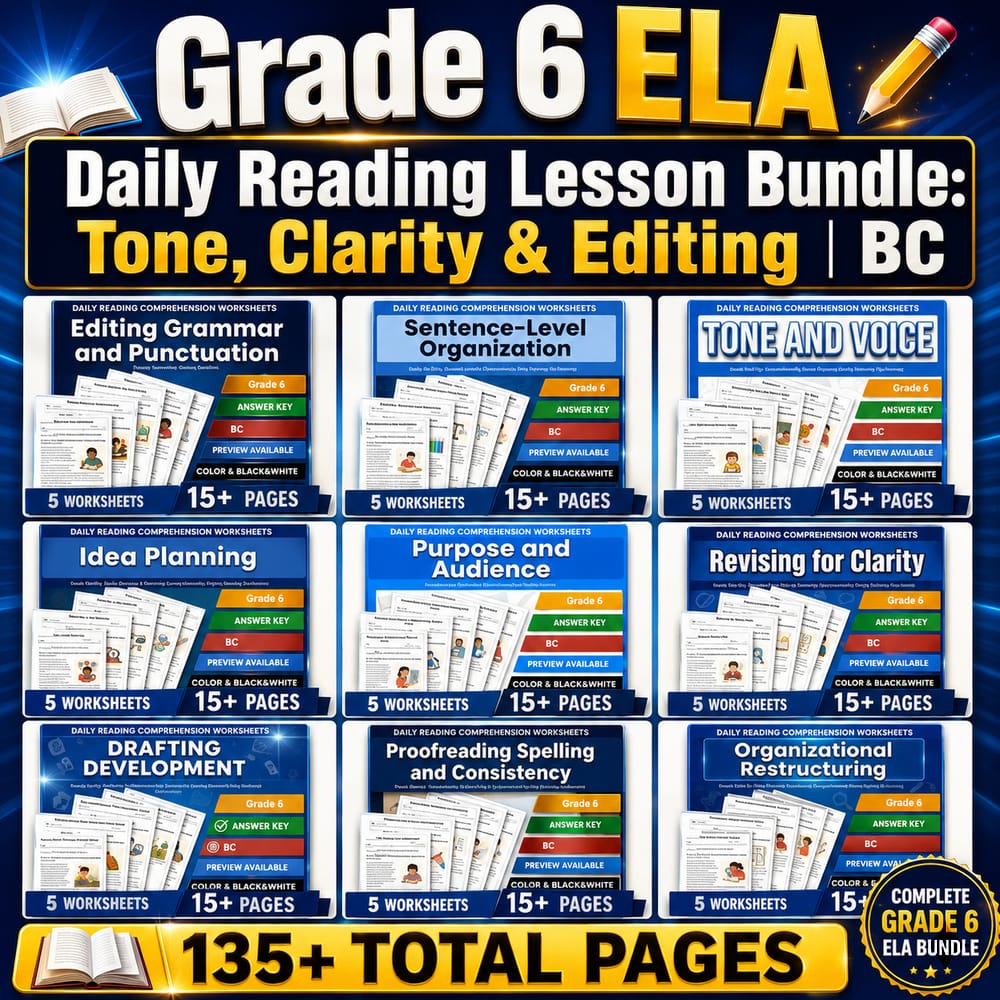
Grade 6 ELA Daily Reading Lesson Bundle: Tone, Clarity & Editing | BC
$28.80$36.00Save $7.20
Quiet Forest Education
·3 followers·20 sales
SubjectELAGradeGrade 6Pages273 Pages
What’s included
9 worksheets · 273 pages · Save $7.20 (20%) · prices shown inside the bundle
 Grade 6 ELA – Editing Grammar & Punctuation Daily Worksheet | BC Standards
- Understand key concepts related to ELA
- Apply knowledge through practice questions
- Demonstrate comprehension of the material
$3.20$4.00 Grade 6 ELA – Sentence-Level Organization Daily Reading Worksheet
- Identify the main idea of individual sentences
- Ensure each sentence contributes to the paragraph's point
- Recognize sentence coherence through proper subjects and verbs
$3.20$4.00 Grade 6 ELA – Understanding Tone & Voice | Daily Reading Worksheet
- Identify different tones used by writers in various texts.
- Recognize how tone influences the reader’s perception.
- Differentiate between formal and informal voice in writing.
$3.20$4.00 Grade 6 ELA – Idea Planning & Reading Comprehension | Daily Reading Worksheet
- Understand key concepts related to ELA
- Apply knowledge through practice questions
- Demonstrate comprehension of the material
$3.20$4.00 Grade 6 ELA – Purpose & Audience | Daily Reading Worksheet
- Identify the purpose of a written text and the intended audience.
- Understand how writers choose language and details based on their goals.
- Recognize different types of writing suited for various audiences and purposes.
$3.20$4.00 Grade 6 ELA – Revising for Clarity & Writing Improvement | Daily Worksheet
- Identify vague and unclear sentences in a paragraph
- Understand the importance of clarity in writing
- Learn strategies to revise sentences for precision
$3.20$4.00 Grade 6 ELA – Drafting Development & Planning a School Garden | Daily Worksheet
- Understand the importance of sequencing and development of ideas in writing.
- Identify how focus statements and elaboration support a paragraph's main idea.
- Recognize transitional phrases that connect ideas smoothly.
$3.20$4.00 Grade 6 ELA – Proofreading for Spelling & Capitalization | Daily Worksheet
- Understand key concepts related to ELA
- Apply knowledge through practice questions
- Demonstrate comprehension of the material
$3.20$4.00 Grade 6 ELA – Daily Reading Worksheet | Organizational Restructuring in Writing
- Understand key concepts related to ELA
- Apply knowledge through practice questions
- Demonstrate comprehension of the material
$3.20$4.00
Reviews & Feedback
Loading reviews...
Questions & Answers
Loading questions…
About this bundle
Related categories
Frequently asked questions
Who is Grade 6 ELA Daily Reading Lesson Bundle: Tone, Clarity & Editing | BC designed for?
Grade 6 ELA Daily Reading Lesson Bundle: Tone, Clarity & Editing | BC is designed for Grade 6 students and ELA learners and can be used in classrooms, homeschool, or independent practice.
How do I download Grade 6 ELA Daily Reading Lesson Bundle: Tone, Clarity & Editing | BC?
Add it to your cart and complete checkout. After payment, you can download immediately from your account, and you'll also receive a download link by email.
Similar Products

Research Writing & Editing Daily Reading Lesson Bundle | Grade 6 ELA | TeKS
$38.40$48.00

Tone & Diction Grade 12 ELA Daily Reading Worksheets Lesson Bundle | Ontario
$44.80$56.00

Grade 10 ELA Daily Reading Worksheets: Tone & Style Lesson Bundle | BC
$38.40$48.00

Grade 10 Tone & Language ELA Daily Reading Worksheets Lesson Bundle | BC
$28.80$36.00

Grade 6 Language ELA Daily Reading Worksheets & Editing Lesson Bundle | BC
$25.60$32.00