
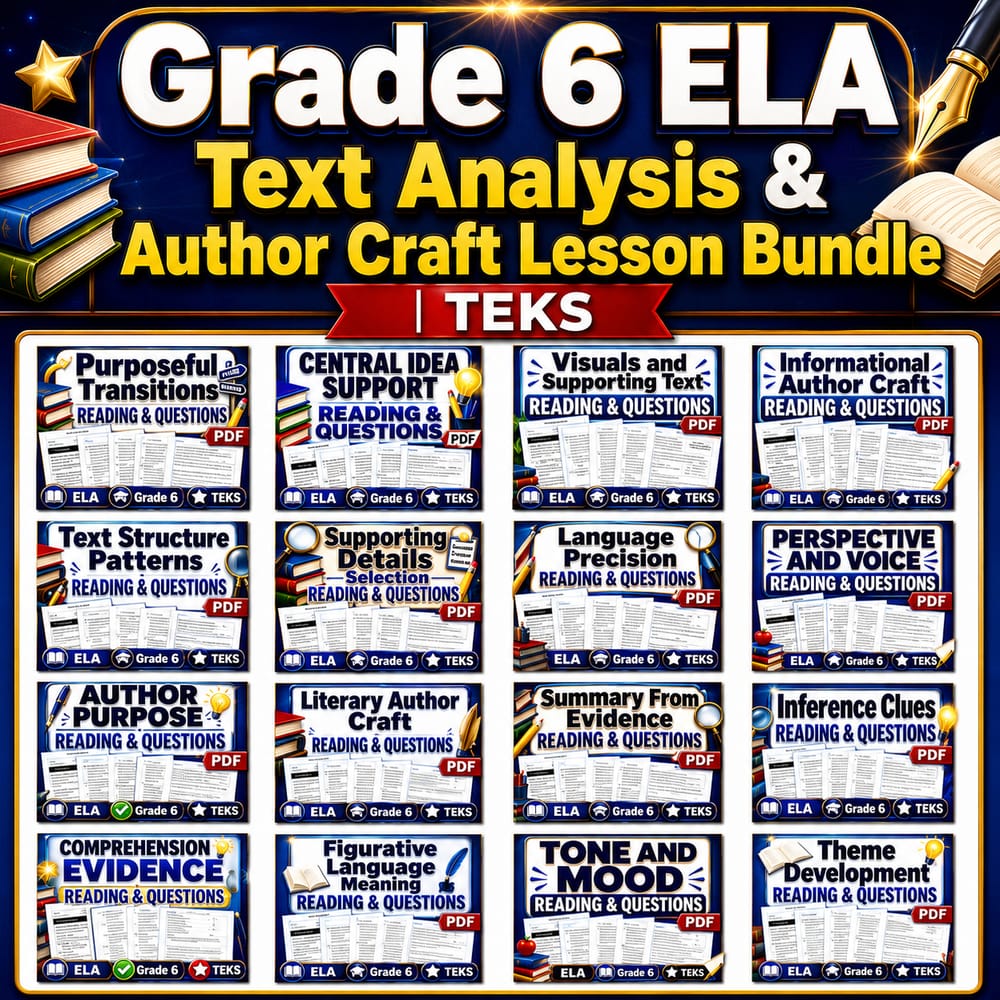


Grade 6 ELA Text Analysis & Author Craft Lesson Bundle | TEKS
$51.20$64.00Save $12.80
Golden Apple Studio
New·2 followers·3 sales
SubjectELAGradeGrade 6Pages251 Pages
What’s included
16 worksheets · 251 pages · Save $12.80 (20%) · prices shown inside the bundle
 Purposeful Transitions Worksheet Grade 6 ELA TEKS Writing Practice
- Identify how transitions (however, therefore, for example, in contrast) signal relationships among ideas
- Explain whether a transition shows cause, contrast, example/support, or conclusion
- Use transitions to improve clarity and coherence in informational writing
$3.20$4.00 Central Idea Support Worksheet Grade 6 ELA TEKS Reading Comprehension
- Identify the central idea or theme of a realistic fiction text.
- Explain how supporting details reinforce the central idea across multiple paragraphs.
- Use evidence from the text to answer questions about central ideas and themes.
$3.20$4.00 Visuals and Supporting Text Worksheet Grade 6 ELA TEKS Analysis
- Explain how visuals (labels, captions, charts, maps) connect to claims and details in an informational text.
- Determine how headings and subtopics guide understanding before and during reading.
- Use textual evidence to describe relationships between diagram information and surrounding sentences.
$3.20$4.00 Informational Author Craft Worksheet Grade 6 ELA TEKS Text Analysis
- Identify how an informational author organizes ideas using headings, transitions, and examples.
- Explain how supporting details (statistics, labeled sections, and bullet points) improve clarity and understanding.
- Revise a short informational message by adding structure that better guides the reader.
$3.20$4.00 Text Structure Patterns Worksheet Grade 6 ELA TEKS Reading Skills
- Identify common text structure patterns (cause-and-effect, problem-and-solution, compare-and-contrast, and sequence).
- Explain how a writer’s organizational choices help readers understand main ideas and relationships among events or ideas.
- Use evidence from a text to describe how structure influences meaning.
$3.20$4.00 Supporting Details Selection Worksheet Grade 6 ELA TEKS Reading Skills
- Identify the central idea of a persuasive nonfiction text.
- Select supporting details (reasons, facts, examples, elaborations) that strengthen the author’s claim.
- Distinguish essential supporting details from interesting but nonessential information.
$3.20$4.00 Language Precision Worksheet Grade 6 ELA TEKS Vocabulary & Writing Skills
- Analyze how specific word choices (especially verbs, qualifiers, and comparative terms) affect meaning and inference.
- Identify how language signals certainty, sequence, and comparison in informational text.
- Explain how precise language prevents readers from misreading implied conclusions.
$3.20$4.00 Perspective and Voice Worksheet Grade 6 ELA TEKS Literary Analysis
- Analyze how point of view and author voice shape what a reader learns and how it feels.
- Infer characters’ motives using textual evidence from different perspectives (first-person, third-person limited, and external narrator).
- Explain how diction and sentence style contribute to tone and the reader’s conclusions.
$3.20$4.00 Author's Purpose Worksheet Grade 6 ELA TEKS Reading Comprehension
- Determine an author’s likely purpose (to inform, explain, persuade, or entertain) by using evidence from the text.
- Identify which details, examples, and transitions the author uses to support that purpose.
- Explain how word choice and organization reveal an intended message for the reader.
$3.20$4.00 Literary Author Craft Worksheet Grade 6 ELA TEKS Literary Analysis
- Analyze how an author’s choices in plot, characterization, setting, dialogue, point of view, and sensory details develop theme or message.
- Explain how specific scenes contribute to a fable or short realistic story’s overall meaning.
- Use evidence from the text to support claims about author craft and theme.
$3.20$4.00
Reviews & Feedback
Loading reviews...
Questions & Answers
Loading questions…
About this bundle
Related categories
Frequently asked questions
Who is Grade 6 ELA Text Analysis & Author Craft Lesson Bundle | TEKS designed for?
Grade 6 ELA Text Analysis & Author Craft Lesson Bundle | TEKS is designed for Grade 6 students and ELA learners and can be used in classrooms, homeschool, or independent practice.
How do I download Grade 6 ELA Text Analysis & Author Craft Lesson Bundle | TEKS?
Add it to your cart and complete checkout. After payment, you can download immediately from your account, and you'll also receive a download link by email.
Similar Products

Text Analysis Grade 7 ELA Daily Reading Worksheets Lesson Bundle | TEKS
$38.40$48.00

Grade 11 Text Analysis & Reasoning ELA Lesson Bundle: Common Core (CCSS)
$16.80$21.00

Grade 11 Text-Based Analysis & Argument Writing Lesson Bundle | CCSS ELA
$26.40$33.00

Grade 10 Text Structure Analysis ELA Lesson Bundle for Common Core (CCSS)
$16.80$21.00

Text Evidence and Author Craft Lesson Bundle | Grade 5 ELA | Common Core (CCSS)
$28.80$36.00