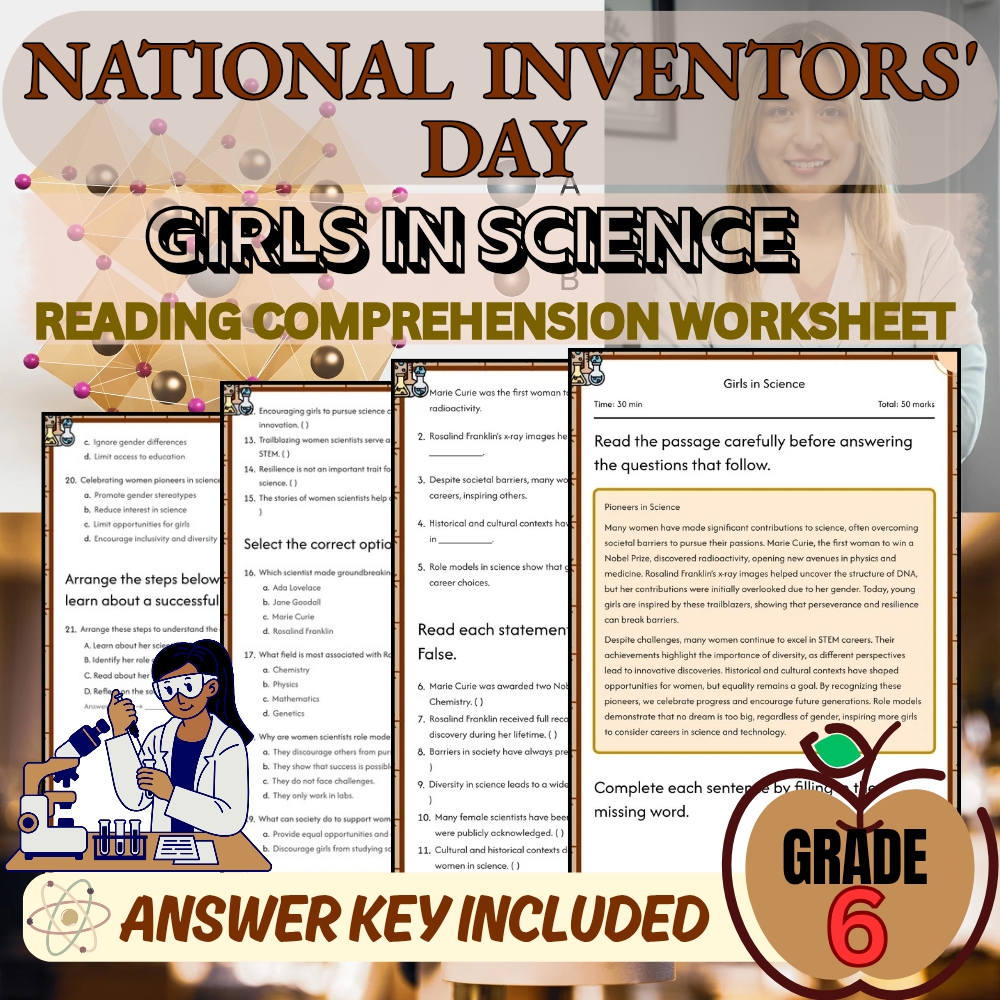
Imagine walking into a classroom during a holiday week, where students are excited yet appear a bit unsure about recognizing the vital contributions women have made to science. Some students may struggle to recall key figures like Marie Curie or Rosalind Franklin, or to understand the significance of their discoveries. This worksheet provides a straightforward, print and go solution to help clarify these important concepts, making it easier for teachers to guide students through the achievements of women in science with confidence.
What This Resource Helps Students Do
This worksheet supports students in learning about notable women scientists by guiding them through a variety of question types. It helps students develop their reading comprehension skills through a short passage about women’s contributions to science. The fill in the blank questions reinforce key vocabulary and facts, encouraging recall and understanding. The true/false section prompts students to evaluate their knowledge, while the multiple-choice questions test their ability to identify important scientists and their fields. The ordering activity helps students sequence historical contributions logically. Overall, the worksheet promotes independent practice, critical thinking, and confidence in their knowledge about impactful women scientists.
Inside the PDF
• 22 structured questions designed for clear, step by step learning
• A print-ready format that requires no additional preparation
• PDF answer key to facilitate quick assessment
• Layout optimized for easy photocopying and classroom use
How It Improves Learning
This worksheet enhances learning by providing a focused review of the contributions made by women scientists, making complex information accessible through varied question formats. The short reading passage builds background knowledge, while the fill-in-the-blank questions reinforce specific facts, encouraging students to recall key details. The true/false questions help students assess their understanding immediately, fostering confidence as they identify correct statements. The multiple-choice items further develop their ability to differentiate between scientific fields and recognize influential figures. The sequencing activity encourages logical thinking about the chronological order of scientific discoveries. As students work through these activities, they move from uncertainty to clarity, building a stronger and more connected understanding of women’s achievements in science.
Core Skills Students Will Develop
- ➡️ reading comprehension of scientific texts
- ➡️ retention of key scientific facts and figures
- ➡️ critical evaluation of statements
- ➡️ sequencing historical scientific contributions
Ways Teachers Use This Worksheet
This worksheet is versatile and can be used in a variety of ways to support student learning. It makes an effective classwork activity, providing a structured way for students to review important content. It also works well as homework, offering students an opportunity to reinforce their understanding at home. Teachers can incorporate it into small-group practice sessions or review lessons, allowing for more targeted instruction. Additionally, it serves as a helpful assessment tool to gauge student comprehension or as early finisher work, giving students meaningful tasks while others finish their assignments.
Why This PDF Saves Time
The resource is already formatted in a print-ready PDF, enabling immediate use without any extra setup. Its layout is designed for quick photocopying, ensuring minimal prep time for teachers. The included answer key simplifies grading and saves time during assessments, providing a reliable and consistent evaluation method that helps maintain classroom flow.
With this worksheet, teachers can confidently provide a well-structured, engaging review of women’s contributions to science that promotes understanding and celebrates diversity in the field. It’s a practical, ready to use tool that supports student growth and shifts the focus toward meaningful learning. 😊