
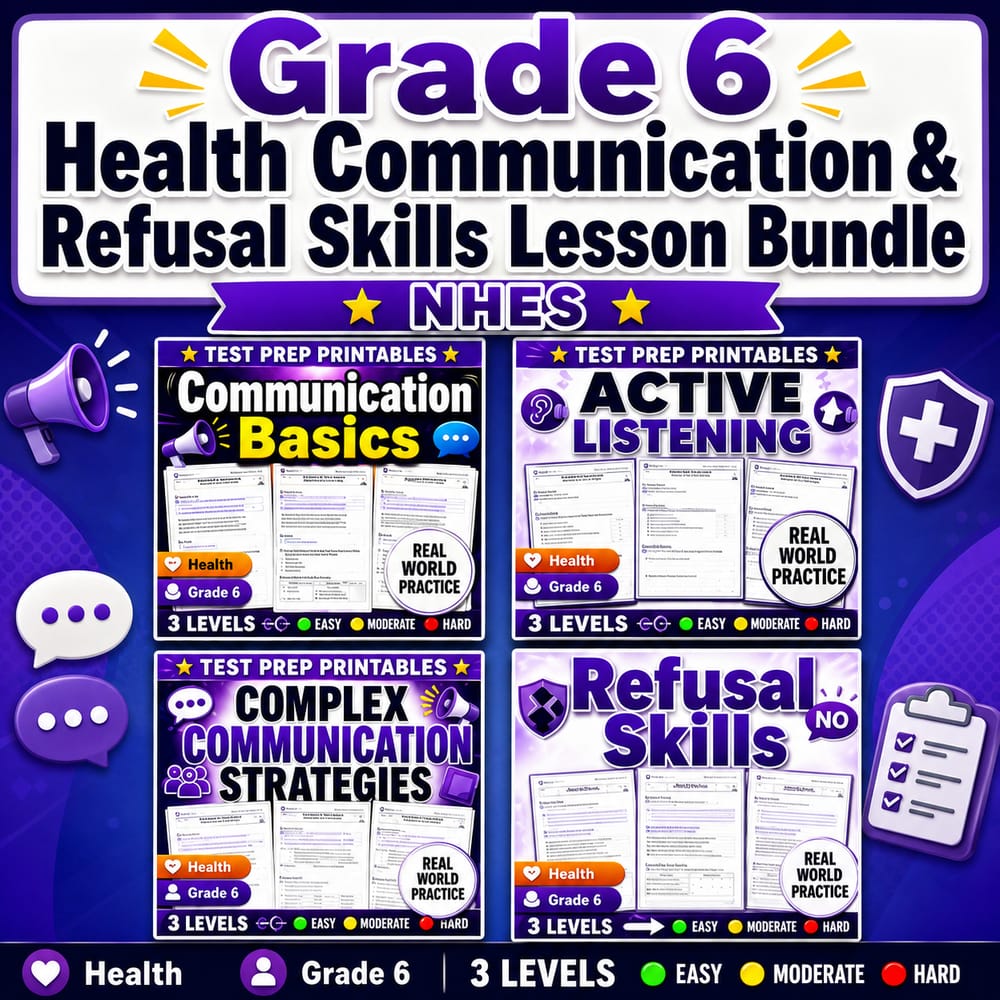
Grade 6 Health Communication & Refusal Skills Lesson Bundle | NHES
$16.00$20.00Save $4.00
Prism Point Learning
·2 followers·13 sales
SubjectHealthGradeGrade 6Pages120 Pages
What’s included
4 worksheets · 120 pages · Save $4.00 (20%) · prices shown inside the bundle
 Communication Skills Worksheet Grade 6 Health Clear Messages & Respect
- Explain how spoken, written, and non-verbal communication work together in everyday interactions.
- Identify respectful ways to share feelings and ideas during conversations at school and at home.
- Use context clues and listening skills to understand others more clearly.
$4.00$5.00 Active Listening Skills Worksheet | Grade 6 Health Communication Lesson
- Explain what active listening means and why it matters in conversations.
- Identify behaviors that show you are listening actively (attention, clarification, and feedback).
- Use active listening strategies such as paraphrasing and asking questions to reduce misunderstandings.
$4.00$5.00 Complex Communication Strategies Health Worksheet Grade 6 NHES Activities
- Recognize social cues and interpret what people may mean beyond their words.
- Use active listening and empathy to reduce misunderstandings.
- Practice conflict-management strategies and choose communication styles for different situations.
$4.00$5.00 Refusal Skills Worksheet | Saying No With Confidence Grade 6 Health
- Identify key refusal skills for handling peer pressure and unsafe situations.
- Practice clear, respectful ways to decline unwanted offers or requests.
- Choose effective responses that protect personal safety and well-being.
$4.00$5.00
Reviews & Feedback
Loading reviews...
Questions & Answers
Loading questions…
About this bundle
Related categories
Frequently asked questions
Who is Grade 6 Health Communication & Refusal Skills Lesson Bundle | NHES designed for?
Grade 6 Health Communication & Refusal Skills Lesson Bundle | NHES is designed for Grade 6 students and Health learners and can be used in classrooms, homeschool, or independent practice.
How do I download Grade 6 Health Communication & Refusal Skills Lesson Bundle | NHES?
Add it to your cart and complete checkout. After payment, you can download immediately from your account, and you'll also receive a download link by email.
Similar Products

Grade 12 Health Lesson Bundle | Interpersonal Communication Skills NHES
$12.00$15.00

Grade 5 Interpersonal Communication Skills Health Lesson Bundle: NHES
$9.60$12.00

Grade 3 Interpersonal Communication Skills Health Lesson Bundle | NHES
$9.60$12.00

Grade 11 Health | Interpersonal Communication Skills Unit Bundle (NHES Aligned)
$12.00$15.00

Grade 11 Refusal & Communication Health Lesson Bundle Worksheets - NHES
$16.00$20.00