
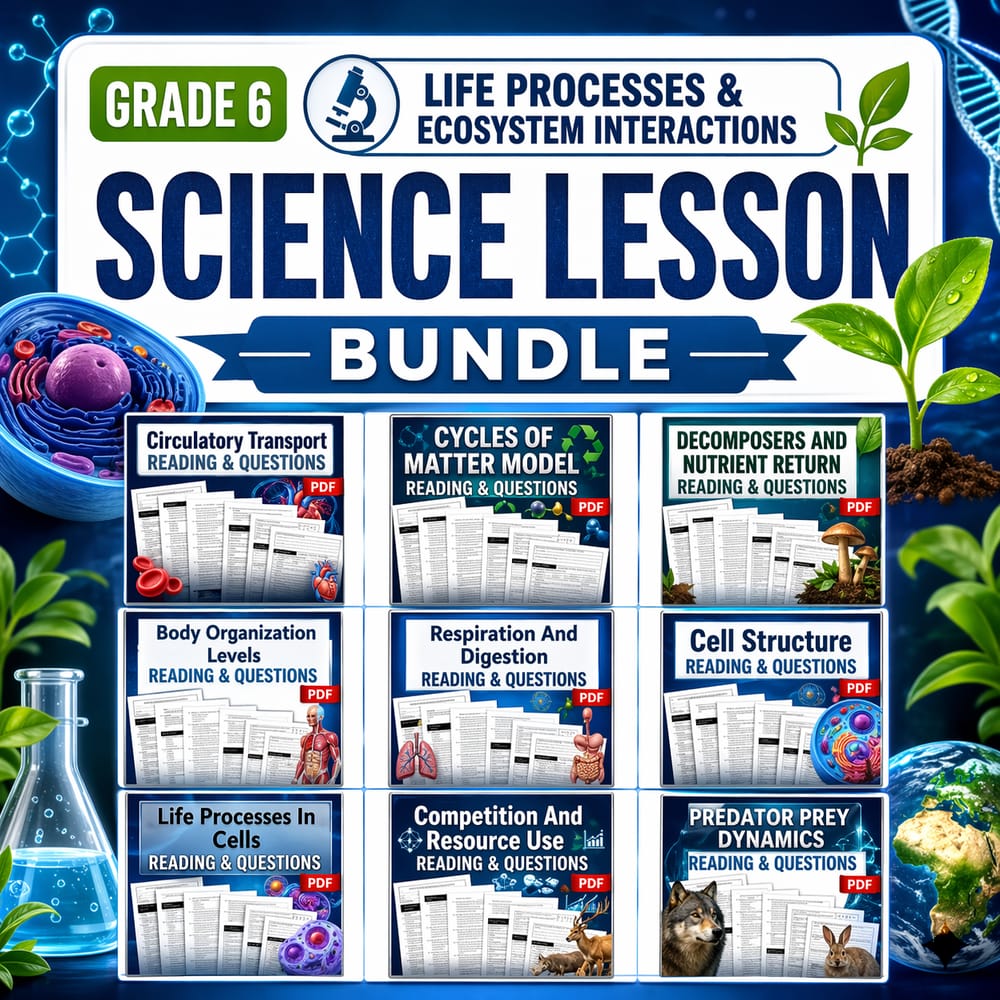
Grade 6 Life Processes & Ecosystem Interactions Science Lesson Bundle: General
$28.80$36.00Save $7.20
Evergreen Desk Education
·2 followers·17 sales
SubjectScienceGradeGrade 6Pages135 Pages
What’s included
9 worksheets · 135 pages · Save $7.20 (20%) · prices shown inside the bundle
 6th Grade Science Worksheet | Circulatory System Blood Movement (PDF)
- Explain how the heart’s rhythmic pumping creates pressure that moves blood through the circulatory system.
- Compare the structure and function of arteries, veins, and capillaries in transporting blood.
- Describe how capillaries enable exchange of oxygen, nutrients, and wastes between blood and body cells.
$3.20$4.00 6th Grade Science Worksheet | Cycles of Matter Model (PDF)
- Explain how matter cycles between living and non-living parts of an ecosystem.
- Use a cycles-of-matter model to identify reservoirs (storage) and flows (movement).
- Describe how carbon and water move through air, soil, water, plants, and animals.
$3.20$4.00 6th Grade Science Worksheet | Decomposers & Nutrient Cycle (PDF)
- Explain how decomposers (fungi and bacteria) break down dead organisms and waste
- Describe how decomposers return nutrients to soil and water for producers to reuse
- Connect decomposer activity to ecosystem productivity, growth patterns, and long-term sustainability
$3.20$4.00 6th Grade Science | Body Organization Levels Worksheet (PDF)
- Explain the hierarchy of body organization from cells to tissues, organs, and body systems.
- Describe how each level supports specific functions in the body.
- Predict how a change at one level can affect the performance of a body system.
$3.20$4.00 Grade 6 Science Worksheet | Respiration and Digestion Systems Support Life (PDF)
- Describe key structures of the respiratory and digestive systems and explain how each structure supports its function.
- Explain how gas exchange in the lungs happens through efficient diffusion driven by concentration differences.
- Model how digestion breaks food into smaller molecules that can enter circulation.
$3.20$4.00 6th Grade Science Worksheet – Cell Structure & Organelles (PDF)
- Identify major cell parts (cell membrane, cytoplasm, nucleus, and organelles) and describe their functions.
- Explain how cell structure helps life processes happen in an organized way.
- Compare the roles of shared cell parts and how specialized organelles support controlled chemical reactions.
$3.20$4.00 6th Grade Science Worksheet | Life Processes in Cells (PDF) Standard Basics
- Explain how cells convert energy and exchange materials to support life processes.
- Describe photosynthesis and cellular respiration as linked pathways for energy transfer and gas exchange.
- Use the ideas of diffusion and transport to predict how materials move across cell membranes.
$3.20$4.00 Grade 6 Science Worksheet | Competition and Resource Use (PDF)
- Explain why organisms compete for limited resources such as space, light, water, and nutrients
- Describe how traits and behaviors affect access to resources during competition
- Predict how competition can change population sizes and influence which species persist in a community
$3.20$4.00 Grade 6 Science Worksheet – Predator-Prey Dynamics (PDF)
- Explain how predator and prey populations affect each other in an ecosystem
- Identify examples of prey adaptations that reduce predator capture
- Describe cause-and-effect feedback loops in food webs
$3.20$4.00
Reviews & Feedback
Loading reviews...
Questions & Answers
Loading questions…
About this bundle
Related categories
Frequently asked questions
Who is Grade 6 Life Processes & Ecosystem Interactions Science Lesson Bundle: General designed for?
Grade 6 Life Processes & Ecosystem Interactions Science Lesson Bundle: General is designed for Grade 6 students and Science learners and can be used in classrooms, homeschool, or independent practice.
How do I download Grade 6 Life Processes & Ecosystem Interactions Science Lesson Bundle: General?
Add it to your cart and complete checkout. After payment, you can download immediately from your account, and you'll also receive a download link by email.
Similar Products

Grade 6 Life Processes & Ecosystems Science lesson bundle: General Framework
$36.00$45.00

Grade 4 Science Lesson Group Bundle | Ecosystems, Life Cycles & Classification
$21.60$27.00

Grade 5 Science Ecosystems & Life Cycles Worksheets Bundle | 10 Resources
$24.00$30.00

Grade 8 Interactions, Homeostasis & Genetics Science Lesson Bundle (General)
$19.20$24.00

Grade 4 Science Life Cycles Ecosystems & Metamorphosis Worksheets Bundle
$21.60$27.00