
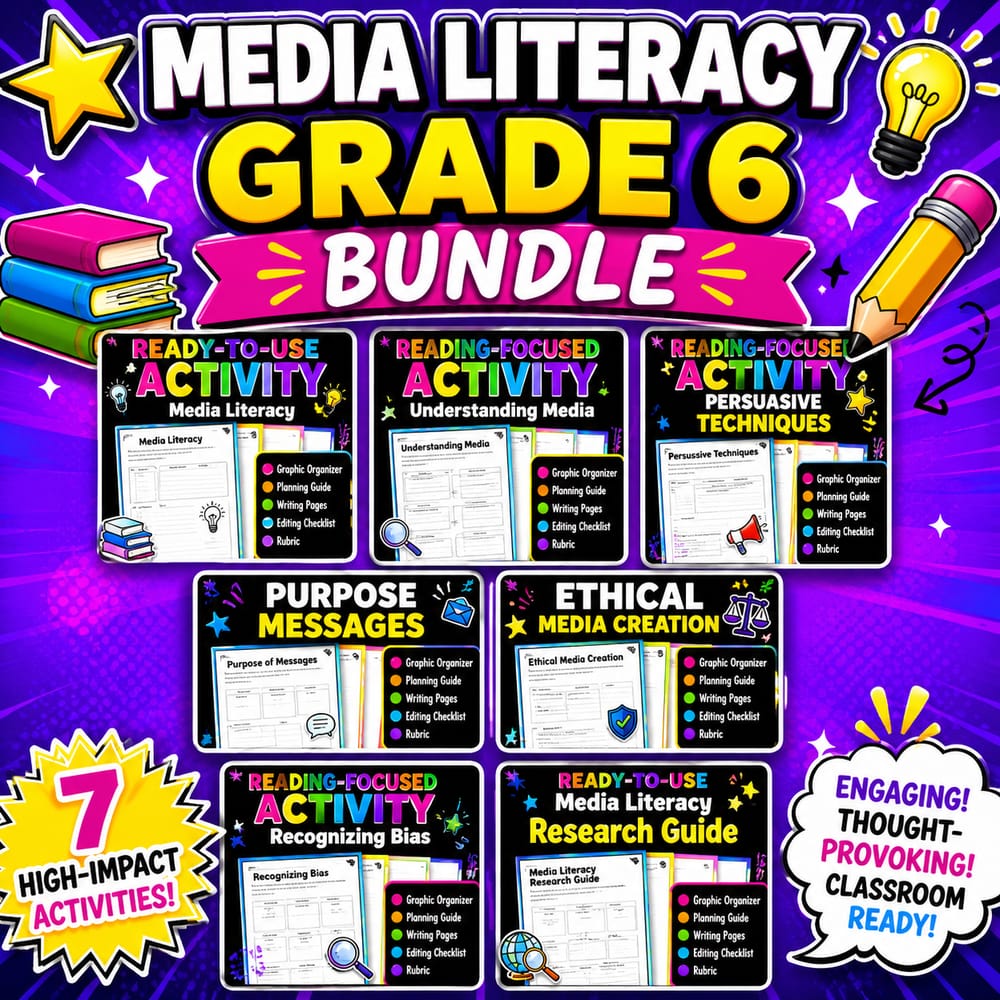
Grade 6 Media Literacy Lesson Bundle: ELA Alberta Framework
$16.80$21.00Save $4.20
Sunny Desk Resources
·2 followers·18 sales
SubjectELAGradeGrade 6Pages78 Pages
What’s included
7 worksheets · 78 pages · Save $4.20 (20%) · prices shown inside the bundle
 Simple Media Product Worksheet Pack | Grade 6 ELA Practice
- Explain how purpose and audience guide the format and content of a simple media product
- Use the idea of coherence to select supporting details that match the main message
- Describe ethical representation by avoiding distortion and using accurate, contextual information
$2.40$3.00 Source Credibility Worksheet Pack | Grade 6 ELA Practice
- Explain how to evaluate the credibility of a source using author, date, context, and evidence quality.
- Differentiate facts from opinions by checking whether claims can be verified with reliable support.
- Analyze how visuals (like infographics or charts) can be credible or misleading depending on missing context.
$2.40$3.00 Persuasive Techniques Worksheet Pack | Grade 6 ELA Practice
- Identify common persuasive techniques used in media and explain how they influence an audience’s attention and emotions
- Analyze how design and delivery choices (such as visuals, music, repetition, and testimonials) support a persuasive message
- Evaluate whether persuasive techniques align with the needs and interests of a specific audience
$2.40$3.00 Purpose in Messages Worksheet | Grade 6 ELA Practice
- Identify a message’s purpose by finding its main claim, intended audience, and emphasized details
- Explain how wording and visuals can narrow attention toward one idea
- Distinguish between purposes such as persuading, informing, and entertaining
$2.40$3.00 Ethical Media Creation Worksheet | Grade 6 ELA Practice Activity
- Explain how ethical media creation uses credible information and clear attribution for images, audio, and quotes.
- Describe how a creator should balance supporting details so the message does not mislead an audience.
- Identify responsible choices for perspective, organization, and avoiding unauthorized copying.
$2.40$3.00 Perspective and Framing Worksheets | Grade 6 ELA Practice
- Explain how word choice and selective details can shape a media message
- Identify how framing choices affect the perspective and meaning in headlines and visuals
- Use evidence to describe what context is omitted and how that changes interpretation
$2.40$3.00 Comparing Claims Worksheet for Grade 6 ELA Practice and Review
- Identify and restate claims from different versions of the same topic (news post, opinion piece, or paid promotion).
- Compare evidence, context, and sourcing to judge credibility more effectively.
- Use labels such as “sponsored” to understand potential bias or marketing goals.
$2.40$3.00
Reviews & Feedback
Loading reviews...
Questions & Answers
Loading questions…
About this bundle
Related categories
Frequently asked questions
Who is Grade 6 Media Literacy Lesson Bundle: ELA Alberta Framework designed for?
Grade 6 Media Literacy Lesson Bundle: ELA Alberta Framework is designed for Grade 6 students and ELA learners and can be used in classrooms, homeschool, or independent practice.
How do I download Grade 6 Media Literacy Lesson Bundle: ELA Alberta Framework?
Add it to your cart and complete checkout. After payment, you can download immediately from your account, and you'll also receive a download link by email.
Similar Products

Grade 4 Media Literacy Lesson Bundle | Ontario ELA Worksheets
$12.00$15.00

Grade 6 Media Literacy in ELA Lesson Bundle for Alberta Framework
$28.00$35.00

Grade 6 ELA Media Literacy Worksheets Alberta Bundle
$28.00$35.00

Grade 6 Media Literacy ELA Daily Reading Worksheets Lesson Bundle | Alberta
$22.40$28.00

Grade 3 ELA Media Literacy Lesson Bundle | Alberta Framework
$12.00$15.00