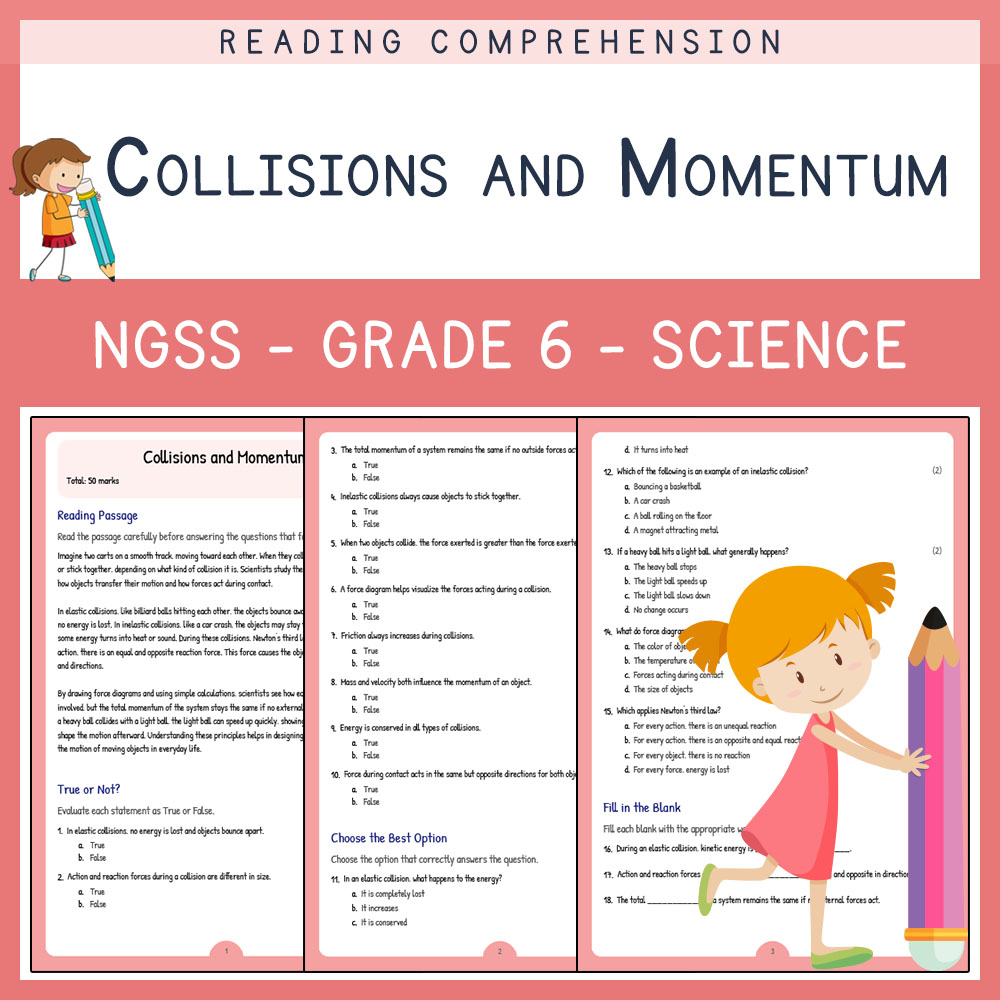
Are your Grade 6 students exploring the fascinating concepts of collisions and momentum? This engaging worksheet offers a comprehensive exploration of physics principles, perfectly aligned with Next Generation Science Standards (NGSS). It is designed to help educators facilitate understanding of fundamental mechanics through structured activities that promote critical thinking and real-world application.
🌿 This collection of printable PDFs includes thoughtfully crafted worksheets and detailed answer keys with rubrics, making it an invaluable resource for science teachers. Designed specifically for primary grades, these activities support hands-on learning and reinforce core scientific concepts. Whether used for classroom instruction, homework, or assessment, these materials help foster a deeper understanding of how objects move and interact during collisions, encouraging students to develop both conceptual knowledge and analytical skills.
What's Included
✅ Reading passage that introduces the basic principles of collisions and momentum
✅ 1 comprehension question based on the passage
✅ 10 true or false questions to assess conceptual understanding
✅ 5 multiple-choice questions to challenge critical thinking
✅ 5 fill-in-the-blank exercises to reinforce key terminology
✅ 5 brief response questions for deeper reflection and explanation
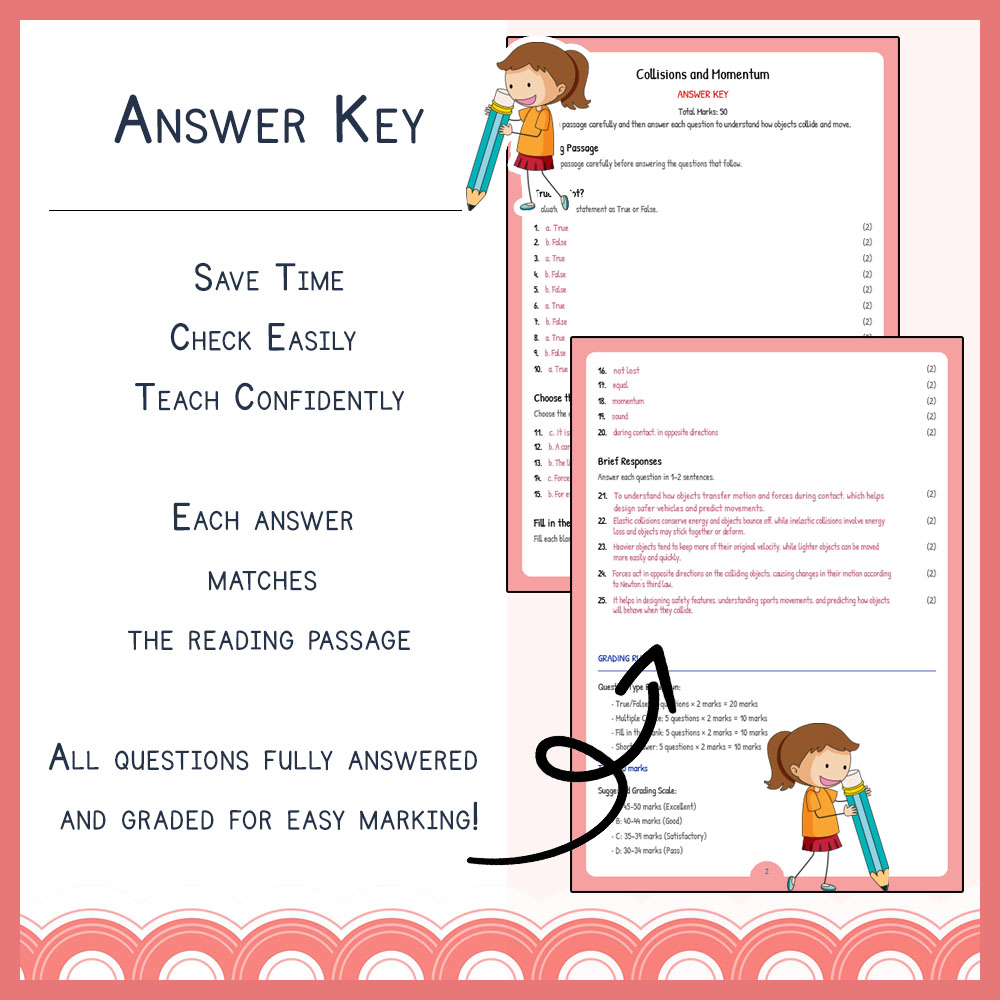
✅ All materials provided as easy-to-print PDF worksheets and PDF answer keys with rubrics
Key Concepts Covered
➡️ Momentum – The quantity of motion an object has, calculated by mass times velocity, essential for understanding interactions during collisions
➡️ Elastic collision – A type of collision where objects bounce off with no kinetic energy lost, important for physics foundations
➡️ Inelastic collision – Collisions where objects stick together or deform, leading to energy loss and real-world examples
➡️ Kinetic energy – The energy that objects possess due to motion, which can be conserved or transferred during collisions
➡️ Forces during collisions – Action-reaction pairs that help explain how object interactions occur and their effects
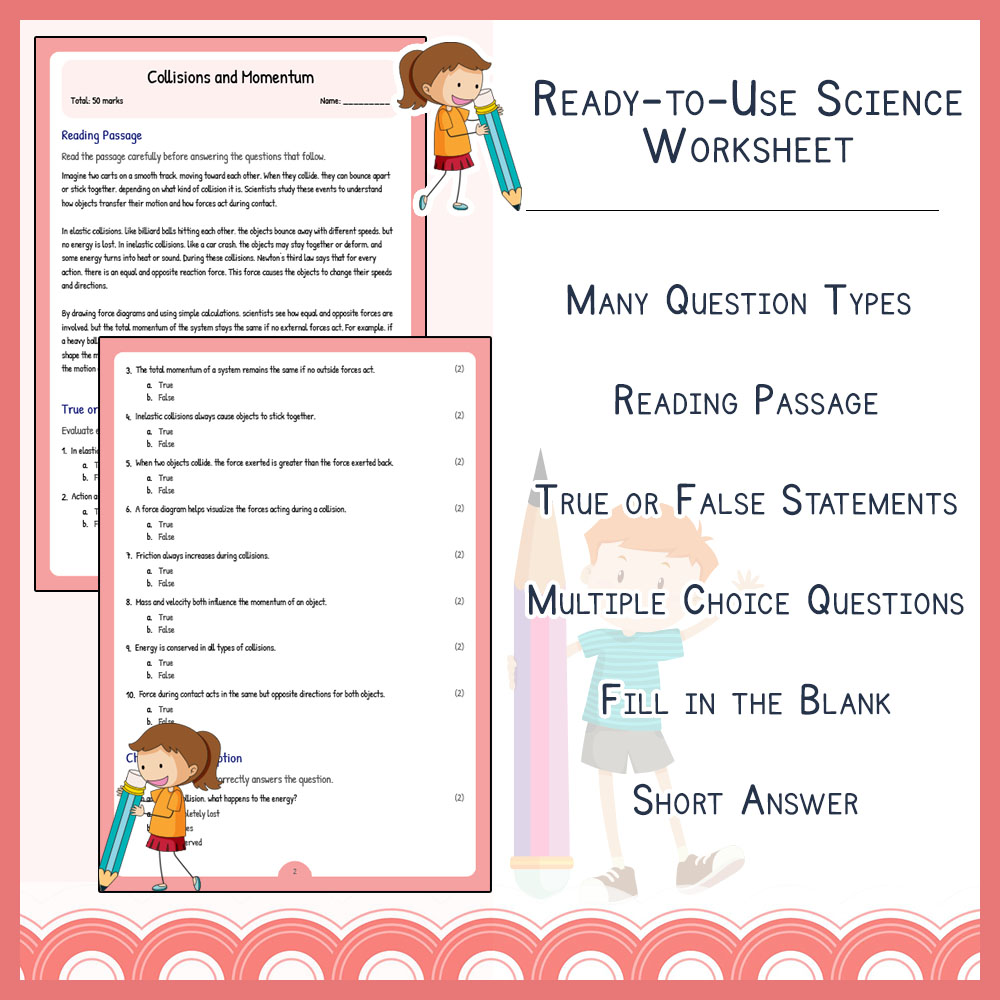
Question Types / Formats
1. Reading comprehension with a passage to evaluate understanding
2. True or false questions to quickly assess grasp of fundamental principles
3. Multiple-choice questions for applying concepts and critical thinking
4. Fill-in-the-blank exercises to strengthen vocabulary and key ideas
5. Short answer questions encouraging explanation and reasoning
Teacher Benefits
✅ Provides ready-to-use PDFs for quick preparation and smooth lesson planning
✅ Aligns with NGSS standards to support curriculum requirements
✅ Includes detailed answer keys and rubrics for efficient assessment and feedback
✅ Encourages active student engagement through varied question formats
✅ Supports differentiated instruction with clear, accessible activities
Student Benefits
✅ Enhances understanding of core physics concepts in an interactive way
✅ Builds critical thinking and analytical skills through diverse question types
✅ Reinforces vocabulary and scientific terminology for better comprehension
✅ Promotes active learning with real-world examples and hands-on activities
✅ Prepares students for higher-level science topics with a solid foundation
Perfect For
➡️ Classroom instruction that supports interactive learning
✅ At-home practice to reinforce classroom lessons
➡️ Homework assignments that promote independent thinking
✅ Science assessments aligned with NGSS standards
➡️ Small group activities and station work to foster collaboration
Ready to enhance your Science teaching? Download this dynamic worksheet today and inspire your students to explore the principles of collisions and momentum! 🚀