
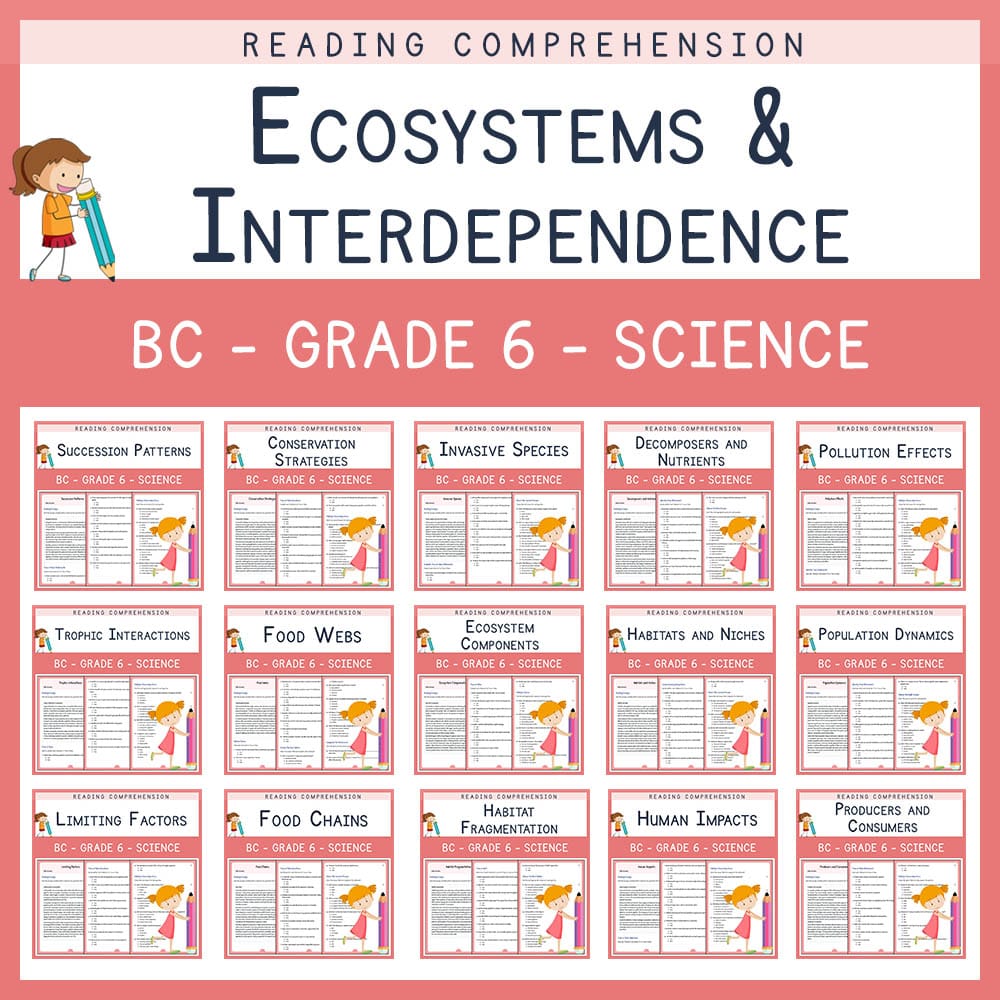


Grade 6 Science | Ecosystem Relationships Science Custom Bundle | BC Framework
$36.00$45.00Save $9.00
Lumora Learning
·3 followers·12 sales
GradeGrade 6
What’s included
15 worksheets · Save $9.00 (20%) · prices shown inside the bundle
 Grade 6 Science | Invasive Species Worksheet | BC Aligned
- Understand what invasive species are and how they impact native ecosystems.
- Identify examples of invasive plants and animals introduced by human activities.
- Explain the ecological and economic effects of invasive species.
$2.40$3.00 Grade 6 Science | Habitats and Niches Worksheet | BC Aligned
- Understand the difference between habitats and niches in ecosystems.
- Identify how resource sharing leads to competition or coexistence among species.
- Describe how variations in niches and habitats influence ecosystem resilience.
$2.40$3.00 Grade 6 Science | Pollution Effects Worksheet | BC Aligned
- Understand the types of pollutants and their sources in ecosystems.
- Explain how pollutants bioaccumulate and biomagnify in food chains.
- Identify the impacts of nutrient over-enrichment and algal blooms on ecosystems.
$2.40$3.00 Grade 6 Science | Food Webs Worksheet | BC-Aligned
- Understand the concept of a food web and its components.
- Identify key species interactions within an ecosystem food web.
- Analyze how changes in one species can affect others in a web.
$2.40$3.00 Grade 6 Science | Trophic Interactions Worksheet | BC Aligned
- Understand different types of trophic interactions such as predation, herbivory, parasitism, competition, and mutualism.
- Explain how these interactions influence species survival, community structure, and energy flow.
- Identify examples of trophic interactions in ecosystems and their effects on populations.
$2.40$3.00 Grade 6 Science | Producers and Consumers Science Worksheet | BC Standards
- Understand the roles of producers and consumers in ecosystems.
- Identify different types of consumers and their feeding habits.
- Explain how energy is transferred through trophic levels in food webs.
$2.40$3.00 Grade 6 Science | Food Chains Worksheet | BC Standard
- Understand the concept of food chains and their role in ecosystems.
- Identify producers, consumers, and decomposers in food chains.
- Analyze the flow of energy through different levels of a food chain.
$2.40$3.00 Grade 6 Science | Ecosystem Components Worksheet | BC Standards
- Identify the main biotic and abiotic components of an ecosystem.
- Explain how living and nonliving factors interact within habitats.
- Understand the influence of environmental factors like sunlight, water, and soil on living organisms.
$2.40$3.00 Grade 6 Science | Conservation Strategies Worksheet | BC Aligned
- Understand different conservation strategies used to restore or maintain ecosystems.
- Identify the purpose and benefits of protected areas, habitat restoration, sustainable harvesting, and invasive species control.
- Evaluate trade-offs among ecological, economic, and social goals in conservation efforts.
$2.40$3.00 Grade 6 Science | Limiting Factors Worksheet | BC Standards
- Define limiting factors and explain their role in ecosystems.
- Identify abiotic and biotic limiting factors affecting populations.
- Analyze how changes in limiting resources influence population dynamics.
$2.40$3.00
Reviews & Feedback
Loading reviews...
Questions & Answers
Loading questions…
About this bundle
Related categories
Frequently asked questions
Who is Grade 6 Science | Ecosystem Relationships Science Custom Bundle | BC Framework designed for?
Grade 6 Science | Ecosystem Relationships Science Custom Bundle | BC Framework is designed for Grade 6 students and can be used in classrooms, homeschool, or independent practice.
How do I download Grade 6 Science | Ecosystem Relationships Science Custom Bundle | BC Framework?
Add it to your cart and complete checkout. After payment, you can download immediately from your account, and you'll also receive a download link by email.
Similar Products

Grade 7 Science Lesson Bundle with Ontario Framework | Ecosystems & Biodiversity
$28.80$36.00

Grade 9 Ecosystems Science Worksheets Bundle | NGSS Ecosystems Unit
$12.00$15.00

Grade 11 Science | Biology and Ecosystems Custom Bundle | AP Framework
$33.60$42.00

Lesson Bundle: Grade 8 Earth & Space Science Science General Framework
$32.00$40.00

Grade 11 Science Practices AP Framework Science Lesson Bundle Worksheets
$38.40$48.00