
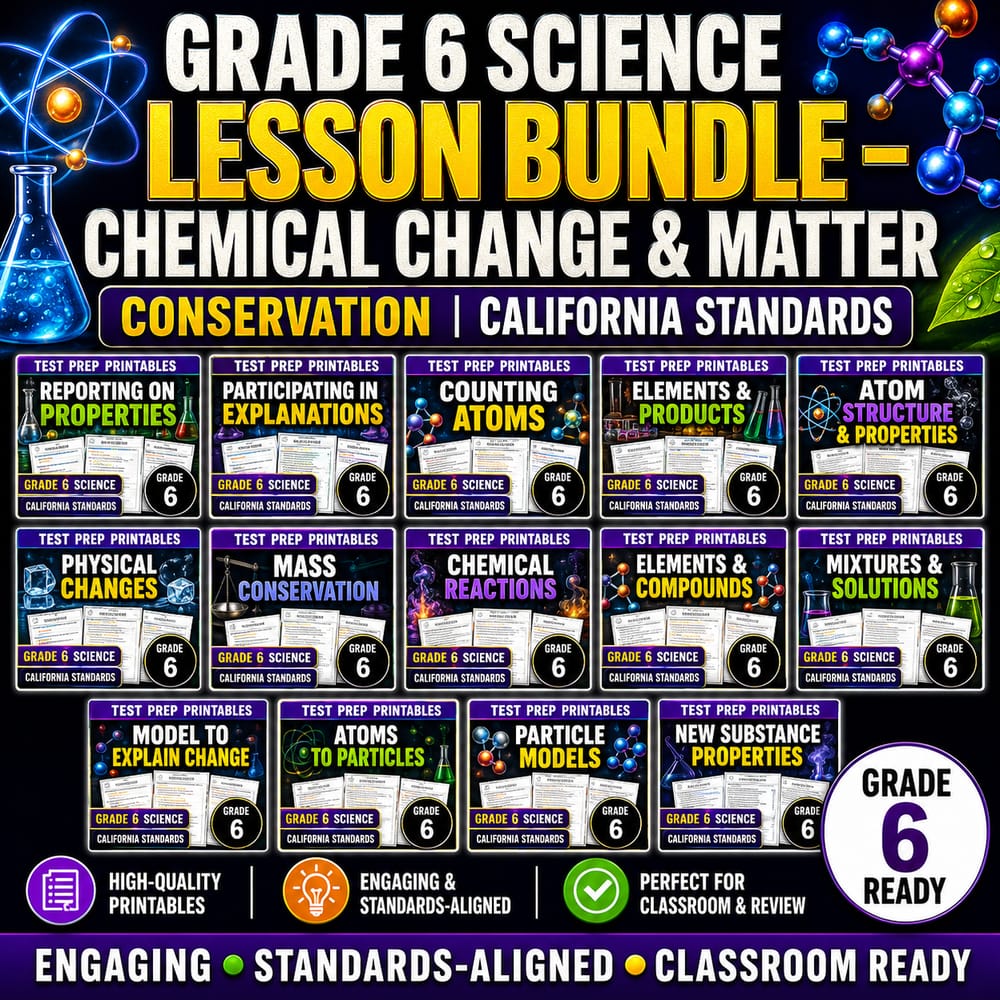


Grade 6 Science Lesson Bundle — Chemical Change & Matter Conservation | California Standards
$56.00$70.00Save $14.00
Prism Point Learning
·2 followers·14 sales
SubjectScienceGradeGrade 6Pages430 Pages
What’s included
14 worksheets · 430 pages · Save $14.00 (20%) · prices shown inside the bundle
 Before & After Properties Chemical Change Worksheet Grade 6 Science
- Explain how scientists compare properties of substances before and after an interaction to determine if a new substance forms.
- Identify evidence of chemical change, including changes in color, formation of a solid, gas release, and new material with different behavior.
- Distinguish between physical changes (appearance changes without new substances) and chemical changes (new substances with new properties).
$4.00$5.00 Rearrangement Explanation Worksheet Grade 6 Science Chemical Change
- Explain how rearranging atoms in a chemical reaction leads to new substances
- Use evidence from particle models to describe what changes and what stays the same
- Predict how new atomic arrangements can change the properties of products
$4.00$5.00 Counting Atoms Worksheet Grade 6 Science Chemical Formulas Practice
- Use particle models to count atoms of each element on both sides of a chemical reaction
- Explain how conservation of matter is supported by matching atom counts in reactants and products
- Use evidence from particle-level reasoning to justify claims about new substances
$4.00$5.00 Reactants and Products Chemical Reactions Worksheet Grade 6 Science
- Identify reactants and products in a chemical reaction scenario
- Explain how product properties can differ from reactant properties as evidence that a reaction occurred
- Use particle diagrams to describe how atoms are rearranged during a reaction
$4.00$5.00 Atom Conservation Worksheet Grade 6 Science Matter Conservation Practice
- Explain how atoms are conserved during chemical reactions using particle diagrams.
- Describe reactants and products as rearrangements of atoms rather than creation or destruction.
- Use particle-level evidence to connect conservation of atoms to observable changes.
$4.00$5.00 Physical Changes Worksheet Grade 6 Science Matter Changes
- Describe what physical changes do to matter and how they differ from chemical changes
- Identify examples of physical changes such as melting, freezing, tearing, and dissolving
- Explain how physical changes can be reversible and how the atoms stay the same
$4.00$5.00 Mass Conservation Worksheet Grade 6 Science Matter Conservation Practice
- Explain mass conservation in terms of conservation of atoms in a closed system.
- Connect particle-level changes to macroscopic measurements of reactants and products.
- Use evidence from a model to predict whether total mass changes in a closed reaction.
$4.00$5.00 Chemical Evidence Worksheet Grade 6 Science Chemical Change Activities
- Identify chemical evidence by observing changes such as color change, gas formation, and precipitates.
- Explain why chemical evidence shows a change in composition, not just temporary mixing.
- Use examples like iron rusting and burning paper to connect observations to particle-level changes.
$4.00$5.00 Elements in Compounds Worksheet Grade 6 Science Atoms Compounds
- Explain that compounds form when atoms of different elements combine in fixed, definite proportions.
- Use particle models to describe how atoms connect in a compound.
- Relate atomic composition to observable properties such as density and chemical behavior.
$4.00$5.00 Mixtures and Compounds Worksheet Pack Grade 6 Science Chemistry
- Explain how mixtures and compounds differ in particle arrangement and atomic composition
- Identify examples of mixtures and compounds using particle model ideas
- Describe how physical separation often works for mixtures but not for compounds
$4.00$5.00
Reviews & Feedback
Loading reviews...
Questions & Answers
Loading questions…
About this bundle
Related categories
Frequently asked questions
Who is Grade 6 Science Lesson Bundle — Chemical Change & Matter Conservation | California Standards designed for?
Grade 6 Science Lesson Bundle — Chemical Change & Matter Conservation | California Standards is designed for Grade 6 students and Science learners and can be used in classrooms, homeschool, or independent practice.
How do I download Grade 6 Science Lesson Bundle — Chemical Change & Matter Conservation | California Standards?
Add it to your cart and complete checkout. After payment, you can download immediately from your account, and you'll also receive a download link by email.
Similar Products

Matter and Chemical Change Lesson Bundle | Grade 9 Science | Ontario
$38.40$48.00

Matter and Chemical Change Lesson Bundle: Grade 7 Science Alberta
$60.00$75.00

Grade 8 Matter & Chemical Change Science Lesson Bundle | Alberta Framework
$60.00$75.00

Grade 8 Matter and Chemical Change Science Lesson Bundle – Alberta Framework
$60.00$75.00

Grade 8 Matter & Chemical Change Lesson Bundle | Alberta Science
$60.00$75.00