
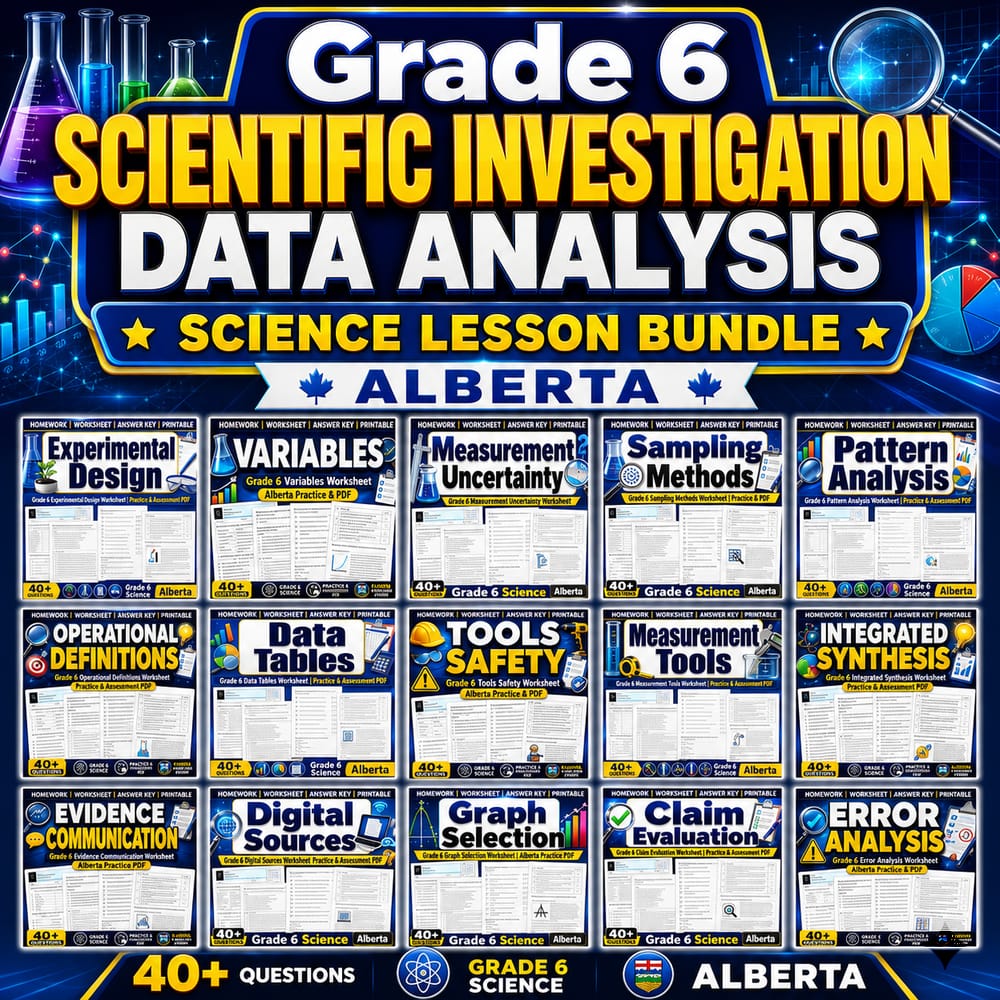


Grade 6 Scientific Investigation Data Analysis Science Lesson Bundle | Alberta
$60.00$75.00Save $15.00
Clear Sky Classroom
·1 followers·19 sales
SubjectScienceGradeGrade 6
What’s included
15 worksheets · Save $15.00 (20%) · prices shown inside the bundle
 Grade 6 Experimental Design Worksheet | Practice & Assessment PDF
- Identify independent, dependent, and controlled variables when designing a fair scientific test.
- Explain how to choose a control condition and keep measurements consistent and repeatable.
- Interpret results by using clear testable questions and well-defined measurement procedures.
$4.00$5.00 Grade 6 Variables Worksheet | Alberta Practice & PDF
- Identify independent, dependent, and controlled variables in a science investigation
- Use operational definitions and consistent measurement intervals to reduce environmental noise
- Explain why researchers keep controls constant to make patterns easier to detect
$4.00$5.00 Grade 6 Measurement Uncertainty Worksheet | Practice & PDF
- Explain what measurement uncertainty is and why scientific measurements can vary.
- Identify common sources of uncertainty, including instrument resolution, environmental variation, and human observation limits.
- Use repeated measurements, ranges, and percent error ideas to estimate uncertainty.
$4.00$5.00 Grade 6 Sampling Methods Worksheet | Alberta Use Practice PDF
- Explain the differences between random, stratified, and systematic sampling
- Identify trade-offs between sample coverage, bias reduction, and practical constraints
- Evaluate how sampling choices affect the strength and limits of conclusions
$4.00$5.00 Grade 6 Pattern Analysis Worksheet | Practice & Assessment PDF
- Identify patterns in environmental data by describing trends, cycles, and anomalies
- Use descriptive statistics and moving averages to interpret data more clearly
- Explain how seasonal decomposition and graphs help reveal recurring patterns
$4.00$5.00 Grade 6 Operational Definitions Worksheet | Practice & Assessment PDF
- Define operationally what a scientific observation means by stating how it is measured
- Convert qualitative ideas into quantitative measurements using clear units and procedures
- Compare and evaluate measurement definitions for clarity, reliability, and reproducibility
$4.00$5.00 Grade 6 Data Tables Worksheet | Practice & Assessment PDF
- Identify key parts of a science data table (column headings, units, time stamps, and metadata).
- Use conventions to interpret measurements correctly and consistently.
- Determine whether a data table entry is complete and reliable for later reanalysis.
$4.00$5.00 Grade 6 Tools Safety Worksheet | Alberta Practice & PDF
- Identify safe ways to select, handle, clean, and store scientific measurement tools (thermometers, pH probes, anemometers, and dataloggers).
- Explain how calibration checks, battery management, and proper PPE reduce errors and hazards during fieldwork.
- Describe protocols that prevent contamination of samples and protect equipment from damage.
$4.00$5.00 Grade 6 Measurement Tools Worksheet | Practice & Assessment PDF
- Identify common measurement tools and the type of quantity each tool measures
- Explain how calibration and unit choice affect the accuracy of collected data
- Record observations consistently so the data can be graphed and compared over time
$4.00$5.00 Grade 6 Integrated Synthesis Worksheet | Practice & Assessment PDF
- Explain how question framing, fair design, measurement strategy, data handling, and evidence-based reporting work together in an integrated synthesis inquiry
- Identify and apply key ideas of data provenance, cross-site comparability, and clear communication of limitations when combining datasets
- Use evidence from multiple sources to draw cautious, policy-relevant conclusions about environmental health
$4.00$5.00
Reviews & Feedback
Loading reviews...
Questions & Answers
Loading questions…
About this bundle
Related categories
Frequently asked questions
Who is Grade 6 Scientific Investigation Data Analysis Science Lesson Bundle | Alberta designed for?
Grade 6 Scientific Investigation Data Analysis Science Lesson Bundle | Alberta is designed for Grade 6 students and Science learners and can be used in classrooms, homeschool, or independent practice.
How do I download Grade 6 Scientific Investigation Data Analysis Science Lesson Bundle | Alberta?
Add it to your cart and complete checkout. After payment, you can download immediately from your account, and you'll also receive a download link by email.
Similar Products

Scientific Inquiry, Measurement & Data Analysis Lesson Bundle | Grade 6 Science | Alberta
$60.00$75.00

Grade 7 Science Scientific Inquiry & Data Analysis Lesson Bundle | Ontario
$48.00$60.00

Grade 7 Scientific Inquiry and Data Analysis Science Lesson Bundle - Ontario
$48.00$60.00

Grade 12 Scientific Inquiry & Data Analysis Science Lesson Bundle | TEKS
$32.00$40.00

Grade 6 Scientific Inquiry & Data Analysis Science Lesson Bundle: Alberta
$60.00$75.00