
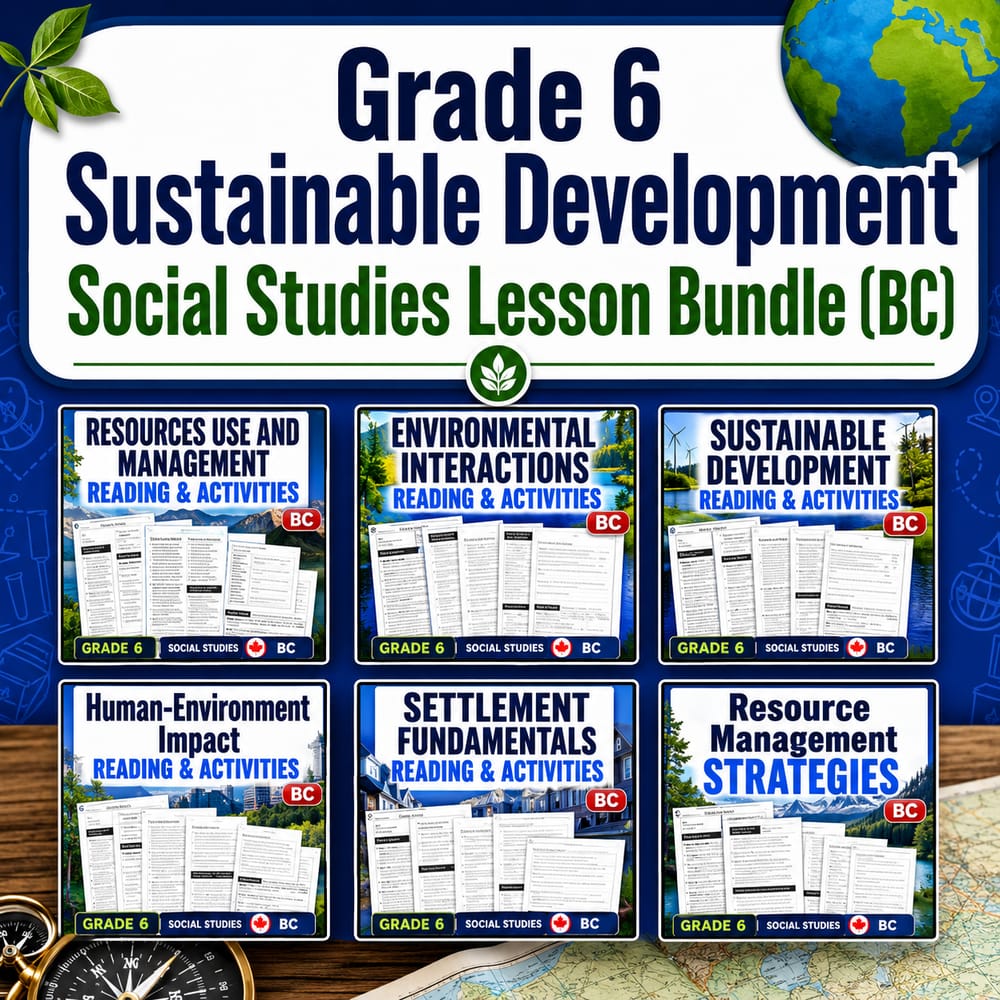
Grade 6 Sustainable Development Social Studies Lesson Bundle (BC)
$22.40$28.00Save $5.60
Sunny Desk Resources
·2 followers·18 sales
SubjectSocial StudiesGradeGrade 6Pages111 Pages
What’s included
7 worksheets · 111 pages · Save $5.60 (20%) · prices shown inside the bundle
 6th Grade Social Studies Worksheet | Resource Use & Management (PDF)
- Explain the difference between sustainable harvesting and industrial exploitation of resources.
- Assess how human choices about resources can affect local environments and communities.
- Evaluate case studies to determine which resource-management approach supports long-term sustainability.
$3.20$4.00 6th Grade Social Studies Worksheet | Environmental Interactions (PDF)
- Describe how human activities such as agriculture, infrastructure, and resource extraction can change environmental conditions
- Analyze cause-and-effect relationships between human behavior and ecological change in a community
- Explain how indigenous perspectives can support environmental stewardship and sustainable community development
$3.20$4.00 6th Grade Social Studies Worksheet | Sustainable Development (PDF)
- Explain sustainable development by describing how communities balance economic growth with environmental conservation.
- Use examples from Canada to identify practices that support environmental stewardship and long-term sustainability.
- Connect sustainable development to Indigenous knowledge and modern policies for resource management.
$3.20$4.00 6th Grade Social Studies Worksheet – Human-Environment Impact (PDF)
- Explain how human activities can change local ecosystems and community well-being.
- Use evidence from real-world examples to identify cause-and-effect relationships between human actions and environmental outcomes.
- Evaluate trade-offs involved in infrastructure development and resource use, considering ecological health and social impacts.
$3.20$4.00 6th Grade Social Studies – Settlement Foundations Worksheet (PDF)
- Identify how physical geography (rivers, coastlines, and fertile land) affects where people settle.
- Describe how resource availability supports economic activities in early communities.
- Explain how settlement patterns can differ across regions due to environmental conditions.
$3.20$4.00 Grade 6 Social Studies | Settlement Patterns Analysis Worksheet (PDF)
- Compare how geographic features, climate, and resource availability influence where communities develop.
- Interpret settlement patterns on maps by identifying clues such as water access, landforms, and resource zones.
- Explain how environmental factors can affect community layouts and growth over time.
$3.20$4.00 6th Grade Social Studies | Resource Management Strategies Worksheet (PDF)
- Compare indigenous and modern strategies for managing natural resources and explain potential benefits and risks.
- Evaluate how regulations and renewable-resource practices can improve sustainability.
- Use case studies (fisheries and forests in Canada) to assess effectiveness of conservation methods.
$3.20$4.00
Reviews & Feedback
Loading reviews...
Questions & Answers
Loading questions…
About this bundle
Related categories
Frequently asked questions
Who is Grade 6 Sustainable Development Social Studies Lesson Bundle (BC) designed for?
Grade 6 Sustainable Development Social Studies Lesson Bundle (BC) is designed for Grade 6 students and Social Studies learners and can be used in classrooms, homeschool, or independent practice.
How do I download Grade 6 Sustainable Development Social Studies Lesson Bundle (BC)?
Add it to your cart and complete checkout. After payment, you can download immediately from your account, and you'll also receive a download link by email.
