
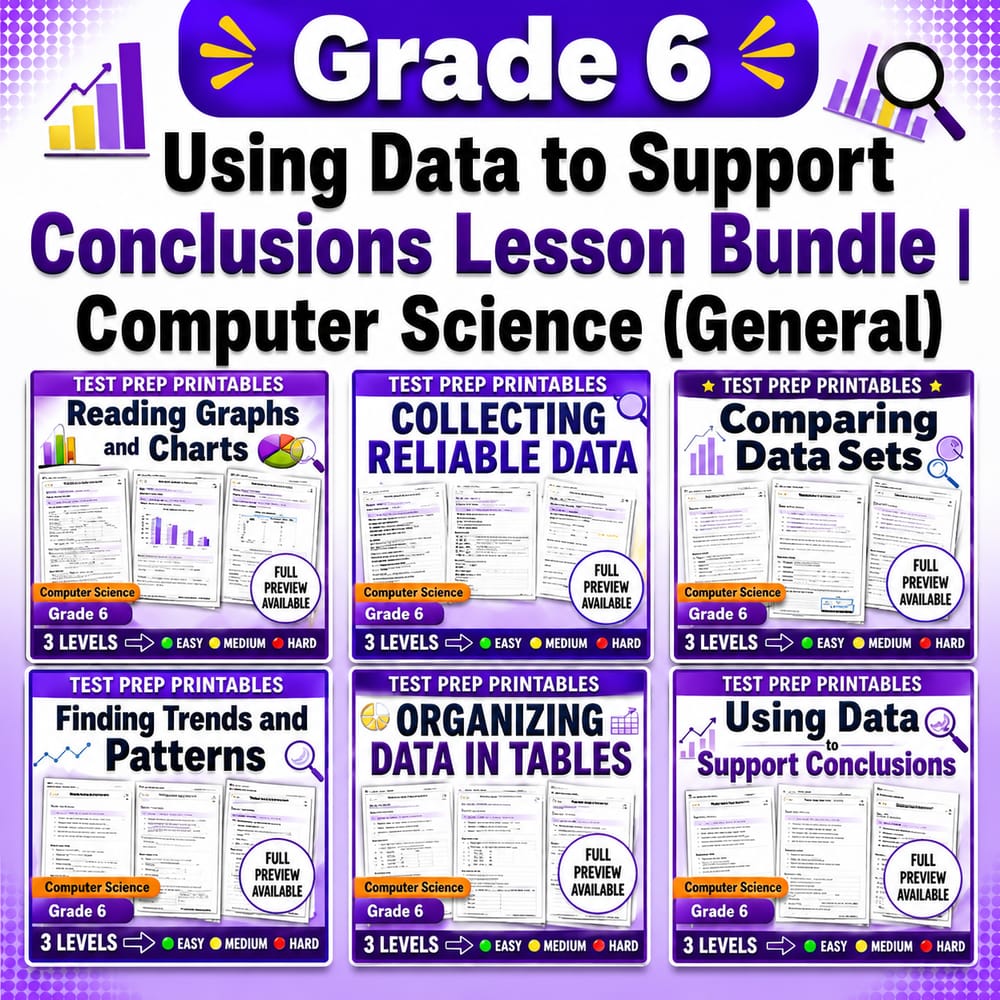
Grade 6 Using Data to Support Conclusions Lesson Bundle | Computer Science (General)
$24.00$30.00Save $6.00
Prism Point Learning
·2 followers·13 sales
SubjectComputer ScienceGradeGrade 6Pages181 Pages
What’s included
6 worksheets · 181 pages · Save $6.00 (20%) · prices shown inside the bundle
 Reading Graphs and Charts Worksheet Grade 6 Computer Science Activity
- Identify key parts of bar graphs, line graphs, and pictographs, including axes and categories
- Use graph information to compare values and describe patterns
- Choose the correct graph type for a data question
$4.00$5.00 Collecting Reliable Data Worksheet Grade 6 Computer Science Activity
- Describe how reliable data is collected using careful observation, accurate counting, and consistent methods.
- Use key vocabulary words (reliable, observe, count, data) correctly in science and computer science contexts.
- Decide whether statements about data collection are true or false and explain short answers clearly.
$4.00$5.00 Comparing Data Sets Worksheet Grade 6 Computer Science Activity
- Compare two or more data sets to find similarities and differences
- Use data words such as greater, less, equal, and changing to describe relationships
- Identify patterns by describing how values change across data sets
$4.00$5.00 Finding Trends and Patterns Worksheet Grade 6 Computer Science Activity
- Identify the difference between a trend and a pattern in data
- Use trend and pattern clues to make an evidence-based prediction
- Describe whether data is increasing or decreasing over time
$4.00$5.00 Organizing Data in Tables Worksheet Grade 6 Computer Science Activity
- Explain what tables, rows, and columns are used for when organizing data.
- Identify how table structure helps compare information accurately.
- Use table vocabulary to describe sorting and organizing data.
$4.00$5.00 Using Data to Support Conclusions Worksheet Grade 6 Computer Science
- Identify evidence from graphs and tables to support a claim or conclusion.
- Use careful analysis of data displays to explain why a conclusion is valid.
- Distinguish between guessing and conclusions supported by reliable data.
$4.00$5.00
Reviews & Feedback
Loading reviews...
Questions & Answers
Loading questions…
About this bundle
Related categories
Frequently asked questions
Who is Grade 6 Using Data to Support Conclusions Lesson Bundle | Computer Science (General) designed for?
Grade 6 Using Data to Support Conclusions Lesson Bundle | Computer Science (General) is designed for Grade 6 students and Computer Science learners and can be used in classrooms, homeschool, or independent practice.
How do I download Grade 6 Using Data to Support Conclusions Lesson Bundle | Computer Science (General)?
Add it to your cart and complete checkout. After payment, you can download immediately from your account, and you'll also receive a download link by email.