
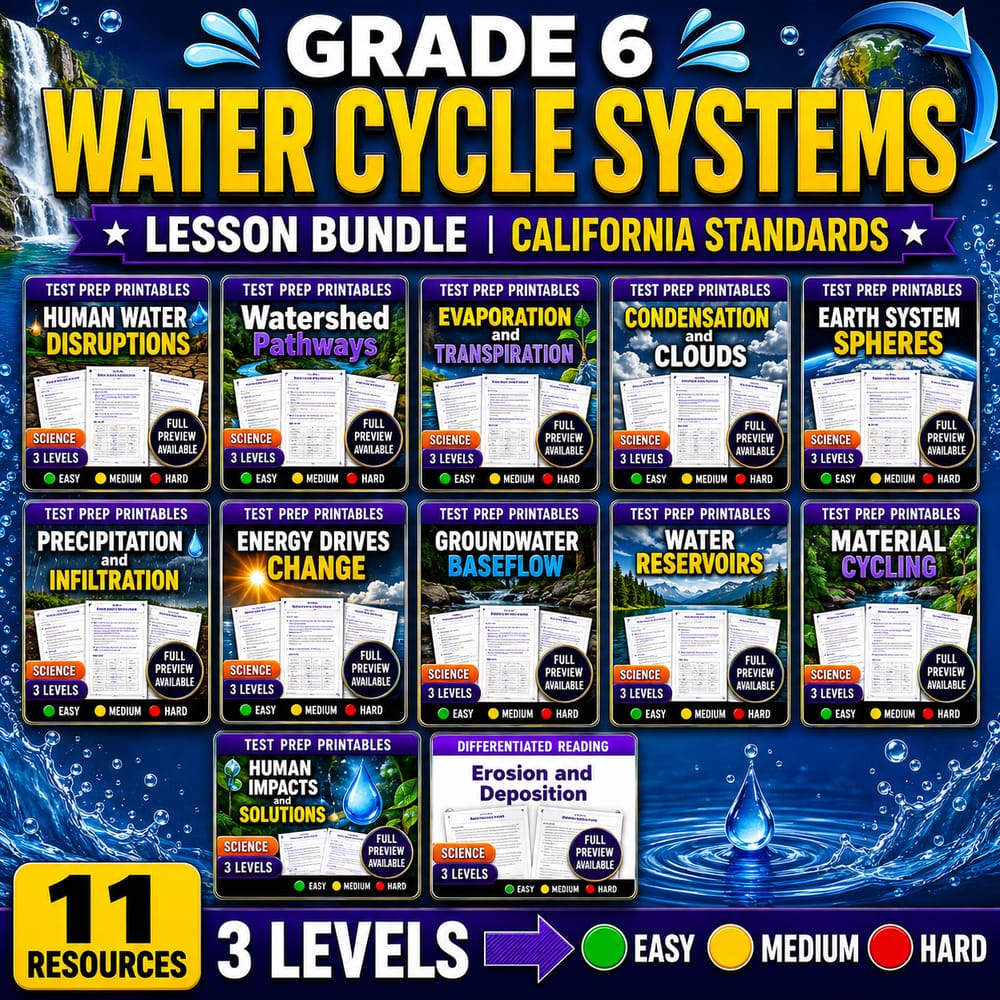

Grade 6 Water Cycle Systems Lesson Bundle | California Standards
$44.00$55.00Save $11.00
Prism Point Learning
·2 followers·13 sales
SubjectScienceGradeGrade 6Pages333 Pages
What’s included
11 worksheets · 333 pages · Save $11.00 (20%) · prices shown inside the bundle
 Human Water Disruptions Worksheet Grade 6 Science Water Cycle Impact
- Explain how human actions can change the movement of water through Earth systems
- Describe how dams, withdrawals, pollution, and land-cover change can affect water quality and habitats
- Use cause-and-effect reasoning to predict impacts on aquatic life and flood risk
$4.00$5.00 Watershed Pathways Worksheet Grade 6 Science Water Systems Practice
- Describe how water moves through a watershed using interconnected pathways shaped by terrain and land cover.
- Explain how gravity, infiltration, and vegetation affect the timing and amount of water moving downstream.
- Connect watershed processes to downstream conditions such as stream flow, erosion, and water quality.
$4.00$5.00 Evaporation and Transpiration Worksheet Grade 6 Water Cycle Science
- Explain how evaporation adds water vapor to the atmosphere when temperatures increase.
- Describe how transpiration from plants contributes water vapor to the air.
- Connect phase changes to the hydrosphere and atmosphere and the start of precipitation.
$4.00$5.00 Condensation and Clouds Worksheet Grade 6 Science Water Cycle
- Explain how water vapor changes into liquid droplets or ice crystals during condensation.
- Describe how cloud formation connects atmospheric conditions to rainfall.
- Connect clouds to energy balance by explaining how they affect sunlight.
$4.00$5.00 Earth System Spheres Worksheet Pack Grade 6 Science Earth Systems
- Identify Earth’s major spheres (geosphere, hydrosphere, atmosphere, biosphere) and describe how they interact.
- Explain how energy and gravity help move matter and influence changes across Earth systems.
- Use cause-and-effect reasoning to predict how changes in one sphere can affect other spheres.
$4.00$5.00 Precipitation and Infiltration Worksheet Grade 6 Water Cycle Practice
- Explain how precipitation returns water to Earth’s surface.
- Describe how infiltration affects soil moisture and possible groundwater recharge.
- Compare infiltration and surface runoff as pathways for water movement.
$4.00$5.00 Energy Drives Change Worksheet Grade 6 Science Energy Transfer
- Explain how energy from the Sun and gravity drive Earth system processes such as heating, evaporation, and the movement of water and sediments.
- Describe how changes in energy affect water’s state and how this relates to evaporation and cloud formation.
- Connect energy-driven weathering and transport to changes in where sediments and soils accumulate.
$4.00$5.00 Groundwater and Baseflow Worksheet | Grade 6 Water Cycle Practice
- Explain how precipitation infiltrates and percolates to recharge groundwater stored in aquifers.
- Describe how groundwater can supply streams as baseflow and help maintain river flow during dry periods.
- Identify how permeability and landscape geometry affect the connection between groundwater and surface water.
$4.00$5.00 Water Reservoirs Worksheet Grade 6 Science Water Cycle Systems
- Identify major water reservoirs on Earth and describe the form of water each one stores.
- Explain how state changes move water between reservoirs and affect where water is available over time.
- Distinguish between fast and gradual water movement between reservoirs using examples.
$4.00$5.00 Material Cycling Worksheet Grade 6 Science Cycles of Matter Practice
- Explain how physical and chemical weathering break rocks into sediments
- Describe how sediments move and deposit to form layered materials over time
- Connect biological processes to the formation of soil and nutrient availability
$4.00$5.00
Reviews & Feedback
Loading reviews...
Questions & Answers
Loading questions…
About this bundle
Related categories
Frequently asked questions
Who is Grade 6 Water Cycle Systems Lesson Bundle | California Standards designed for?
Grade 6 Water Cycle Systems Lesson Bundle | California Standards is designed for Grade 6 students and Science learners and can be used in classrooms, homeschool, or independent practice.
How do I download Grade 6 Water Cycle Systems Lesson Bundle | California Standards?
Add it to your cart and complete checkout. After payment, you can download immediately from your account, and you'll also receive a download link by email.
Similar Products

Weather, Water Cycle & Climate Systems Lesson Bundle | Grade 6 Science | NGSS
$24.00$30.00

Water Cycle & Weather Grade 7 Science Daily Reading Lesson Bundle | CA Standards
$32.00$40.00

Water Cycle Grade 6 Science Lesson Bundle Daily Reading | California Standards
$35.20$44.00

Grade 6 Science | Weather, Water Cycle & Climate Systems Worksheet Bundle
$9.60$12.00