
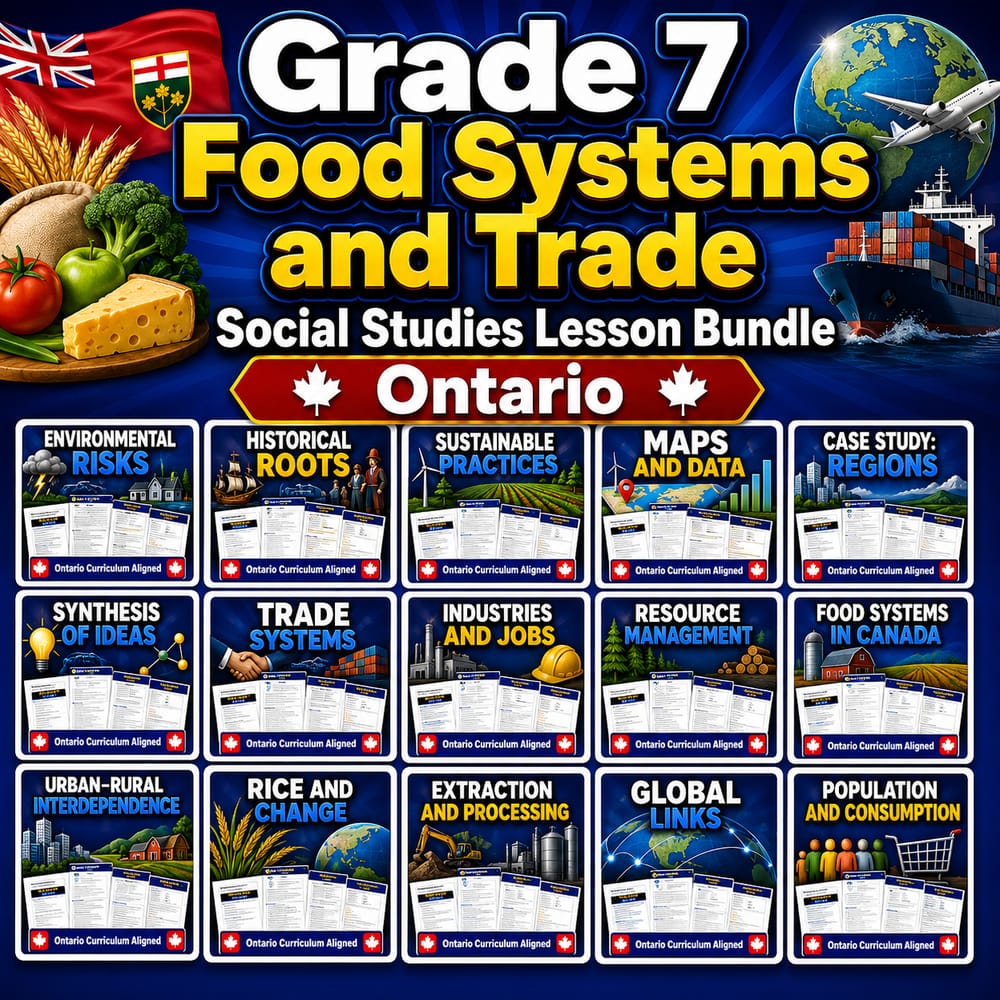


Grade 7 Food Systems and Trade Social Studies Lesson Bundle Ontario
$54.40$68.00Save $13.60
Sunny Desk Resources
·2 followers·18 sales
SubjectSocial StudiesGradeGrade 7
What’s included
17 worksheets · Save $13.60 (20%) · prices shown inside the bundle
 Grade 7 Social Studies | Environmental Risks Worksheet (Ontario PDF)
- Identify major environmental risks and explain how they affect human health and communities.
- Describe ways to reduce environmental risks using individual, community, and policy-level actions.
- Evaluate claims about environmental risk using evidence from a passage and real-world examples.
$3.20$4.00 Grade 7 Social Studies | Migration Flows Worksheet (Ontario Standards) (PDF)
- Explain major causes that drive migration flows between regions
- Describe how migration affects labor markets, culture, and urban form in both origin and destination places
- Analyze continuity and change in migration patterns over time using evidence and feedback effects
$3.20$4.00 Grade 7 Social Studies | Sustainable Practices Worksheet (Ontario) (PDF)
- Explain how sustainable practices reduce environmental impacts through conservation, renewable energy, and better resource management.
- Describe how technology adoption, policy decisions, and economic incentives can create both benefits and trade-offs.
- Compare local sustainability initiatives with global commitments and explain how governance and Indigenous stewardship affect long-term outcomes.
$3.20$4.00 Grade 7 Social Studies | Maps And Data Worksheet (Ontario Standards)
- Explain how thematic maps and GIS outputs reveal spatial patterns and trends in geographic data.
- Use geographic terminology (scale, classification, and data sources) to interpret maps more accurately.
- Describe causes and consequences shown in mapped data and connect local observations to broader regional and global processes.
$3.20$4.00 Grade 7 Social Studies | Port & Trade Case Study Worksheet (Ontario)
- Explain how an international seaport connects global trade to inland distribution and local urban economies.
- Describe continuity and change in port functions from historical docks to modern container terminals.
- Analyze how port expansion affects labor markets, housing, and environmental management.
$3.20$4.00 Grade 7 Social Studies Worksheet | Synthesis Maps (PDF) – Ontario Standards
- Explain how synthesis maps combine multiple datasets and map types to reveal spatial patterns.
- Interpret overlapping evidence to infer likely causes, effects, and interrelationships.
- Evaluate how scale, projection, and classification choices can change conclusions.
$3.20$4.00 Grade 7 Social Studies Worksheet | Trade Networks and Commerce (PDF)
- Explain how trade networks depend on supply chains, transportation corridors, and ports
- Analyze continuity and change in trade routes and logistics technologies over time
- Evaluate how tariffs and infrastructure affect regional development and resilience
$3.20$4.00 Grade 7 Social Studies – Industries Worksheet (Ontario) (PDF)
- Explain how different industries (manufacturing, service, and extractive) depend on geographic factors.
- Analyze how industrial location decisions affect employment, regional identity, and local environments.
- Evaluate how globalization and technology can create change and continuity in industrial systems.
$3.20$4.00 Grade 7 Social Studies Resource Mapping Worksheet (Ontario) PDF
- Explain how maps and spatial data show where resources are located and why those locations matter for industry.
- Describe how transportation networks connect resource regions to markets and global commodity chains.
- Analyze how resource extraction can cause environmental and social consequences in different places.
$3.20$4.00 Grade 7 Social Studies – Food Systems Worksheet (Ontario) (PDF)
- Describe how Ontario’s food system connects farming, processing, transportation, and consumption.
- Explain how food choices can affect the environment, community health, and food security.
- Analyze relationships between food system stages and outcomes such as waste and equity.
$3.20$4.00
Reviews & Feedback
Loading reviews...
Questions & Answers
Loading questions…
About this bundle
Related categories
Frequently asked questions
Who is Grade 7 Food Systems and Trade Social Studies Lesson Bundle Ontario designed for?
Grade 7 Food Systems and Trade Social Studies Lesson Bundle Ontario is designed for Grade 7 students and Social Studies learners and can be used in classrooms, homeschool, or independent practice.
How do I download Grade 7 Food Systems and Trade Social Studies Lesson Bundle Ontario?
Add it to your cart and complete checkout. After payment, you can download immediately from your account, and you'll also receive a download link by email.
Similar Products

High School Social Studies 9-12 Full-Year Bundle | California
$262.50$525.00

Grade 11 Social Studies Full-Year Worksheets Bundle | California
$105.00$150.00

Grade 10 Social Studies Full-Year Worksheets Bundle | California
$84.00$120.00

Grade 9 Social Studies Full-Year Worksheets Bundle | California
$77.00$110.00

Middle School Social Studies 6-8 Full-Year Bundle | California
$447.50$895.00