
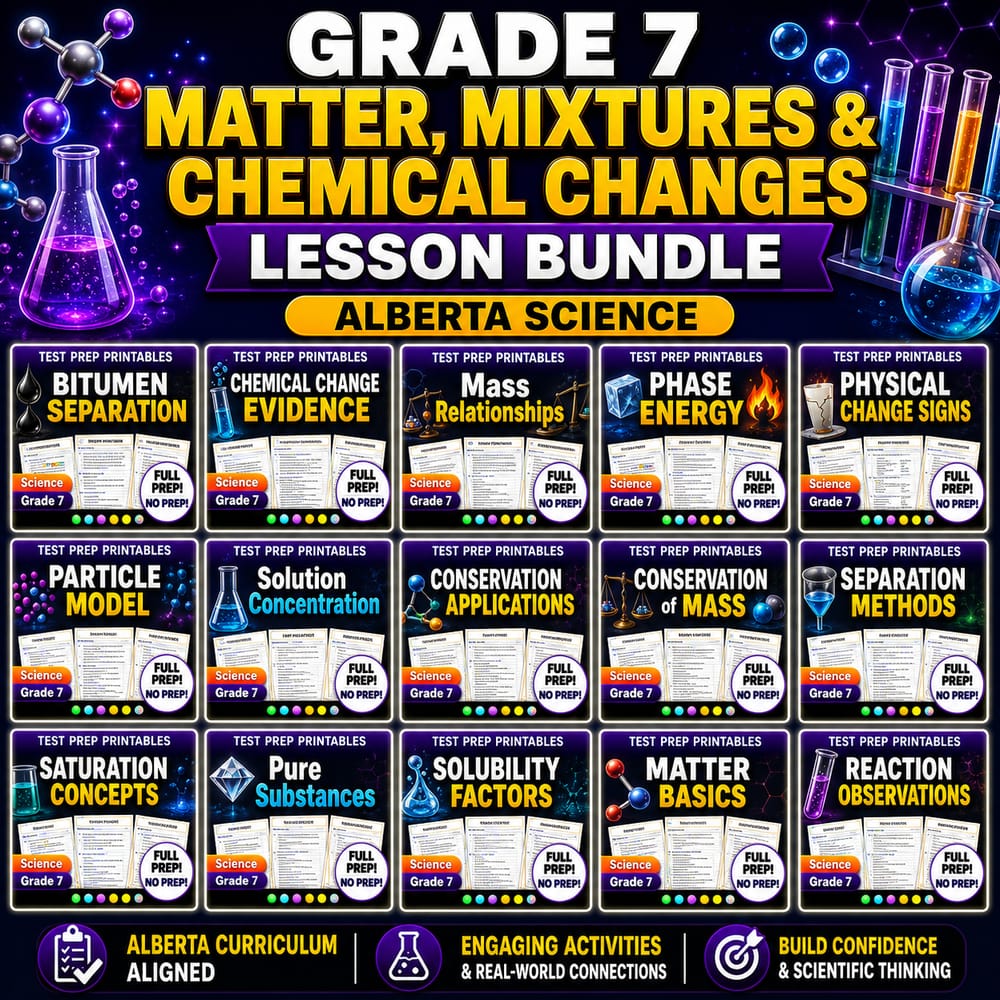


Grade 7 Matter, Mixtures & Chemical Changes Lesson Bundle | Alberta Science
$60.00$75.00Save $15.00
Prism Point Learning
·2 followers·13 sales
SubjectScienceGradeGrade 7
What’s included
15 worksheets · Save $15.00 (20%) · prices shown inside the bundle
 Bitumen Separation Worksheet | Grade 7 Science Activities
- Explain how physical separation can separate components of oil sands using density and particle size.
- Describe how chemical treatment and temperature changes affect emulsions and dissolved organics.
- Classify processing steps as physical versus chemical changes in bitumen extraction.
$4.00$5.00 Chemical Change Evidence Worksheet | Grade 7 Science Practice
- Identify observable evidence that a chemical change has occurred.
- Explain, using a particle-level model, how bonds can break and form during a chemical change.
- Distinguish chemical changes from physical changes based on whether new substances form.
$4.00$5.00 Mass Relationships Worksheet | Grade 7 Science Activities
- Explain how conservation of mass applies to closed-system chemical reactions.
- Use mass accounting to relate reactant masses to product masses.
- Interpret theoretical vs. measured mass distributions to assess reaction completeness.
$4.00$5.00 Phase Energy Worksheet | Grade 7 Science Activities
- Explain how phase changes relate to particle kinetic energy and potential energy
- Describe how energy is absorbed or released during melting, freezing, evaporation, and condensation
- Interpret latent heat as an energy change that occurs without changing chemical identity
$4.00$5.00 Physical Change Signs Worksheet Grade 7 Science Activities
- Identify signs of a physical change by linking particle behavior to observable properties.
- Explain how phase transitions and dissolving can occur without changing chemical identity.
- Use mass conservation in closed systems to support whether a change is physical.
$4.00$5.00 Particle Model Worksheet | Grade 7 Science Activities
- Explain how the particle model uses discrete particles, spaces, and motion to describe matter
- Connect particle behavior to observable properties and state changes (such as density, diffusion, evaporation, and condensation)
- Differentiate physical rearrangements from chemical transformations using particle interactions
$4.00$5.00 Solution Concentration Worksheet | Grade 7 Science Practice
- Explain what solution concentration means and identify the roles of solute and solvent.
- Use mass percent and grams per litre to describe how concentrated a solution is.
- Predict how concentration can affect boiling point and freezing point.
$4.00$5.00 Conservation Applications Worksheet Pack | Grade 7 Science Activities
- Use mass conservation to build simple mass budgets for closed or near-closed science systems.
- Explain how reaction stoichiometry and waste/environmental accounting apply conservation of mass.
- Analyze measured versus expected masses and suggest plausible reasons for differences.
$4.00$5.00 Conservation Mass Worksheet | Grade 7 Science Activities
- Explain conservation of mass in terms of atoms being conserved in a closed system.
- Predict whether total mass changes by comparing masses of reactants and products when nothing enters or leaves.
- Use sealed-container observations to support claims about conservation of mass during physical or chemical changes.
$4.00$5.00 Separation Methods Worksheet Grade 7 Science Practice
- Explain how physical properties (particle size, solubility, magnetism, boiling point) can be used to separate mixtures without changing chemical identity
- Match common separation techniques to the physical property differences they exploit
- Interpret separation efficiency by linking observations (what remains vs. what is removed) to the type of material in a mixture
$4.00$5.00
Reviews & Feedback
Loading reviews...
Questions & Answers
Loading questions…
About this bundle
Related categories
Frequently asked questions
Who is Grade 7 Matter, Mixtures & Chemical Changes Lesson Bundle | Alberta Science designed for?
Grade 7 Matter, Mixtures & Chemical Changes Lesson Bundle | Alberta Science is designed for Grade 7 students and Science learners and can be used in classrooms, homeschool, or independent practice.
How do I download Grade 7 Matter, Mixtures & Chemical Changes Lesson Bundle | Alberta Science?
Add it to your cart and complete checkout. After payment, you can download immediately from your account, and you'll also receive a download link by email.
Similar Products

Matter and Chemical Change Lesson Bundle | Grade 9 Science | Ontario
$38.40$48.00

Matter & Chemical Change Grade 8 Science Bundle | Alberta Worksheets
$36.00$45.00

Grade 8 Alberta Science Matter and Chemical Change Worksheet Bundle
$60.00$75.00

Matter and Chemical Change Lesson Bundle: Grade 7 Science Alberta
$60.00$75.00

Matter and Chemical Change Grade 7 Alberta Science Worksheets Bundle
$36.00$45.00