
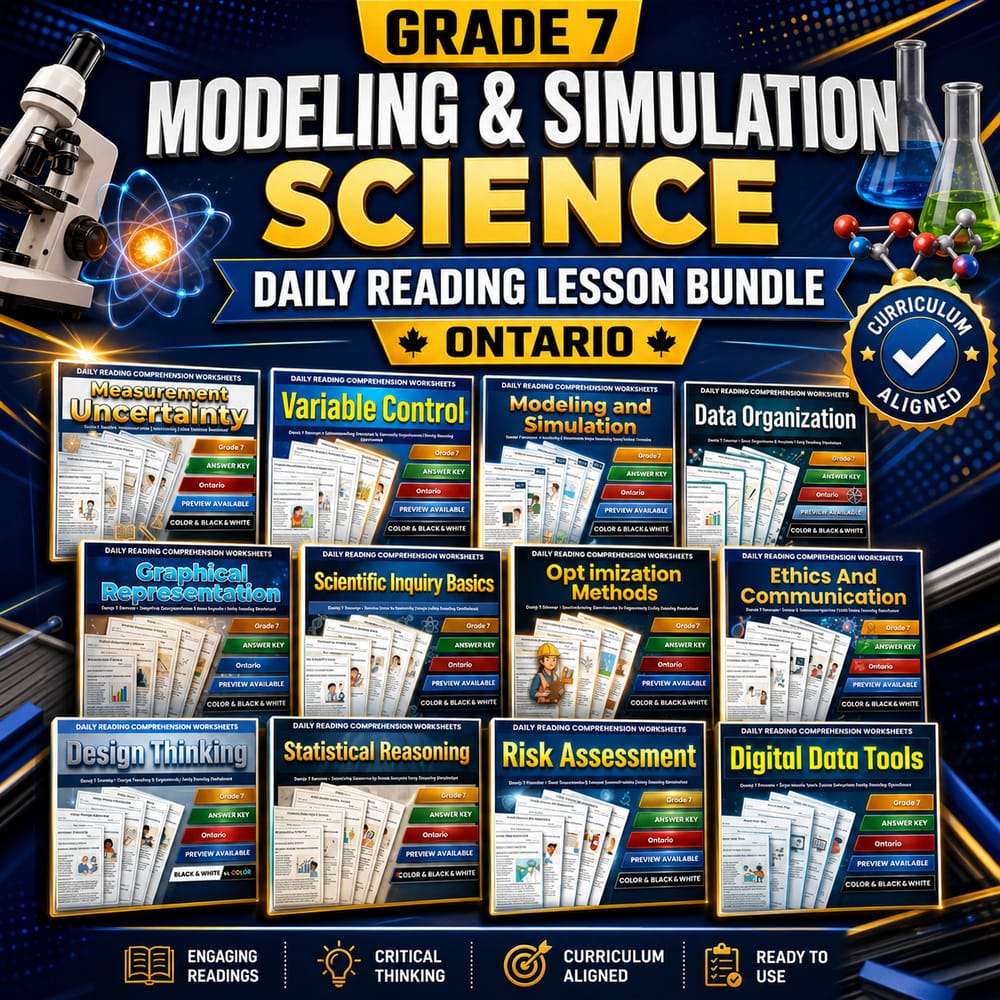


Grade 7 Modeling & Simulation Science Daily Reading Lesson Bundle | Ontario
$38.40$48.00Save $9.60
Bright Mind Resources
New·1 followers·12 sales
SubjectScienceGradeGrade 7
What’s included
12 worksheets · Save $9.60 (20%) · prices shown inside the bundle
 Grade 7 Science – Measurement & Uncertainty | Daily Reading Worksheet
- Understand the basic units used in scientific measurements
- Learn the importance of accuracy and precision in measurements
- Recognize sources of measurement uncertainty, including systematic and random errors
$3.20$4.00 Grade 7 Science – Variables & Scientific Experiments | Daily Reading Worksheet
- Identify independent, dependent, and controlled variables in experiments
- Understand the importance of operational definitions
- Recognize sources of confounding variables
$3.20$4.00 Grade 7 Science – Modeling & Simulation Daily Reading Worksheet | Ontario
- Understand the purpose and types of scientific models
- Identify the key components in simple numerical models
- Explain the concept of assumptions and their role in modeling
$3.20$4.00 Grade 7 Science – Data Organization & Analysis | Daily Reading Worksheet
- Understand different types of data used in scientific studies (categorical and numerical).
- Learn how to organize data systematically using tables and logs.
- Recognize standards for metadata, timestamps, and documentation to ensure data credibility.
$3.20$4.00 Grade 7 Science – Graphical Representation & Data Analysis | Reading Worksheet
- Understand different types of graphs used in scientific data presentation
- Recognize when to use bar charts, histograms, line graphs, and scatter plots
- Interpret elements of graphs such as axes, trend lines, and error bars
$3.20$4.00 Grade 7 Science – Introduction to Scientific Inquiry Daily Reading Worksheet
- Understand the fundamental components of scientific inquiry
- Learn how to formulate clear and testable scientific questions
- Identify key variables and operational definitions in experiments
$3.20$4.00 Grade 7 Science – Optimization & Engineering | Daily Reading Worksheet
- Identify key performance metrics used in engineering design.
- Understand how constraints influence design decisions.
- Evaluate trade-offs among strength, cost, and sustainability.
$3.20$4.00 Grade 7 Science – Ethics & Communication in STEM | Daily Reading Worksheet
- Understand the importance of honesty and transparency in scientific communication.
- Recognize ethical considerations in data sharing, attribution, and intellectual property.
- Learn conventions for technical reporting, graphical annotation, and peer review.
$3.20$4.00 Grade 7 Science – Design Thinking & Engineering | Daily Reading Worksheet
- Understand the fundamentals of engineering design processes.
- Identify problem constraints and define clear specifications.
- Learn how to evaluate solutions using trade-off considerations.
$3.20$4.00 Grade 7 Science – Statistical Reasoning & Data Analysis Daily Reading Worksheet
- Understand and calculate measures of central tendency: mean, median, and mode.
- Interpret dispersion using interquartile range, variance, and outliers.
- Represent data with simple graphical summaries.
$3.20$4.00
Reviews & Feedback
Loading reviews...
Questions & Answers
Loading questions…
About this bundle
Related categories
Frequently asked questions
Who is Grade 7 Modeling & Simulation Science Daily Reading Lesson Bundle | Ontario designed for?
Grade 7 Modeling & Simulation Science Daily Reading Lesson Bundle | Ontario is designed for Grade 7 students and Science learners and can be used in classrooms, homeschool, or independent practice.
How do I download Grade 7 Modeling & Simulation Science Daily Reading Lesson Bundle | Ontario?
Add it to your cart and complete checkout. After payment, you can download immediately from your account, and you'll also receive a download link by email.

