
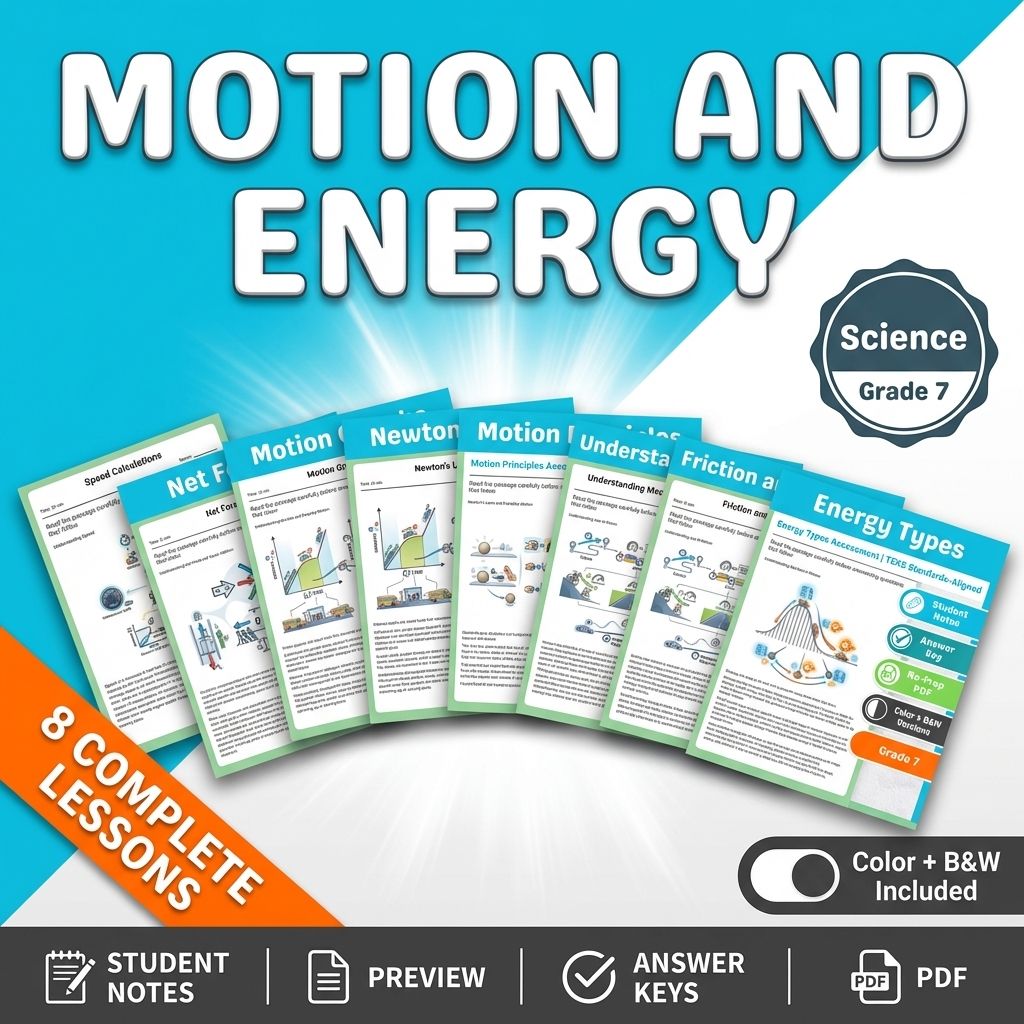
Grade 7 Motion and Energy Science: Lesson Bundle TEKS Unit Assessment
$32.00$40.00Save $8.00
Prism Point Learning
·2 followers·14 sales
SubjectScienceGradeGrade 7
What’s included
8 worksheets · Save $8.00 (20%) · prices shown inside the bundle
 Speed Calculations Assessment for Grade 7 Science | TEKS Standards
- Understand how to calculate average speed using distance and time data.
- Distinguish between average speed and instantaneous speed through examples.
- Convert speed units between meters per second and kilometers per hour.
$4.00$5.00 Net Force Assessment | TEKS Grade 7 Science Standards-Aligned
- Understand the concept of net force and how it determines motion.
- Learn to interpret free-body diagrams for systems such as elevators, tug-of-war, and carts on ramps.
- Apply vector addition and equilibrium conditions to solve for net force in one dimension.
$4.00$5.00 Motion Principles Assessment for Grade 7 Science – Standards-Aligned
- Understand the basic concepts of speed, velocity, and acceleration in motion.
- Distinguish between scalar and vector quantities related to motion.
- Interpret motion scenarios qualitatively and relate them to displacement, time, and rate of change.
$4.00$5.00 Friction and Gravity Assessment | TEKS Grade 7 Science Worksheet
- Understand how friction opposes motion and affects objects on different surfaces.
- Explain the role of gravity as a force pulling objects toward planetary surfaces.
- Differentiate between contact forces and long-range forces, with observable effects.
$4.00$5.00 Understanding Mechanical Energy Assessment for Grade 7 Science TEKS
- Explain the concept of mechanical energy and how it is conserved in ideal systems.
- Describe how energy transfers among system components in phenomena like pendulums and springs.
- Identify real-world examples of mechanical energy and explain the role of energy loss to non-mechanical forms.
$4.00$5.00 Motion Graphs Assessment for Grade 7 Science TEKS Standards
- Interpret distance–time and velocity–time graphs to describe motion patterns.
- Identify examples of uniform motion, acceleration, deceleration, and rest from graphs.
- Relate slopes to speed and analyze areas under velocity curves for displacement.
$4.00$5.00 Energy Types Assessment | TEKS Grade 7 Science Standards-Aligned
- Define kinetic and potential energy with real-world examples.
- Explain how height and motion relate to different energy forms.
- Illustrate energy transfer and conservation concepts in systems.
$4.00$5.00 Newton's Laws Assessment for Grade 7 Science | TEKS Standards
- Understand the core principles of Newton's three laws of motion.
- Identify real-world examples illustrating inertia, acceleration, and action–reaction pairs.
- Explain how mass, force, and motion are related through qualitative relationships.
$4.00$5.00
Reviews & Feedback
Loading reviews...
Questions & Answers
Loading questions…
About this bundle
Related categories
Frequently asked questions
Who is Grade 7 Motion and Energy Science: Lesson Bundle TEKS Unit Assessment designed for?
Grade 7 Motion and Energy Science: Lesson Bundle TEKS Unit Assessment is designed for Grade 7 students and Science learners and can be used in classrooms, homeschool, or independent practice.
How do I download Grade 7 Motion and Energy Science: Lesson Bundle TEKS Unit Assessment?
Add it to your cart and complete checkout. After payment, you can download immediately from your account, and you'll also receive a download link by email.
Similar Products

Grade 8 Force, Motion, and Energy Science Lesson Bundle TEKS Standards
$40.00$50.00

Grade 7 Motion & Energy Science Daily Reading Worksheets Lesson Bundle | TEKS
$25.60$32.00

Grade 9 Motion and Energy Science Lesson Bundle: General Framework
$28.80$36.00

Grade 7 Science Unit Workbook | Motion, Forces & Energy TEKS-Aligned Worksheets
$19.20$24.00

Energy, Motion and Electricity Lesson Bundle | Grade 10 Science | Alberta
$60.00$75.00