
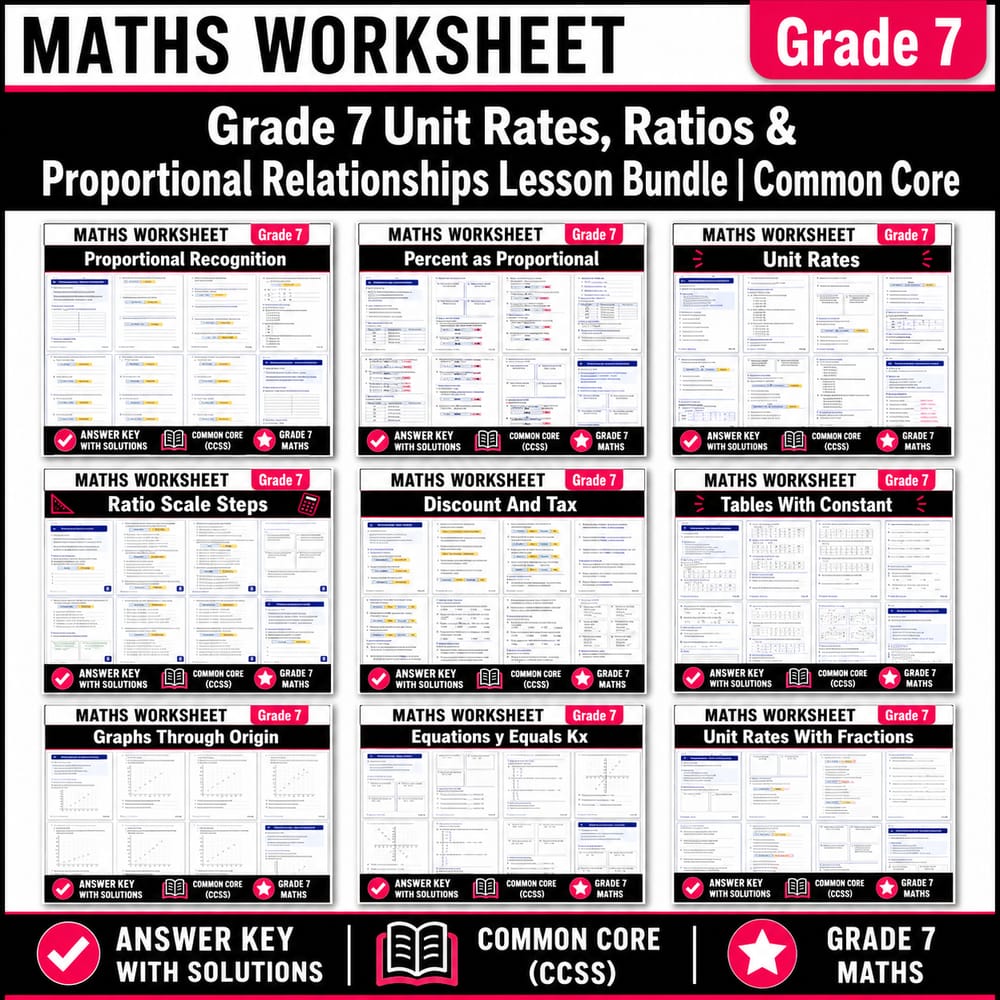
Grade 7 Ratios & Proportional Relationships Lesson Bundle | Math CCSS
$36.00$45.00Save $9.00
BRIGHT PATH RESOURCES
·3 followers·23 sales
SubjectMathsGradeGrade 7Pages112 Pages
What’s included
9 worksheets · 112 pages · Save $9.00 (20%) · prices shown inside the bundle
 Proportional Recognition Math Worksheet for Grade 7 | CCSS Aligned
- Recognise proportional relationships by checking whether corresponding values form equivalent ratios
- Use constant multiplicative change (a single scale factor) to find missing values in proportional situations
- Identify the constant of proportionality k in models of the form y = kx
$4.00$5.00 Percent as Proportional Change Worksheet | Grade 7 Maths | CCSS Math
- Represent a percent increase or decrease as a multiplicative factor (e.g., +15% → ×1.15, −25% → ×0.75).
- Use proportional reasoning to find a new amount from a base amount after a percent change.
- Interpret percent models and conversion tables to move between fraction, decimal, and percent forms.
$4.00$5.00 Converting Ratios to Unit Rates - Grade 7 Maths Worksheet PDF
- Convert a ratio into a unit rate by dividing so the second quantity is 1
- Interpret unit rates in real-world contexts such as speed and price per item
- Solve problems using unit rates to scale to different quantities
$4.00$5.00 Ratio Scale Steps Worksheet for Grade 7 | Maths Worksheet | CCSS
- Use tape diagrams to interpret ratios and ratios that stay equivalent when quantities are scaled.
- Solve multi-step ratio scaling problems by applying proportional scale factors consistently across steps.
- Check that intermediate and final quantities keep the same ratio.
$4.00$5.00 Discount And Tax Maths Worksheet | Common Core Grade 7 Maths Worksheet
- Apply sequential percent changes using multiplicative factors (e.g., discount then tax).
- Represent percent change using parts of a 100% tape diagram model.
- Translate percent situations into equations and solve for the unknown original amount.
$4.00$5.00 Grade 7 Maths Worksheet | Tables With Constant – Standard CCSS
- Complete proportional tables by finding missing values using a constant ratio y/x
- Use the constant of proportionality y/x to extend patterns in tables
- Check whether a table represents a proportional relationship by comparing y/x across rows
$4.00$5.00 Graphs Through Origin Worksheet Grade 7 Maths | CCSS Printable PDF
- Recognise that proportional relationships form straight lines that pass through the origin.
- Find the unit rate (slope) k from plotted points on a line through the origin.
- Use y = kx to predict y-values for new x-values and check whether a point fits the relationship.
$4.00$5.00 Equations y = kx Grade 7 Maths Worksheet | Common Core CCSS
- Understand proportional relationships can be written in the form y = kx.
- Identify and interpret the constant of proportionality k as the unit rate.
- Solve simple equations of the form kx = y to find x or k.
$4.00$5.00 Unit Rates With Fractions Worksheet for Grade 7 | Maths Worksheet CCSS
- Interpret unit rates as ratios divided to a per-1 quantity, even when amounts are fractions
- Compute unit rates by dividing by a fractional quantity (using equivalent fractions or reciprocals)
- Use tape diagrams and ratio reasoning to support unit rate calculations with fractional parts
$4.00$5.00
Reviews & Feedback
Loading reviews...
Questions & Answers
Loading questions…
About this bundle
Related categories
Frequently asked questions
Who is Grade 7 Ratios & Proportional Relationships Lesson Bundle | Math CCSS designed for?
Grade 7 Ratios & Proportional Relationships Lesson Bundle | Math CCSS is designed for Grade 7 students and Maths learners and can be used in classrooms, homeschool, or independent practice.
How do I download Grade 7 Ratios & Proportional Relationships Lesson Bundle | Math CCSS?
Add it to your cart and complete checkout. After payment, you can download immediately from your account, and you'll also receive a download link by email.

