
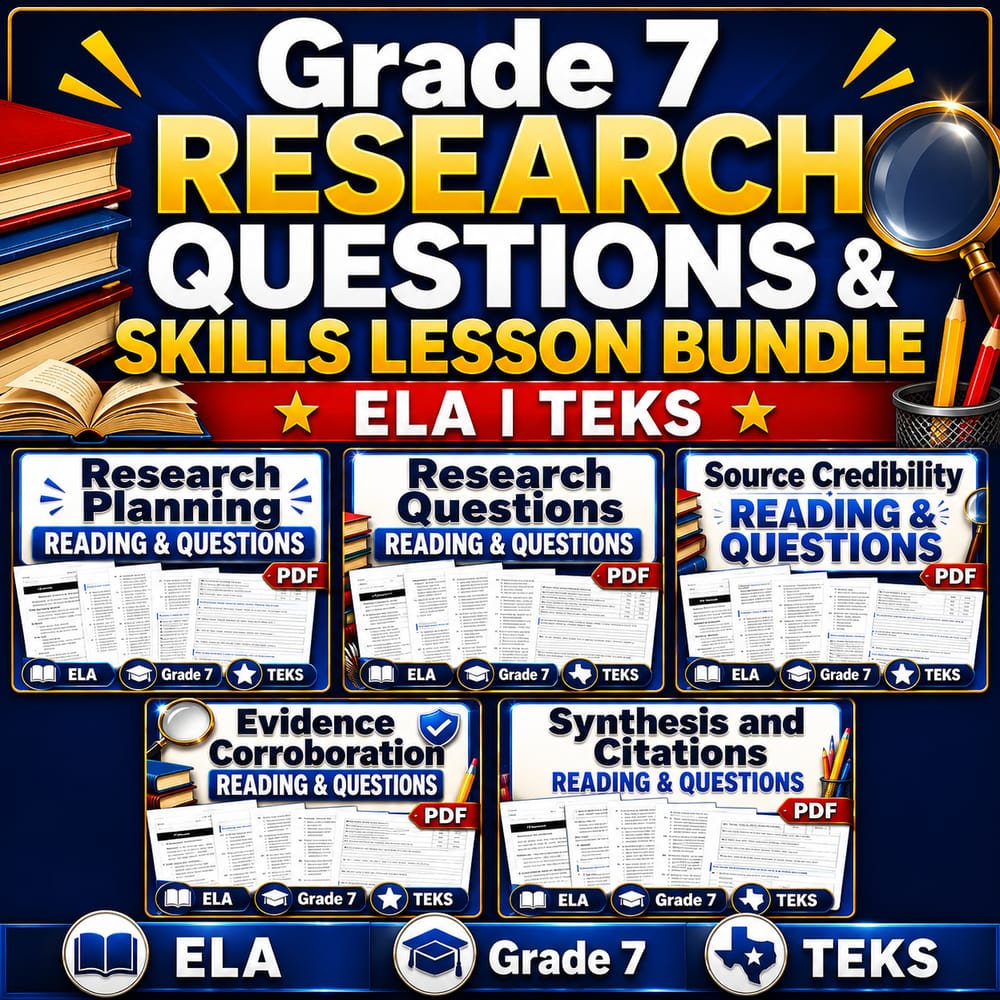
Grade 7 Research Questions & Skills Lesson Bundle | ELA | TEKS
$16.00$20.00Save $4.00
Golden Apple Studio
New·2 followers·3 sales
SubjectELAGradeGrade 7Pages78 Pages
What’s included
5 worksheets · 78 pages · Save $4.00 (20%) · prices shown inside the bundle
 Research Planning Worksheet Grade 7 ELA TEKS Research Skills Activity
- Plan a research project by selecting key terms, setting priorities, and deciding what information is needed.
- Connect collected notes to parts of a developing outline to support clear, organized writing.
- Collect research while preserving context (author, date, and publication type) to strengthen evaluation and accurate attribution.
$3.20$4.00 Research Questions Worksheet Grade 7 ELA TEKS Research Skills Practice
- Identify the features of a strong research question (focused, specific, and evidence-guiding).
- Revise a broad topic into a research question with clear boundaries and relevant keywords.
- Explain how research questions determine what counts as relevant evidence and the depth of a report.
$3.20$4.00 Source Credibility Worksheet Grade 7 ELA TEKS Research Skills
- Evaluate source credibility by examining authority, evidence, and transparency.
- Use a checklist to judge whether a source’s reasoning matches the evidence it provides.
- Consider currency and context when deciding whether information is reliable.
$3.20$4.00 Evidence Corroboration Worksheet Grade 7 ELA TEKS Reading Activity
- Explain how corroboration strengthens a conclusion by comparing evidence across multiple credible sources.
- Evaluate source credibility by identifying bias, incomplete coverage, and differences in methods or purpose.
- Use conflicting and matching evidence to decide which claims are best supported and most relevant to a research question.
$3.20$4.00 Synthesis and Citations Worksheet Grade 7 ELA TEKS Research Skills
- Explain how synthesis goes beyond summary by connecting multiple sources to support a line of reasoning.
- Distinguish facts, interpretations, and author claims when evaluating evidence in texts.
- Use quotes and paraphrases effectively and explain how each source contributes to a claim.
$3.20$4.00
Reviews & Feedback
Loading reviews...
Questions & Answers
Loading questions…
About this bundle
Related categories
Frequently asked questions
Who is Grade 7 Research Questions & Skills Lesson Bundle | ELA | TEKS designed for?
Grade 7 Research Questions & Skills Lesson Bundle | ELA | TEKS is designed for Grade 7 students and ELA learners and can be used in classrooms, homeschool, or independent practice.
How do I download Grade 7 Research Questions & Skills Lesson Bundle | ELA | TEKS?
Add it to your cart and complete checkout. After payment, you can download immediately from your account, and you'll also receive a download link by email.
Similar Products

Grade 3 ELA Writing, Reading, and Research Skills Full-Year Bundle TEKS
$84.00$120.00

TEKS Writing & Argument Research Skills Lesson Bundle | Grade 10 ELA | TEKS
$28.80$36.00

Grade 9 ELA Writing & Research Skills Lesson Bundle | TEKS Framework
$38.40$48.00

Grade 7 ELA Writing & Research Skills Lesson Bundle | CCSS
$24.00$30.00

Grade 12 Writing Skills & Research Lesson Bundle | CCSS ELA
$16.80$21.00