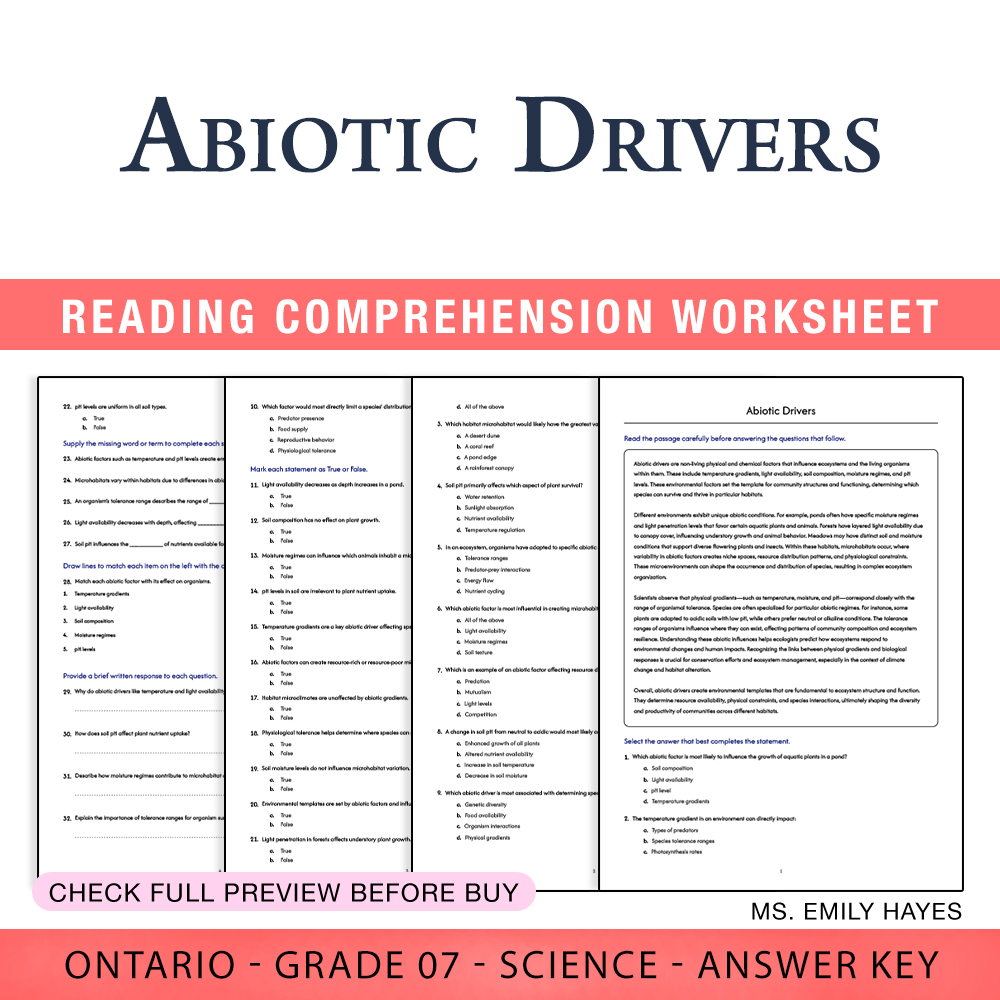
Are you seeking a practical and engaging way to help your Grade 7 students master the concept of abiotic drivers? This comprehensive worksheet is designed to address a common classroom challenge: understanding how non-living physical and chemical factors influence ecosystems and living organisms. With this worksheet, teachers can seamlessly integrate a variety of question types to foster critical thinking and deepen ecological knowledge, all while saving preparation time. The print-ready PDF format ensures easy classroom implementation, providing a structured resource that promotes active learning and measurable assessment.
Why Teachers Love This ✅ Saves valuable planning time with a ready-made, high-quality worksheet focused on abiotic factors – crucial for climate, soil, and ecosystem studies
✅ Effortlessly printable as a PDF for quick distribution in any classroom setting
✅ Designed to reinforce key scientific concepts through a variety of question formats that facilitate student engagement
✅ Fully aligned with Ontario standards for Grade 7 science, ensuring relevance and curriculum compliance
Why Students Succeed With This ✅ Clear, concise instructions and diverse question types make complex ideas accessible to all students
✅ Scaffolded questions encourage critical thinking, from basic comprehension to in-depth analysis of ecological interactions
✅ Uses real-world examples, such as pond depth and soil pH, to connect science concepts to students' everyday experiences
✅ Builds confidence in understanding ecosystem dynamics and the role of abiotic factors within them
What You Get Complete, print-ready PDF worksheets that include:
• A detailed reading passage explaining abiotic drivers and their influence on ecosystems
• 10 multiple-choice questions to assess foundational knowledge
• 12 true/false statements to promote comprehension of key concepts
• 5 fill-in-the-blank exercises to reinforce vocabulary and understanding
• A matching activity linking abiotic factors to their effects on organisms
• 5 short-answer questions encouraging critical thinking and written explanations
• 2 essay prompts that challenge students to synthesize their knowledge of abiotic influences on ecosystems and their significance
Key Learning Objectives Students will master these core skills:
➡️ Identify and describe various abiotic factors such as temperature, light, pH, and soil composition
➡️ Explain how abiotic drivers influence ecosystems and organism adaptations
➡️ Analyze the impact of abiotic conditions on habitat diversity and community structure
➡️ Apply ecological concepts to real-world environmental scenarios and conservation efforts
Ideal Usage This worksheet is perfect for in-class practice, homework assignments, or review sessions. Its print-ready format allows for quick distribution during lessons on ecosystems, environmental science, or ecological interactions. Use it as a foundational activity in science centers, group work, or individual assessments. The variety of question types supports differentiated instruction and ensures all students actively engage with key concepts about abiotic drivers.
Drive student understanding of
abiotic factors with this engaging, classroom-friendly worksheet — a vital resource for building ecological literacy and supporting your science curriculum today! 🚀