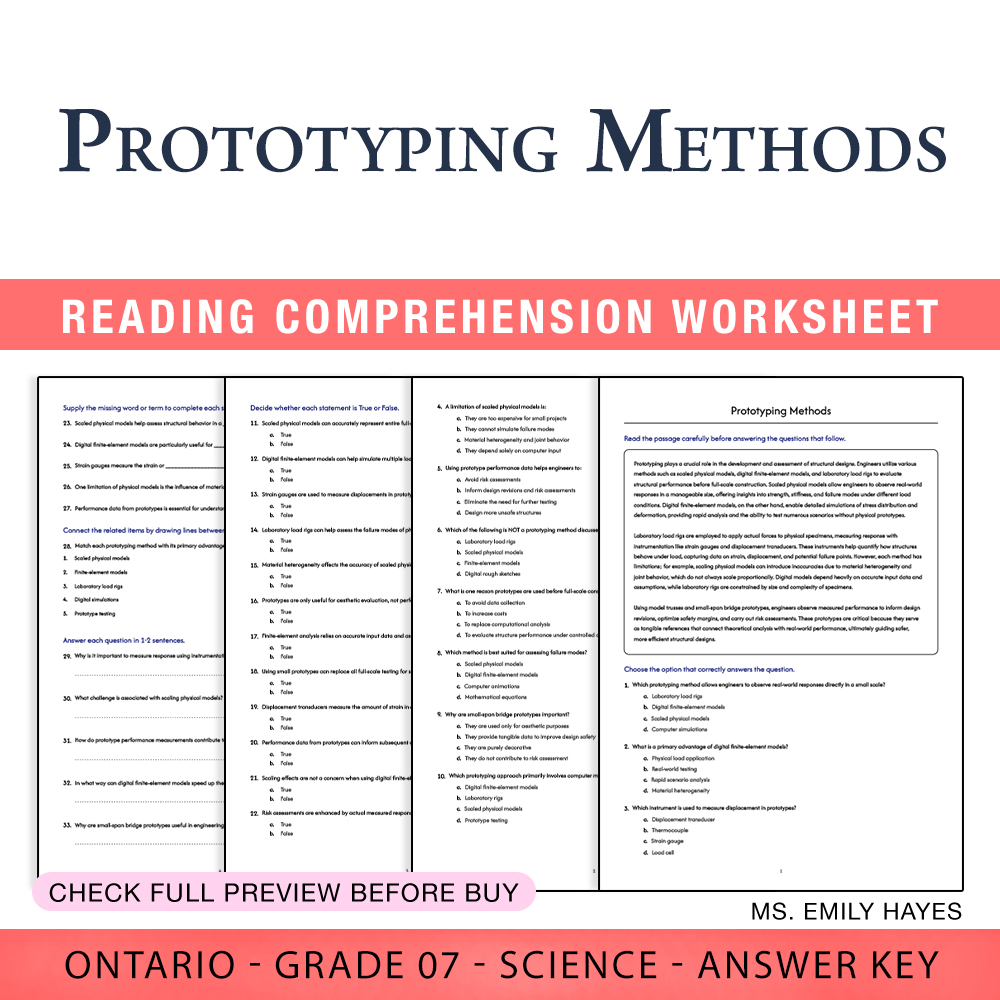
Are you searching for a comprehensive, print-ready resource to help your Grade 7 science students master prototyping methods? This engaging worksheet is the perfect classroom tool to deepen students' understanding of how engineers develop and evaluate structural designs through various prototyping techniques. Designed specifically to meet the Ontario curriculum standards, this worksheet promotes critical thinking, enhances technical skills, and ensures active student engagement. Teachers often face the challenge of providing students with hands-on, real-world applications of science concepts while maintaining easy-to-implement, classroom-ready materials. This worksheet addresses that need by offering a structured, print-friendly resource that encourages exploration of different prototyping methods, their advantages, and their role in modern engineering practice.
Why Teachers Love This ✅ Provides a ready-to-use, high-quality PDF worksheet and answer key with rubric—saving valuable preparation time
✅ Offers a variety of question formats—reading passage, multiple choice, true/false, fill-in-the-blank, matching, short answer, and essay—to accommodate multiple learning styles
✅ Fully aligned with Ontario science standards for Grade 7 – easy to integrate into lesson plans
✅ Facilitates differentiated instruction and classroom discussions by covering fundamental concepts of prototyping in engineering
Why Students Succeed With This ✅ Clear, concise instructions make complex engineering concepts accessible and engaging
✅ Sequential questions build confidence through scaffolded learning and practical application
✅ The worksheet utilizes real-world engineering scenarios to connect science concepts to student interests
✅ Promotes deep understanding of how different prototyping methods—such as physical models and digital simulations—are used in structural testing
What You Get Complete, print-ready PDF materials, including:
• An engaging reading passage on the importance of prototyping in engineering
• 10 multiple choice questions to assess understanding of prototyping techniques
• 12 true/false questions to reinforce key concepts about physical and digital models
• 5 fill-in-the-blank exercises to evaluate students’ grasp of terminology
• A matching activity to link prototyping methods with their primary advantages
• 5 short answer questions prompting critical thinking and application
• 2 in-depth essay prompts for comprehensive assessments
• A PDF answer key with rubric for objective grading—ready for immediate classroom use
Key Learning Objectives Students will master these core skills:
➡️ Understanding different prototyping methods used in structural engineering
➡️ Recognizing the advantages and limitations of physical and digital models
➡️ Applying knowledge to evaluate structural designs through various prototyping techniques
➡️ Using instrumentation like strain gauges and displacement transducers to assess prototype responses
Ideal Usage This worksheet is ideal for classroom reinforcement, homework, or exam review sessions. Its print-ready PDF format simplifies implementation during in-person instruction, whether you'll be doing whole-class activities, small-group work, or independent practice. The diverse question formats promote student engagement and deepen understanding of key concepts, making it a versatile addition to your engineering and science curriculum.
Seize the opportunity to equip your students with valuable engineering skills and understanding of prototyping methods today! With this resource, you'll foster critical thinking, problem-solving skills, and confidence in scientific inquiry—empowering your students for future success in science and engineering careers 🚀