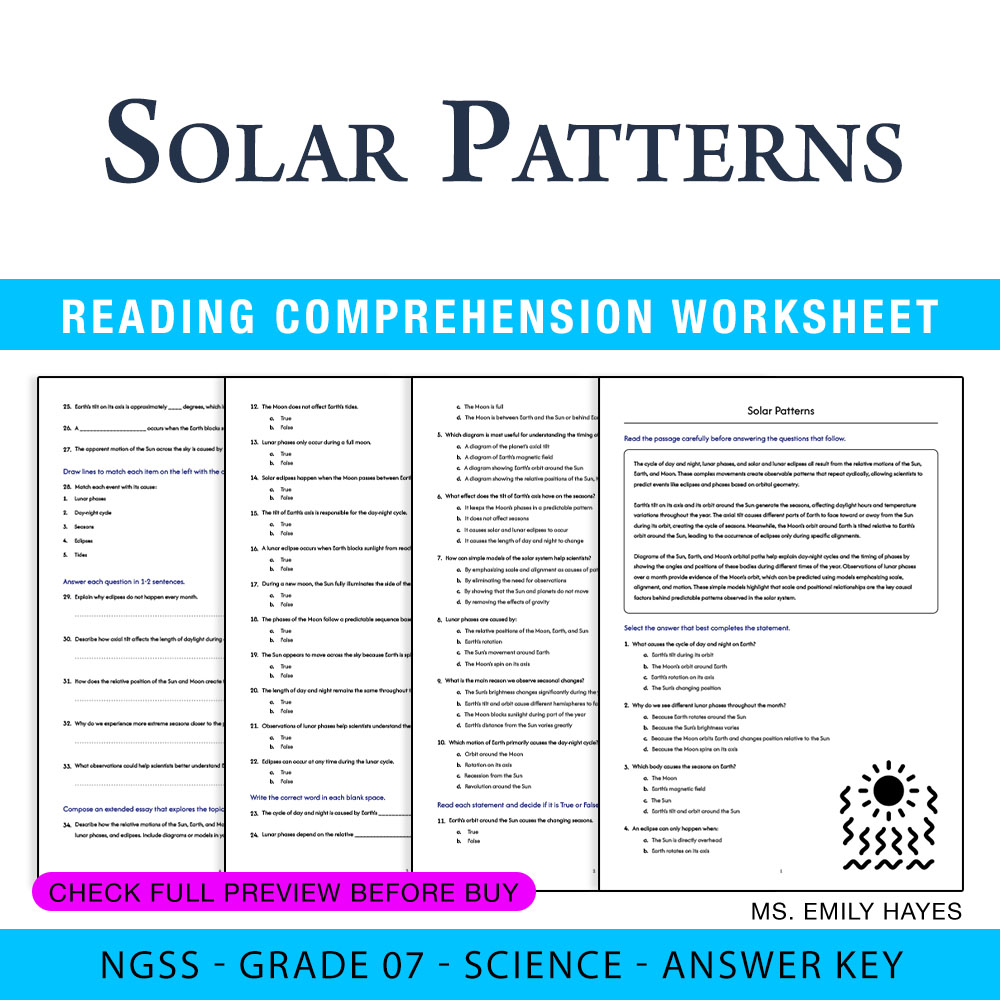
Are you seeking an effective way to reinforce fundamental concepts of solar patterns such as day and night cycles, lunar phases, and solar and lunar eclipses for your Grade 7 students? This comprehensive print-ready worksheet is designed to address the common classroom challenge of making complex astronomical phenomena understandable and engaging. With this resource, teachers can confidently facilitate lessons that build on students' natural curiosity about the cosmos, ensuring mastery of key concepts while saving valuable prep time.
Why Teachers Love This ✅ Provides a complete, ready-to-use PDF worksheet and answer key with rubric, perfect for immediate classroom implementation
✅ Covers a broad range of question types, from reading comprehension and multiple-choice to true/false, fill-in-the-blank, matching, and short answer questions
✅ Aligns seamlessly with Next Generation Science Standards (NGSS), supporting thorough understanding of celestial patterns and cycles
✅ Supports various instructional strategies—ideal for lessons, quick assessments, or homework assignments
✅ Easy to incorporate into both in-person and traditional classroom settings without additional materials
Why Students Succeed With This ✅ Clear, concise instructions and engaging question formats to foster confidence and independent learning
✅ Encourages critical thinking through real-world scenarios, such as explaining eclipse phenomena and lunar phases
✅ Builds foundational knowledge that supports higher-level science inquiry and exploration
✅ Stimulates curiosity about planetary movements and celestial cycles, inspiring lifelong interest in astronomy
What You Get Complete, print-ready PDF worksheet package including:
• An engaging reading passage that introduces fundamental concepts of day/night cycles, lunar phases, and celestial events
• 10 multiple-choice questions that test comprehension of causes behind day/night and lunar phases
• 12 true/false questions to reinforce understanding of seasonal changes and the influence of lunar and solar activities
• 5 fill-in-the-blank exercises that deepen grasp of Earth's rotational and orbital motions
• 1 matching activity connecting celestial events with their causes for better retention
• 5 short-answer prompts encouraging students to explain reasons for eclipse irregularity and effects of axial tilt
• 2 essay questions fostering higher-order thinking about celestial motions and scientific modeling
• PDF answer key with rubric for accurate assessment and feedback, making grading straightforward and consistent
Key Learning Objectives Students will master these core skills:
➡️ Describe the cause of day and night cycles based on Earth's rotation
➡️ Explain lunar phases as a result of relative positions of the Sun, Moon, and Earth
➡️ Identify reasons for changing seasons and the influence of Earth's orbit and tilt
➡️ Analyze the causes of solar and lunar eclipses and why they don't occur monthly
Ideal Usage This worksheet is perfect for individual student practice, small-group activities, or whole-class lessons focused on celestial motion and seasonal patterns. It works well as a lesson supplement during astronomy units, a formative assessment, or homework to reinforce class discussions. Its print-ready format ensures quick distribution and efficient classroom management without the need for digital devices, making it an ideal resource for busy teachers seeking immediate, practical solutions.
Take the guesswork out of teaching complex
solar and lunar phenomena with this engaging worksheet — designed to boost student understanding through varied question types, real-world application, and clear, accessible language. Equip your classroom for success today and help students develop a solid grasp of cyclic patterns in our solar system that will serve as a foundation for future scientific inquiry! 🚀