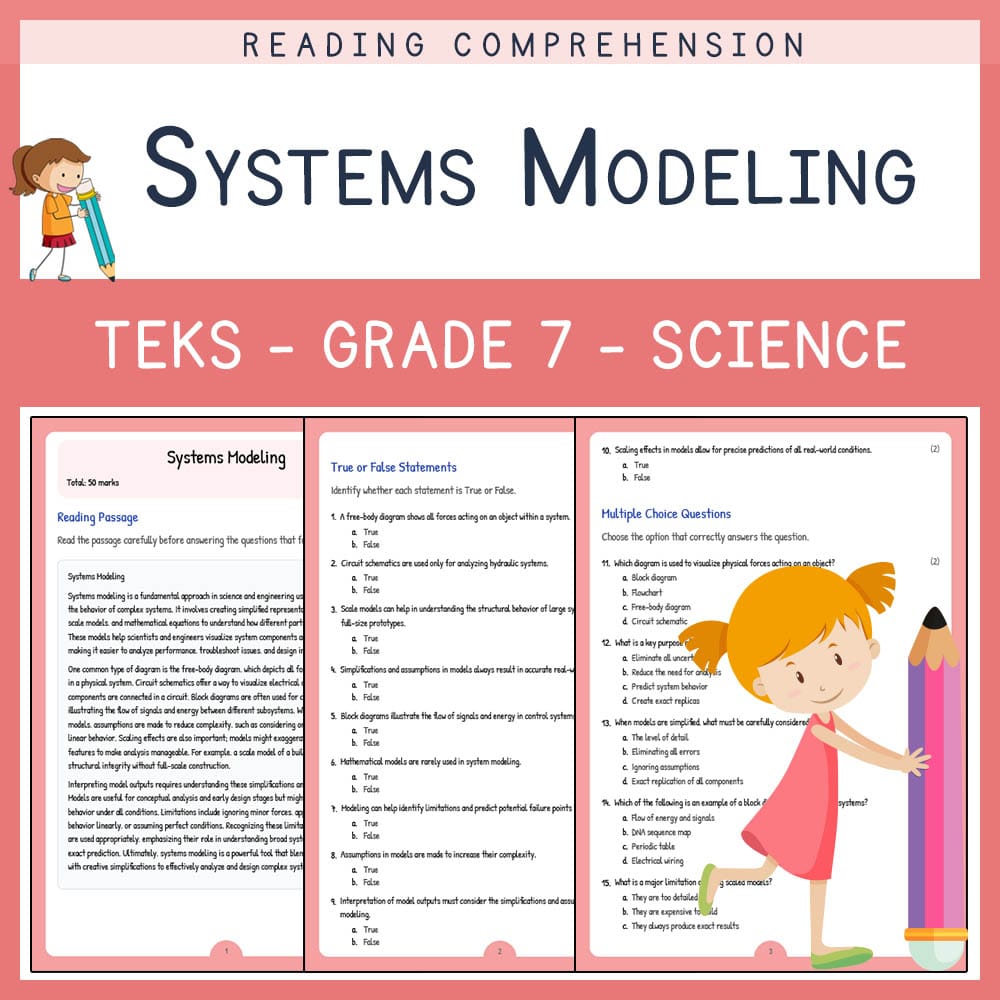
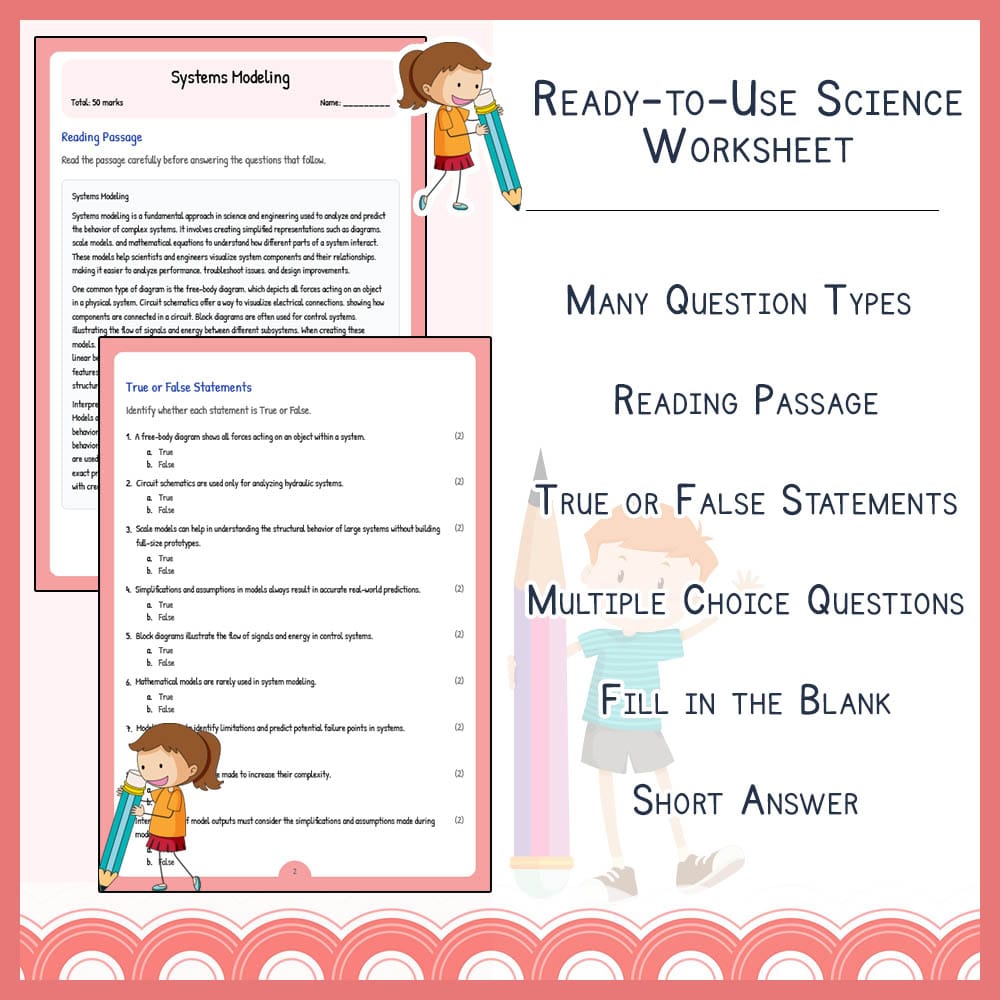
Are your Grade 7 students exploring the fundamentals of systems modeling? Dive into this engaging worksheet designed to deepen their understanding of how systems are analyzed and visualized in science and engineering.
🌿 This comprehensive PDF resource aligns perfectly with TEKS standards, providing a well-structured assessment that covers core concepts related to systems modeling, forces, and flow diagrams. It offers teachers a ready-to-use tool to reinforce learning, assess comprehension, and guide classroom discussions. The worksheet includes a variety of question formats, making it suitable for diverse instructional strategies and student needs, all presented in clear, printable PDF format with an answer key and rubric for easy grading and feedback.
What's Included
✅ A reading passage explaining the fundamentals and importance of systems modeling in science and engineering
✅ Ten true or false questions to test basic understanding of key concepts
✅ Five multiple-choice questions designed to evaluate recognition and application of diagrams and purposes
✅ Five fill-in-the-blank statements to reinforce vocabulary and concept retention
✅ Five short answer questions encouraging critical thinking and explanation skills
✅ All components provided as PDF worksheets and answer keys with rubrics for straightforward grading and student feedback
Key Concepts Covered
➡️ Systems modeling – Understanding how models help analyze, predict, and visualize system behavior
➡️ Force diagrams – Visualizing physical forces acting on objects within a system to analyze motion and interactions
➡️ Flow diagrams and schematics – Using visual tools to represent signal and material flow in control and hydraulic systems
➡️ Model assumptions and limitations – Recognizing how assumptions influence model accuracy and predictions
➡️ Application in engineering – Exploring how models aid in designing and troubleshooting real-world systems
Question Types / Formats
1. Reading comprehension passage with analytical questions
2. True or false statements for quick assessment of factual knowledge
3. Multiple-choice questions to assess diagram recognition and purpose understanding
4. Fill-in-the-blank statements to test vocabulary and concept retention
5. Short answer questions encouraging students to articulate ideas and reasoning
Teacher Benefits
✅ Provides a complete, ready-to-print PDF worksheet and answer key with rubrics for efficient lesson planning and assessment
✅ Offers a variety of question formats to engage students at different learning levels
✅ Aligned with TEKS science standards ensuring relevance and curriculum compliance
✅ Supports both formative and summative assessment strategies
✅ Facilitates easy differentiation by assigning individual sections or the entire worksheet
Student Benefits
✅ Enhances understanding of systems modeling, diagrams, and engineering concepts
✅ Develops critical thinking and analytical reasoning skills
✅ Reinforces vocabulary and technical terminology in a practical context
✅ Promotes active learning through diverse question formats
✅ Prepares students for higher-level STEM coursework and real-world applications
Perfect For
➡️ Classroom instruction on systems modeling and engineering principles
✅ Homework assignments to extend learning outside class
➡️ Formative assessments to identify student understanding
✅ Reinforcement activities following lessons or activities
➡️ Small group or individual practice sessions
✅ Science centers and STEM club activities for project-based learning
🚀