
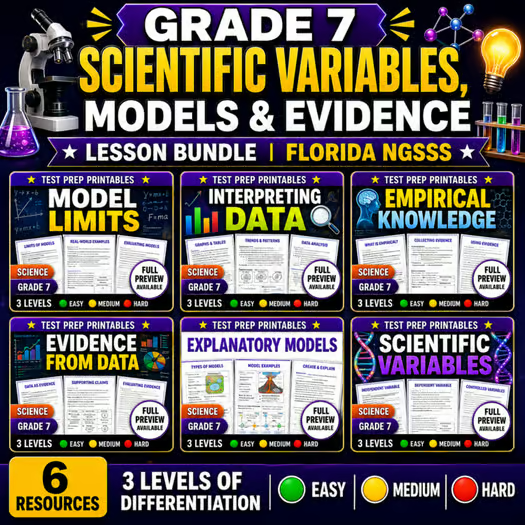
Grade 7 Scientific Variables, Models & Evidence Lesson Bundle | Florida ngsss
$24.00$30.00Save $6.00
Prism Point Learning
·2 followers·13 sales
SubjectScienceGradeGrade 7
What’s included
6 worksheets · Save $6.00 (20%) · prices shown inside the bundle
 Model Limits Worksheet Grade 7 Science Activities | NGSSS Resource
- Explain how models use assumptions and simplifications that can limit what they predict accurately
- Identify how discrepancies between observations and predictions can guide revisions to a model
- Distinguish reliable model predictions from approximate representations of complex systems
$4.00$5.00 Interpreting Data Worksheet for Grade 7 Science | NGSSS Activities
- Interpret patterns and relationships in scientific graphs such as scatter plots, histograms, and line graphs.
- Compare groups of data using summary measures like range and averages, and explain what those measures suggest.
- Evaluate claims by considering outliers, inconsistencies, and possible measurement uncertainty.
$4.00$5.00 Empirical Knowledge Worksheet for Grade 7 Science | NGSSS Activity
- Explain how scientific knowledge develops through empirical investigation and evidence evaluation.
- Describe how alternative explanations and uncertainty are handled in scientific reasoning.
- Evaluate how new data can refine models and lead to changes in explanations.
$4.00$5.00 Evidence From Data Worksheet Pack for Grade 7 Science | NGSSS Activities
- Explain how measurable data supports or weakens a scientific claim
- Distinguish direct observations from interpretations when analyzing evidence
- Use appropriate units, scales, and comparable methods to evaluate reliability
$4.00$5.00 Explanatory Models Worksheet Pack for Grade 7 Science | NGSSS Activities
- Explain how scientific models represent natural phenomena using relationships like cause-and-effect or energy transfer.
- Evaluate how well a model matches observations and whether its predictions agree with new evidence.
- Distinguish models from exact replicas and describe how models guide scientific reasoning.
$4.00$5.00 Scientific Variables Worksheet Grade 7 Science Activities | NGSSS
- Identify independent, dependent, and controlled variables in an investigation
- Explain how controlled variables support fair comparisons
- Interpret how changes in the dependent variable relate to the independent variable using data from tables or graphs
$4.00$5.00
Reviews & Feedback
Loading reviews...
Questions & Answers
Loading questions…
About this bundle
Related categories
Frequently asked questions
Who is Grade 7 Scientific Variables, Models & Evidence Lesson Bundle | Florida ngsss designed for?
Grade 7 Scientific Variables, Models & Evidence Lesson Bundle | Florida ngsss is designed for Grade 7 students and Science learners and can be used in classrooms, homeschool, or independent practice.
How do I download Grade 7 Scientific Variables, Models & Evidence Lesson Bundle | Florida ngsss?
Add it to your cart and complete checkout. After payment, you can download immediately from your account, and you'll also receive a download link by email.
Similar Products

Grade 10 Scientific Reasoning, Models & Evidence Science Lesson Bundle
$24.00$30.00

Scientific Models & Evidence Grade 7 Science Reading Lesson Bundle | General
$25.60$32.00

Grade 7 Science Scientific Modeling & Evidence Lesson Bundle: General Framework
$19.20$24.00

Grade 9 Scientific Evidence & Modeling Science Full-Year Bundle: General
$112.00$160.00

Grade 7 Science Worksheets Bundle | Models, Variables & Evidence
$19.20$24.00