
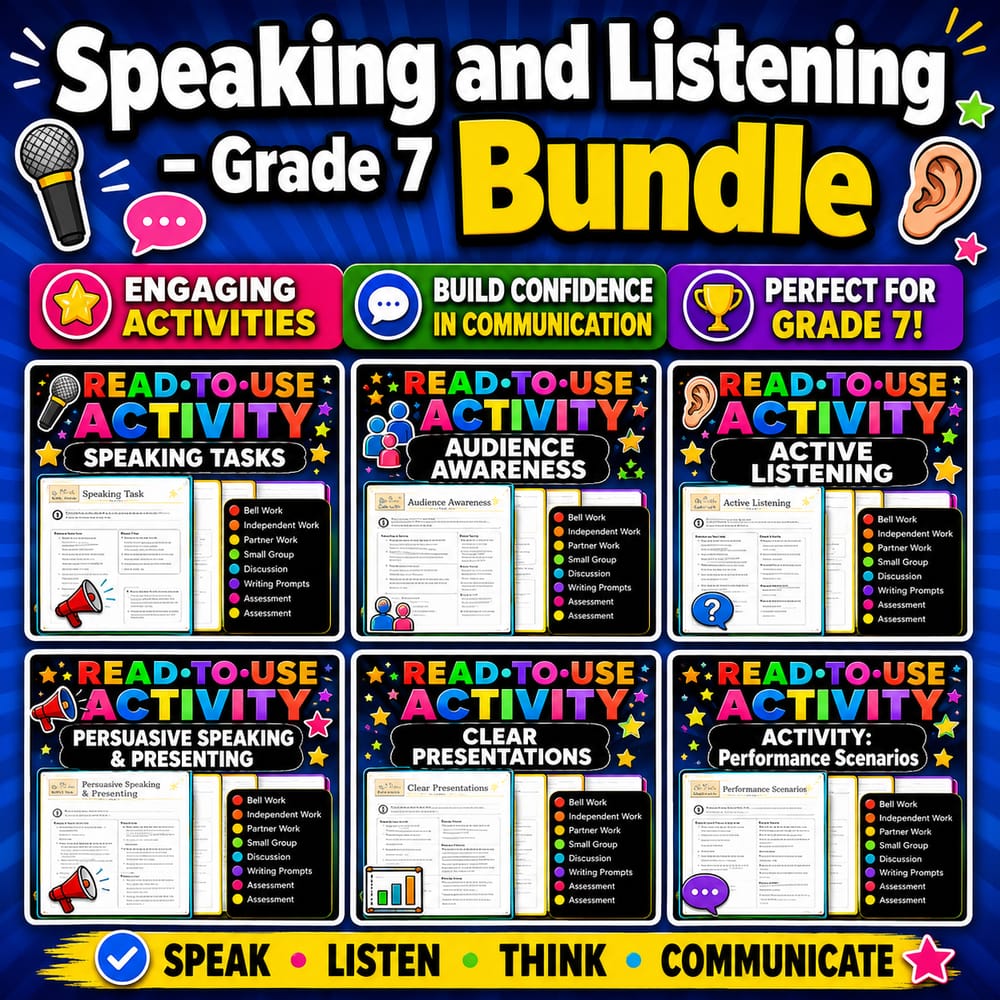
Grade 7 Speaking and Listening Lesson Bundle | ELA | BC Framework
$16.80$21.00Save $4.20
Sunny Desk Resources
·2 followers·18 sales
SubjectELAGradeGrade 7Pages77 Pages
What’s included
7 worksheets · 77 pages · Save $4.20 (20%) · prices shown inside the bundle
 Counter Evidence Worksheet Pack | Grade 7 ELA Practice
- Explain how counterevidence can support or weaken a speaker’s main claim
- Use comparisons between examples to evaluate competing claims
- Refine a viewpoint in real time by integrating new counterarguments
$2.40$3.00 Audience Organization Worksheet Pack | Grade 7 ELA Practice
- Explain how audience needs affect the organization of an ELA message
- Identify and use transitions to show relationships such as cause, contrast, and sequence
- Organize supporting details into meaningful categories and define key terminology for unfamiliar audiences
$2.40$3.00 Collaborative Tone Worksheet Pack | Grade 7 ELA Practice
- Use collaborative discussion language that is respectful, clear, and productive.
- Recognize how word choice and precise vocabulary reduce misunderstandings in group conversations.
- Revise statements to balance confidence with openness to new information.
$2.40$3.00 Perspective Response Worksheet Pack | Grade 7 ELA Practice
- Restate another person’s perspective accurately before responding
- Connect a response to the other viewpoint using reasons, examples, or additional context
- Identify the specific point of tension without making broad judgments
$2.40$3.00 Clear Presentations Worksheet Pack | Grade 7 ELA Practice
- Identify a clear presentation structure that includes a focused claim, logical supporting points, smooth transitions, and a brief wrap-up.
- Use audience-appropriate wording and examples from familiar contexts to strengthen understanding.
- Apply transitions and pacing strategies that keep the main idea prominent.
$2.40$3.00 Active Listening Worksheet Pack | Grade 7 ELA Practice
- Explain how active listening supports purposeful discussion by acknowledging and building on specific details.
- Practice using clarifying questions and accurate paraphrases to confirm understanding.
- Identify implied assumptions in a speaker’s ideas and respond respectfully with relevant new thoughts.
$2.40$3.00 Evidence Support Worksheet Pack | Grade 7 ELA Practice
- Identify a claim and select evidence that supports it in spoken responses.
- Explain how evidence connects to a claim using clear reasoning and concrete examples.
- Distinguish facts from interpretations and define key terms to prevent confusion.
$2.40$3.00
Reviews & Feedback
Loading reviews...
Questions & Answers
Loading questions…
About this bundle
Related categories
Frequently asked questions
Who is Grade 7 Speaking and Listening Lesson Bundle | ELA | BC Framework designed for?
Grade 7 Speaking and Listening Lesson Bundle | ELA | BC Framework is designed for Grade 7 students and ELA learners and can be used in classrooms, homeschool, or independent practice.
How do I download Grade 7 Speaking and Listening Lesson Bundle | ELA | BC Framework?
Add it to your cart and complete checkout. After payment, you can download immediately from your account, and you'll also receive a download link by email.
Similar Products

Grade 12 ELA Speaking & Listening Lesson Bundle | TEKS Framework
$16.00$20.00

Grade 9 Speaking and Listening ELA Lesson Bundle Framework Alberta
$25.60$32.00

Speaking and Listening Lesson Bundle | Grade 12 ELA | BC Framework
$19.20$24.00

Speaking and Listening Lesson Bundle | Grade 4 ELA | Alberta Framework
$16.80$21.00

Grade 11 Speaking and Listening ELA lesson bundle | General ELA framework
$12.80$16.00