
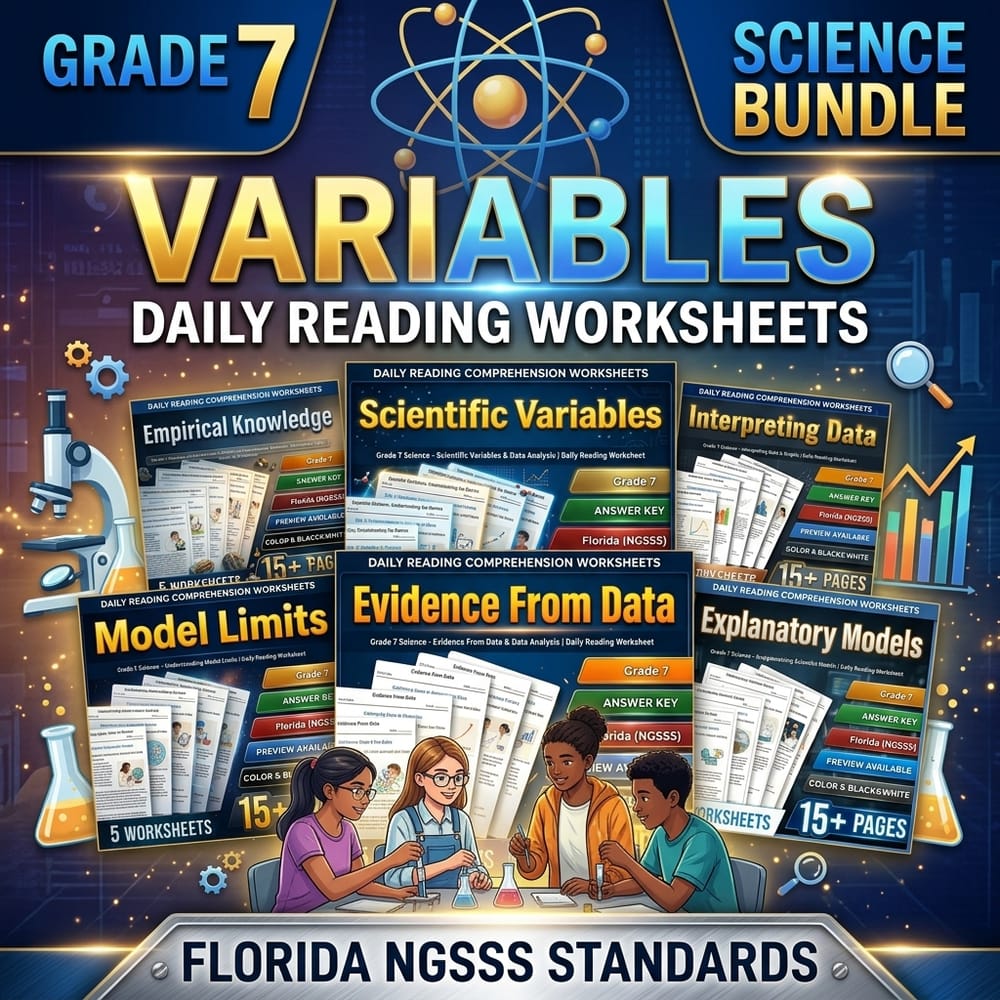
Grade 7 Variables Science lesson-bundle daily reading worksheets | Florida NGSSS
$19.20$24.00Save $4.80
Bright Mind Resources
New·1 followers·12 sales
SubjectScienceGradeGrade 7
What’s included
6 worksheets · Save $4.80 (20%) · prices shown inside the bundle
 Grade 7 Science – Scientific Variables & Data Analysis | Daily Reading Worksheet
- Identify independent and dependent variables in experiments
- Understand the importance of controlled variables
- Interpret data from tables and graphs using the concepts of variables
$3.20$4.00 Grade 7 Science – Empirical Knowledge & Scientific Processes | Reading Worksheet
- Define empirical knowledge and explain its role in scientific investigations.
- Identify evidence through observation and measurement.
- Understand how scientific explanations are supported or revised based on evidence.
$3.20$4.00 Grade 7 Science – Interpreting Data & Graphs | Daily Reading Worksheet
- Understand how to read and interpret line graphs
- Identify patterns and trends in scientific data
- Evaluate the significance of outliers and measurement uncertainty
$3.20$4.00 Grade 7 Science – Understanding Model Limits | Daily Reading Worksheet
- Identify the assumptions made in scientific models.
- Recognize the boundaries and limitations of various models.
- Understand how discrepancies between observations and models signal the need for revision.
$3.20$4.00 Grade 7 Science – Understanding Scientific Models | Daily Reading Worksheet
- Define what a scientific model is and describe its purpose.
- Identify different types of models used in science.
- Explain how models help in understanding and predicting natural phenomena.
$3.20$4.00 Grade 7 Science – Evidence From Data & Data Analysis | Daily Reading Worksheet
- Understand how to gather and interpret data in scientific inquiries.
- Learn to distinguish between direct observations and interpretations.
- Recognize the importance of relevant evidence and measurement scales.
$3.20$4.00
Reviews & Feedback
Loading reviews...
Questions & Answers
Loading questions…
About this bundle
Related categories
Frequently asked questions
Who is Grade 7 Variables Science lesson-bundle daily reading worksheets | Florida NGSSS designed for?
Grade 7 Variables Science lesson-bundle daily reading worksheets | Florida NGSSS is designed for Grade 7 students and Science learners and can be used in classrooms, homeschool, or independent practice.
How do I download Grade 7 Variables Science lesson-bundle daily reading worksheets | Florida NGSSS?
Add it to your cart and complete checkout. After payment, you can download immediately from your account, and you'll also receive a download link by email.
